










Free e-book: IEEE 802.15.4ab vs IEEE 802.15.4z
Free e-book: IEEE 802.15.4ab

End-to-end UWB RTLS - designed, deployed, and built to scale

needCode designs and deploys complete UWB real-time location systems — site survey, anchor infrastructure, ranging algorithms (TDOA/AoA/TWR), and sensor fusion — to centimetre-level static accuracy, in the environments where GPS fails and pilots stall. Not a positioning feed for someone else to productionise: the working system, from the anchor plan to integration with the tools that act on the data.
needCode IoT

We work with Industry Leaders

A positioning feed is not a location system. The gap is where projects stall.

It's not hard to get a UWB tag to report a coordinate on a test floor. It's hard to turn that into a system an operation can rely on: anchors planned for a real building, ranging tuned for metal and interference, sensor fusion that holds pose when a source drops, integration with the WMS or robot stack that uses the data, and reliability that survives from a pilot zone to a full site. Most RTLS efforts deliver the coordinate and stall at the system.

needCode delivers the system. We've brought up UWB across nine hardware platforms, built RTLS to centimetre-level static accuracy, fused UWB with IMU and LiDAR odometry, and deployed reliably amid heavy machinery and RF interference - end to end, and built to scale.

End to end, not a feed

Site survey, anchors, algorithms, fusion, and integration - one team owns the whole system.

In the real environment

Accuracy tuned for metal, machinery, and interference - validated on-site, not on a bench.

Pilot to fleet

Designed for scale from the first anchor, so the system grows instead of stalling after the demo.

The whole real-time location system.

Five things have to work together for RTLS to be real. needCode designs and deploys all five.

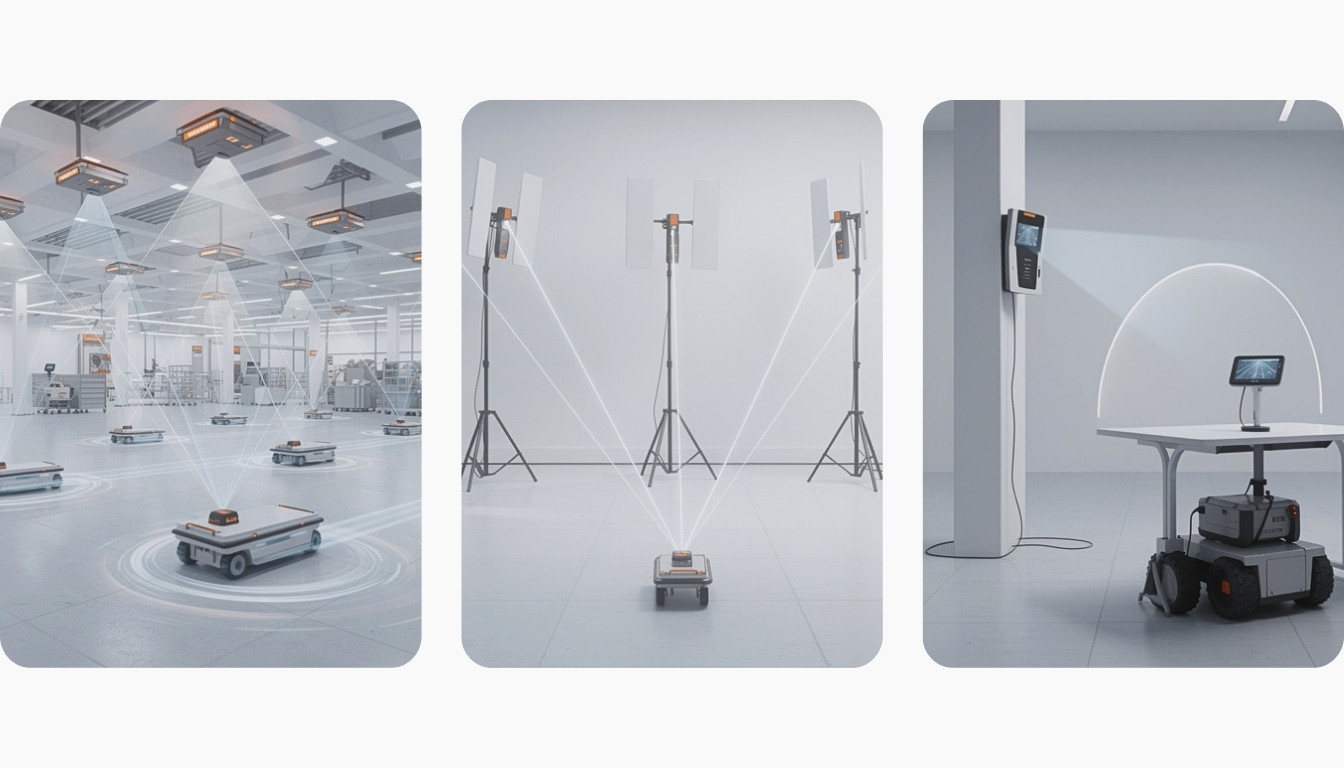
Site Survey & Anchor Design

A realistic accuracy assessment and an anchor plan for your actual space — geometry, materials, interference — validated on-site before any number is committed. The step most projects skip and most failures trace back to.

Ranging & Positioning Algorithms

TDOA/AoA/TWR with NLOS handling, tuned to your environment, to centimetre-level static accuracy. The math that turns raw signals into reliable location.

Sensor Fusion

UWB + IMU + LiDAR odometry fused for robust pose where any single source drifts or drops — the difference between an occasional fix and continuous tracking.

Integration

Location data fed into ERP, WMS, indoor mapping, and robotics middleware (ROS 2), so it drives action rather than sitting as a standalone feed someone else has to connect.

Deployment & Scale

From a pilot zone to a full-site, multi-zone, fleet-wide system, with reliability hardening and OTA as it grows. The path from a working demo to an operation that depends on it.

Your pilot needs to become a deployment?

Book a discovery call with our CEO

Where it deploys

The same end-to-end RTLS adapts to very different floors. We tune it to each environment rather than shipping one configuration.

Warehousing & Logistics

Asset, inventory, and forklift tracking with geofencing and workflow analytics - reduced search times and visibility across the operation.

Manufacturing

Production-floor location, WIP tracking, and safety zones amid heavy machinery, where most positioning systems degrade.

Healthcare

Clinical asset and personnel location, and patient and staff safety, without adding wearable burden.

Robotics & GPS-Denied

Sub-13cm positioning for autonomous robots and contested environments where satellite navigation isn't available.

Why teams deploy RTLS with needCode

The largest dedicated UWB team in Central Europe

Positioning is the core discipline, not a side capability. You get a realistic system designed for your space - with an honest accuracy figure validated on-site - rather than a datasheet promise that evaporates on the floor.

Proven in the environments that break RTLS

We close the integer-ambiguity gap in that the major vendors don't solve internally - making Channel Sounding ranging viable for digital keys and proximity. It's the hardest part of BLE ranging, and it's ours.

Fusion, not just ranging

UWB fused with IMU and LiDAR odometry for robust pose, deployed at scale. Ranging gets a coordinate; fusion keeps it reliable through drift and brief NLOS.

End to end, into your systems

From the anchor plan to ERP, WMS, and ROS 2 integration — we deliver the working system, not a positioning feed and a backlog. One team owns location from silicon to the software that acts on it.

Four ways to bring needCode in

From a site survey to a long-term partnership. We match the engagement to where the deployment is.

01

Feasibility & Site Survey

  • Duration:
    2–4 weeks
  • Best for:
    Validating achievable accuracy and an anchor plan in your actual facility before committing
  • Deliverable:
    Accuracy assessment, site/anchor plan, integration path, leadership readout

02

RTLS Design & Build

  • Duration: 
    Phased
  • Best for:
    Taking location from concept to a working system on target hardware
  • Deliverable:
    Anchor infrastructure, ranging algorithms, sensor fusion, and integration

03

Deployment & Scale-Up

  • Duration: 
    Phased
  • Best for:
    Moving from a pilot zone to a full-site, multi-zone, fleet-wide deployment
  • Deliverable:
    Scaled rollout, reliability hardening, automated OTA, operational handover

04

Long-Term Partnership

  • Duration: 
    Multi-year, retainer-based
  • Best for:
    Operations that want needCode for ongoing expansion and support as the deployment grows
  • Deliverable:
    An embedded team for the full lifecycle - the model behind the 30-FTE Qorvo programme

What we ship on

We pick the silicon, sensors, and integration that match your facility and your operation.

Positioning

UWB (IEEE 802.15.4z / 4ab)
TDOA
AoA
TWR
FiRa
NLOS handling
sub-13cm static

Silicon

Qorvo QM33 / QM35
Nordic
NXP
STMicroelectronics
Infineon
legacy DW1000 / DW3000

Fusion

IMU
LiDAR odometry
sensor fusion
edge inference

Connectivity

BLE mesh (fleet / backhaul)
WiFi
multi-protocol coexistence

Integration

ERP
WMS
indoor mapping
ROS 2
cloud
REST APIs
edge gateways

Case studies

The proof for a deployment service is real environments and real scale.

Qorvo: RF Leadership

Context: Rapid scaling for new chipset bring-up.
  • Scale: Grew from <10 to 30 FTEs.
  • Output: Supported bring-up of 9 new hardware platforms (SDKs, Drivers, Stacks).
  • Retention: Zero-churn core team retained for 5+ years.
Dedicated Development Center for RF Solutions
Bluetooth Mesh Smart Lighting Control System

Smart Lighting: Core R&D Extension

Context: Client needed deep, specialized expertise to pivot from proprietary tech to a new global standard.
  • Service: Deployed a dedicated squad of embedded engineers to function as the client's core R&D team.
  • Output: Co-authored official Bluetooth SIG protocols and delivered the world’s first certified BLE Mesh stack.
  • Value: Enabled the client to secure Series A funding and defined the industry standard for smart buildings.

Creative Werks: Innovation rescue

Context: Hardware obsolescence threatened production shutdown.
  • Action: Full-stack takeover (PCB redesign + Firmware + Mobile App).
  • ROI: 1230% ($1.6M value generated).
  • Speed: Payback period of 2–3 months.
NeedCode-case study - IoT Solution for Boat Lift Modernization - cover2s
needcode-powerpolen-case-study-cover2s

PowerPollen: AgTech automation

Context: Lack of internal expertise stalled a critical automation project.
  • Action: Re-architected system using unified MCU and ISOBUS standards.
  • ROI: 13.8x ($2.9M value generated).
  • Impact: Enabled $1.9M increase in harvester value.

Strategic Partnership

needCode is an official business partner of Qorvo, bringing over 8 years of proven expertise and trusted service to the technology sector.
qorvo-logo-banner
UWB-Alliance-logo-banner

Members of the UWB Alliance

In 2025 we became a member of the UWB Alliance. This strategic step reinforces our commitment to pioneering Ultra-Wideband (UWB) technology.

Proudly Certified for Excellence and Security

needCode is officially certified for:
ISO 9001:2015 – Quality Management
ISO/IEC 27001:2022 – Information Security
ISO certifications reflect our focus on delivering reliable IoT solutions, smart product development, and secure technology services.
ISO 9001_2015ISO - IEC 27001_2022

Testimonials

“I think the key takeaway from needCode is their ability to adapt and understand the customer's requirements. That took away probably a large portion of what could have been a lot of development time and expense for both companies.”
Bob Folkestad
Bob Folkestad
President at Creative Werks
“One aspect that truly sets needCode apart is its profound expertise in firmware development. Their proficiency in various programming languages, embedded systems and hardware architecture is truly impressive. When faced with difficult problems, their strong problem-solving skills and analytical mindset shine through, allowing them to overcome obstacles with remarkable ease.”
avatar Semeh Sarhan
Semeh Sarhan
CEO at Xtrava
“I worked with needCode while leading the NWTN-Berlin team in 2018. A big chunk for our FW development has been outsourced to them and they had proven to iterate very quickly, following specs and deliver on time. It was great working with them. I recommend working with needCode’s team on any Embedded SW development.”
avatar Marco Salvioli Mariani
Marco Salvioli Mariani
CTO at NWTN Berlin GmbH
“needCode Team proved to be one of the best engineers I have ever met. The part I like the most about the team is the more difficult an obstacle seems to be, the more motivated they were to find a solution and a way forward.”
A Testimonial picture
Szymon Słupik
CTO at Silvair
“needCode is an outstanding partner. Their quick follow-up, scalability, and extensive professional network set them apart. Their expertise in wireless technologies has been valuable, supporting us from low-level drivers to architecture discussions.”
avatar Tim Allemeersch
Tim Allemeersch
Director at Qorvo, Inc.
“needCode did a great job improving the firmware of the Vai Kai connected toys and developing new features, surpassing our expectations multiple times. I would definitely recommend hiring Bartek and needCode for the embedded software projects!”
avatar Matas Petrikas
Matas Petrikas
CEO & Co-founder
at Vai Kai UG

Insights

FAQ

needCode's UWB RTLS reaches sub-13cm static accuracy, with real-world accuracy for moving targets depending on anchor density, environment, and update rate - which is why a site survey precedes any committed figure. Sensor fusion with IMU and LiDAR odometry maintains pose between updates and through brief NLOS. The numbers given reflect your actual site, not a lab.

Yes - UWB RTLS works precisely indoors and in GPS-denied spaces because it measures time-of-flight to fixed anchors rather than receiving satellite signals. That makes it suitable for warehouses, factories, hospitals, and contested environments. needCode designs the anchor infrastructure and NLOS handling for reliable indoor location.

Yes - needCode has deployed UWB reliably amid metallic structures, heavy machinery, and RF interference, the conditions where most positioning fails. The time-of-flight approach and tuned NLOS handling are built for these spaces, and achievable accuracy is validated on-site before commitment. The floor is exactly where the accuracy figure is really tested.

Yes - needCode fuses UWB ranging with IMU and LiDAR odometry to produce robust pose estimation, because no single sensor is reliable on its own. UWB anchors absolute position while the IMU and LiDAR bridge gaps and fast motion. This is the difference between an occasional fix and continuous tracking.

Yes - integration is part of the deployment, with location data fed into ERP, WMS, indoor mapping, and robotics middleware including ROS 2. The goal is operational value, not a standalone positioning feed. needCode delivers the location layer and connects it into the systems that act on it.

Yes - needCode designs RTLS for scale and moves engagements from a pilot zone to full-site, multi-zone, fleet-wide deployment, with BLE mesh for fleet coordination and backhaul. Reliability at scale comes from anchor design and algorithm tuning, validated as the system grows. The engagement is structured to scale rather than stall after the pilot.

Yes - a site survey and anchor design are the first step, because realistic accuracy depends on the geometry, materials, and interference of your actual space. needCode validates achievable accuracy on-site before committing to figures or a full build. Skipping this step is where most RTLS deployments go wrong.

An off-the-shelf RTLS product is a fixed box you adapt your operation to; needCode engineers a system tuned to your environment and integrated with your software, which you own rather than rent. That suits demanding environments, specific accuracy targets, or deep WMS/ERP/robot integration where a generic product falls short. For simpler needs an off-the-shelf product may be enough, and needCode will say so.

A feasibility and site survey runs 2–4 weeks, after which design, build, and deployment are phased against the size and complexity of the site. A single zone moves faster than a multi-site, fleet-wide rollout, which is sized during the survey rather than promised blind. needCode structures the work so a pilot proves value before a full-site commitment.

Let's work on your next project together

Book a demo and discovery call with our CEO
to get a look at:
Strategic Expertise
End-to-End Solutions
Advanced Technology
Custom Hardware Devices
Bartek Kling
Bartek Kling / CEO
© 2026 needCode. All rights reserved.

Manufacturing

Modern manufacturing machines are typically equipped with IoT sensors that capture performance data. AIoT technology analyzes this sensor data, and based on vibration patterns, the AI predicts the machine's behavior and recommends actions to maintain optimal performance. This approach is highly effective for predictive maintenance, promoting safer working environments, continuous operation, longer equipment lifespan, and less downtime. Additionally, AIoT enhances quality control on production lines.

For example, Sentinel, a monitoring system used in pharmaceutical production by IMA Pharma, employs AI to evaluate sensor data along the production line. The AI detects and improves underperforming components, ensuring efficient machine operation and maintaining high standards in drug manufacturing.

Logistics & supply chain

IoT devices - from fleet vehicles and autonomous warehouse robots to scanners and beacons - generate large amounts of data in this industry. When combined with AI, this data can be leveraged for tracking, analytics, predictive maintenance, autonomous driving, and more, offering greater visibility into logistics operations and enhancing vendor partnerships.

Example: Amazon employs over 750,000 autonomous mobile robots to assist warehouse staff with heavy lifting, delivery, and package handling tasks. Other examples include AI-powered IoT devices such as cameras, RFID sensors, and beacons that help monitor goods' movement and track products within warehouses and during transportation. AI algorithms can also estimate arrival times and forecast delays by analyzing traffic conditions.

Retail

IoT sensors monitor movement and customer flow within a building, while AI algorithms analyze this data to offer insights into traffic patterns and product preferences. This information enhances understanding of customer behavior, helps prevent stockouts, and improves customer analytics to drive sales. Furthermore, AIoT enables retailers to deliver personalized shopping experiences by leveraging geographical data and individual shopping preferences.

For instance, IoT sensors track movement and customer flow, and AI algorithms process this information to reveal insights into traffic patterns and product preferences. This ultimately leads to better customer understanding, stockout prevention, and enhanced sales analytics.

Agriculture

Recent research by Continental reveals that over 27% of surveyed farmers utilize drones for aerial land analysis. These devices capture images of crops as they are and transmit them to a dashboard for further assessment. However, AI can enhance this process even further.

For example, AIoT-powered drones can photograph crops at various growth stages, assess plant health, detect diseases, and recommend optimal harvesting strategies to maximize yield. Additionally, these drones can be employed for targeted crop treatments, irrigation monitoring and management, soil health analysis, and more.

Smart Cities

Smart cities represent another domain where AIoT applications can enhance citizens' well-being, facilitate urban infrastructure planning, and guide future city development. In addition to traffic management, IoT devices equipped with AI can monitor energy consumption patterns, forecast demand fluctuations, and dynamically optimize energy distribution. AI-powered surveillance cameras and sensors can identify suspicious activities, monitor crowd density, and alert authorities to potential security threats in real-time, improving public safety and security.

For example, an AIoT solution has been implemented in Barcelona to manage water and energy sustainably. The city has installed IoT sensors across its water supply system to gather water pressure, flow rate, and quality data. AI algorithms analyze this information to identify leaks and optimize water usage. Similarly, smart grids have been introduced to leverage AI to predict demand and distribute energy efficiently, minimizing waste and emissions. As a result, these initiatives have enabled the city to reduce water waste by 25%, increase renewable energy usage by 17%, and lower greenhouse gas emissions by 19%.

Healthcare

Integrating AI and IoT in healthcare enables hospitals to deliver remote patient care more efficiently while reducing the burden on facilities. Additionally, AI can be used in clinical trials to preprocess data collected from sensors across extensive target and control groups.

For example, intelligent wearable technologies enable doctors to monitor patients remotely. In real-time, sensors collect vital signs such as heart rate, blood pressure, and glucose levels. AI algorithms then analyze this data, assisting doctors in detecting issues early, developing personalized treatment plans, and enhancing patient outcomes.

Smart Homes

The smart home ecosystem encompasses smart thermostats, locks, security cameras, energy management systems, heating, lighting, and entertainment systems. AI algorithms analyze data from these devices to deliver context-specific recommendations tailored to each user. This enables homeowners to use utilities more efficiently, create a personalized living space, and achieve sustainability goals.

For example, LifeSmart offers a comprehensive suite of AI-powered IoT tools for smart homes, connecting new and existing intelligent appliances and allowing customers to manage them via their smartphones. Additionally, they provide an AI builder framework for deploying AI on smart devices, edge gateways, and the cloud, enabling AI algorithms to process data and user behavior autonomously.

Maintenance (Post-Release Support)

When your product is successfully launched and available on the market we provide ongoing support and maintenance services to ensure your product remains competitive and reliable. This includes prompt resolution of any reported issues through bug fixes and updates.

We continuously enhance product features based on user feedback and market insights, optimizing performance and user experience.

Our team monitors product performance metrics to identify areas for improvement and proactively addresses potential issues. This phase aims to sustain product competitiveness, ensure customer satisfaction, and support long-term success in the market.

Commercialization (From MVP to Product

Our software team focuses on completing the full product feature range, enhancing the user interface and experience, and handling all corner cases. We prepare product software across the whole lifecycle by providing all necessary procedures, such as manufacturing support and firmware upgrade.

We also finalize the product's hardware design to ensure robustness, scalability and cost-effectiveness.

This includes rigorous testing procedures to validate product performance, reliability, and security. We manage all necessary certifications and regulatory compliance requirements to ensure the product meets industry standards and legal obligations.

By the end of this phase, your product is fully prepared for mass production and commercial deployment, with all documentation and certifications in place.

Prototyping (From POC to MVP)

Our development team focuses on implementing core product features and use cases to create a functional Minimum Viable Product (MVP). We advance to refining the hardware design, moving from initial concepts to detailed PCB design allowing us to assemble first prototypes. Updated documentation from the Design phase ensures alignment with current project status. A basic test framework is established to conduct preliminary validation tests.

This prepares the product for real-world demonstrations to stakeholders, customers, and potential investors.

This phase is critical for validating market readiness and functionality before proceeding to full-scale production.

Design (From Idea to POC)

We meticulously select the optimal technology stack and hardware components based on your smart product idea with detailed use cases and feature requirements (Market Requirements Document / Business Requirements Document). Our team conducts thorough assessments of costs, performance metrics, power consumption, and resource requirements.

Deliverables include a comprehensive Product Requirements Document (PRD), detailed Software Architecture plans, an Initial Test Plan outlining validation strategies, Regulatory Compliance Analysis to ensure adherence to relevant standards, and a Proof of Concept (POC) prototype implemented on breakout boards.

This phase aims to validate the technical feasibility of your concept and establish a solid foundation for further development.

If you lack a validated idea and MRD/BRD, consider utilizing our IoT Strategic Roadmap service to gain insights into target markets, user needs, and desired functionality. Having a structured plan in the form of an IoT Strategic Roadmap before development begins is crucial to mitigate complications in subsequent product development phases.