






Prove BLE power, ranging, and mesh – before the programme, not during it

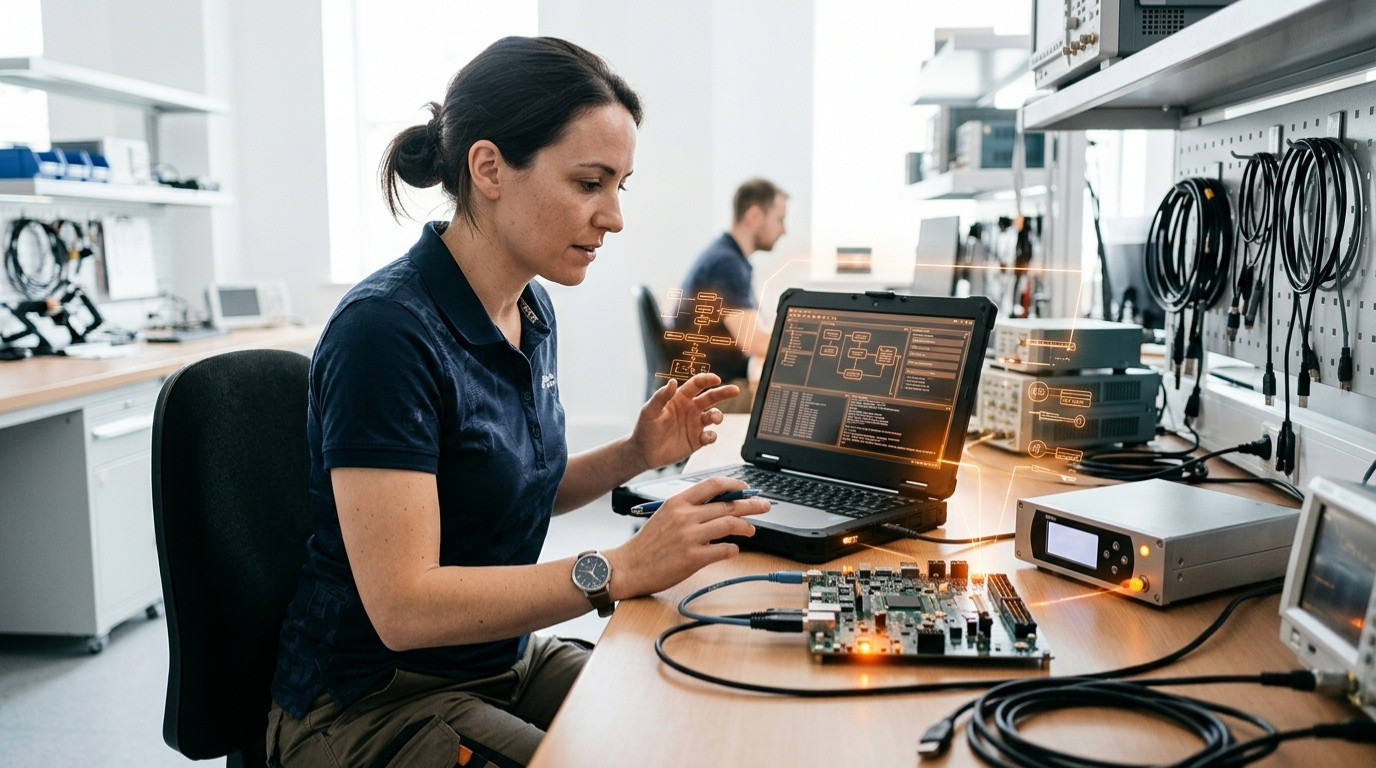
needCode runs fixed-scope BLE proofs of concept – battery life measured in the BLE Power Optimization Lab, Channel Sounding ranging, and mesh scale – with results for your conditions, in 4–6 weeks. A de-risking step before a full SDK commitment, aimed at the parts teams discover too late: power that misses target, ranging that isn't accurate enough, mesh that wobbles at scale. From Bluetooth SIG contributors with a dedicated power lab.
needCode IoT

We work with Industry Leaders

Most BLE products miss on power - and find out too late

BLE connects easily, so the risk hides. The surprises come at the parts you can't eyeball: a battery life that misses target under real traffic, Channel Sounding ranging that isn't accurate enough for the digital key you promised, or a mesh that behaves on the bench and wobbles at the node count you actually need. Discover these inside the programme and they cost schedule and credibility. The cheap place to learn is before it.

A needCode BLE proof of concept measures them - for real. We benchmark battery life in a dedicated Power Optimization Lab, validate Channel Sounding ranging with our proprietary PBR solvers, and test mesh against your topology - then hand back numbers and a go/no-go, so the commitment rests on measurement, not hope.

Power, measured not estimated

Battery life benchmarked in the BLE Power Optimization Lab, in your duty cycle - not modelled in a spreadsheet.

The newest, riskiest parts

Channel Sounding ranging and mesh scale validated before they're load-bearing in your programme.

Fixed scope, 4‑6 weeks

A defined de-risking step with a clear deliverable and a path into the build.

What a needCode BLE proof of concept delivers

A PoC is a small, defined engagement with a concrete output - four parts that turn a BLE question into measured evidence

Use-Case Scoping

We pin the question that decides the product - a power target, Channel Sounding ranging accuracy, mesh scale, or multi-connection stability - and the pass/fail bar. Scope comes first so the PoC proves the right thing.

Power Benchmarking

Battery life measured in the BLE Power Optimization Lab across connection parameters, duty cycle, and sleep behaviour - the single most common BLE risk, quantified on instruments rather than estimated.

Capability Validation

Channel Sounding ranging - with the proprietary PBR solvers - or mesh scale, tested against your requirement on representative hardware. The newest BLE capabilities, proven before you build on them.

Results & Go/No-Go

A measured performance report and a clear recommendation, flowing into BLE SDK Development if it's go - with the findings and setup carried over. Tags: Measured report · Recommendation.

Evaluating BLE for a product?

Book a discovery call with our CEO

What we validate

A PoC is scoped to the one BLE question you're evaluating. These are the ones needCode proves.

Battery Life & Power Budget

Does the product hit its power target under real traffic, not just in a datasheet figure? Measured in the Power Lab, in your duty cycle.

Channel Sounding Ranging

Is BLE 6.0 Channel Sounding ranging accurate enough for your digital-key or proximity use case? Validated with the PBR solvers that make it viable.

BLE Mesh at Scale

Does mesh hold at your node count and topology, with acceptable latency and delivery? Tested by the team that shipped the world's first certified mesh stack.

Why teams run their BLE PoC with needCode

A dedicated Power Optimization Lab

We measure battery life on instruments, not in a spreadsheet - so the riskiest BLE number is real before you commit. A PoC that estimates power only moves the surprise into the programme.

Proprietary Channel Sounding solvers

We validate Channel Sounding ranging with the PBR solvers that make it accurate - a depth the major silicon vendors don't have internally. The ranging answer comes from the team that solves the hard part.

Standards-level mesh experience

The world's first certified BLE Mesh stack, mesh proven at 1,000 nodes and 99.9% delivery - so a mesh-feasibility answer comes from people who've shipped it at scale, not theorised it.

A PoC that goes somewhere

Findings flow straight into BLE SDK Development, so the de-risking step isn't a dead end — the team that measured it can build it.

How a needCode BLE PoC runs

A fixed-scope engagement in four stages, typically 4–6 weeks end to end.

01

Scope & Success Criteria

  • When:
    Week 1
  • Best for:
    Agreeing exactly what "proven" means - the power target, ranging accuracy, or mesh scale - before any work starts
  • Output: 
    Agreed scope, conditions, and pass/fail criteria

02

Build & Instrument

  • When: 
    Early
  • Best for:
    Standing up representative hardware and the measurement setup
  • Output: 
    A working test setup - Power Lab measurement, Channel Sounding, or mesh test bed

03

Measure & Document

  • When: 
    Mid
  • Best for:
    Producing the evidence the decision rests on
  • Output: 
    Measured power, ranging, or mesh results across the relevant conditions

04

Readout & Recommendation

  • When: 
    Close
  • Best for:
    Turning results into a decision
  • Output: 
    Measured performance report, go/no-go, and a defined path into BLE SDK Development

What we ship on

We build the PoC on the silicon and conditions that match the real product.

BLE silicon

Nordic nRF52 / nRF54
NXP
Texas Instruments
Silicon Labs
Espressif (ESP32)

Validation

BLE Power Optimization Lab
Channel Sounding test setup
mesh test bed
automated qualification (PTS)

Capabilities

BLE 5.4 / 6.0
Channel Sounding (PBR solvers)
BLE Mesh
PAwR
multi-connection

Standards & output

Bluetooth SIG
BLE 6.0
measured performance report
go/no-go recommendation

Case studies

A PoC is only worth the honesty of its measurement, and that rests on a real lab and real practice.

Qorvo: RF Leadership

Context: Rapid scaling for new chipset bring-up.
  • Scale: Grew from <10 to 30 FTEs.
  • Output: Supported bring-up of 9 new hardware platforms (SDKs, Drivers, Stacks).
  • Retention: Zero-churn core team retained for 5+ years.
Dedicated Development Center for RF Solutions
Bluetooth Mesh Smart Lighting Control System

Smart Lighting: Core R&D Extension

Context: Client needed deep, specialized expertise to pivot from proprietary tech to a new global standard.
  • Service: Deployed a dedicated squad of embedded engineers to function as the client's core R&D team.
  • Output: Co-authored official Bluetooth SIG protocols and delivered the world’s first certified BLE Mesh stack.
  • Value: Enabled the client to secure Series A funding and defined the industry standard for smart buildings.

Creative Werks: Innovation rescue

Context: Hardware obsolescence threatened production shutdown.
  • Action: Full-stack takeover (PCB redesign + Firmware + Mobile App).
  • ROI: 1230% ($1.6M value generated).
  • Speed: Payback period of 2–3 months.
NeedCode-case study - IoT Solution for Boat Lift Modernization - cover2s
needcode-powerpolen-case-study-cover2s

PowerPollen: AgTech automation

Context: Lack of internal expertise stalled a critical automation project.
  • Action: Re-architected system using unified MCU and ISOBUS standards.
  • ROI: 13.8x ($2.9M value generated).
  • Impact: Enabled $1.9M increase in harvester value.

Strategic Partnership

needCode is an official business partner of Qorvo, bringing over 8 years of proven expertise and trusted service to the technology sector.
qorvo-logo-banner
UWB-Alliance-logo-banner

Members of the UWB Alliance

In 2025 we became a member of the UWB Alliance. This strategic step reinforces our commitment to pioneering Ultra-Wideband (UWB) technology.

Proudly Certified for Excellence and Security

needCode is officially certified for:
ISO 9001:2015 – Quality Management
ISO/IEC 27001:2022 – Information Security
ISO certifications reflect our focus on delivering reliable IoT solutions, smart product development, and secure technology services.
ISO 9001_2015ISO - IEC 27001_2022

Testimonials

“I think the key takeaway from needCode is their ability to adapt and understand the customer's requirements. That took away probably a large portion of what could have been a lot of development time and expense for both companies.”
Bob Folkestad
Bob Folkestad
President at Creative Werks
“One aspect that truly sets needCode apart is its profound expertise in firmware development. Their proficiency in various programming languages, embedded systems and hardware architecture is truly impressive. When faced with difficult problems, their strong problem-solving skills and analytical mindset shine through, allowing them to overcome obstacles with remarkable ease.”
avatar Semeh Sarhan
Semeh Sarhan
CEO at Xtrava
“I worked with needCode while leading the NWTN-Berlin team in 2018. A big chunk for our FW development has been outsourced to them and they had proven to iterate very quickly, following specs and deliver on time. It was great working with them. I recommend working with needCode’s team on any Embedded SW development.”
avatar Marco Salvioli Mariani
Marco Salvioli Mariani
CTO at NWTN Berlin GmbH
“needCode Team proved to be one of the best engineers I have ever met. The part I like the most about the team is the more difficult an obstacle seems to be, the more motivated they were to find a solution and a way forward.”
A Testimonial picture
Szymon Słupik
CTO at Silvair
“needCode is an outstanding partner. Their quick follow-up, scalability, and extensive professional network set them apart. Their expertise in wireless technologies has been valuable, supporting us from low-level drivers to architecture discussions.”
avatar Tim Allemeersch
Tim Allemeersch
Director at Qorvo, Inc.
“needCode did a great job improving the firmware of the Vai Kai connected toys and developing new features, surpassing our expectations multiple times. I would definitely recommend hiring Bartek and needCode for the embedded software projects!”
avatar Matas Petrikas
Matas Petrikas
CEO & Co-founder
at Vai Kai UG

Insights

FAQ

A needCode BLE proof of concept runs on a fixed scope and a 4–6 week timeline, sized to give a clear answer before a programme commitment. The scope is agreed up front, so it is a de-risking step rather than open-ended research. It ends with a measured performance report and a go/no-go recommendation.

Yes - needCode benchmarks BLE battery life in a dedicated Power Optimization Lab, measured on instruments across connection parameters, duty cycle, and sleep behaviour rather than estimated. Power is the most common reason BLE products miss target, so measuring it early is the single highest-value thing a BLE PoC does. The result is a real number for your duty cycle.

Yes - needCode validates Channel Sounding ranging using its proprietary PBR (phase-based ranging) solvers, which resolve the integer-ambiguity problem that determines accuracy. The PoC measures whether CS ranging meets your digital-key or proximity requirement before you build on it. This is ranging depth the major silicon vendors don't have internally.

Yes - needCode tests mesh against your node count and topology on a mesh test bed, run by the team that delivered the world's first certified BLE Mesh stack and proved mesh at 1,000 nodes. The PoC answers whether mesh holds with acceptable latency and delivery at your scale. A bench demo and a real topology are very different questions.

It proves whether BLE can meet your product's hardest requirements in your conditions - battery life, Channel Sounding ranging accuracy, mesh scale, or multi-connection stability. needCode measures these on representative hardware and a real lab, not a clean bench. The result is documented evidence to support a go/no-go decision.

Datasheet power figures describe ideal conditions, while a product's real battery life depends on its traffic, duty cycle, and connection parameters - which often differ materially. A PoC measures power in your conditions, so the programme commitment rests on your number rather than a best case. It is the cheapest place to discover a power problem.

You get measured results - power, ranging, or mesh - on representative hardware, a performance report, and a go/no-go recommendation. If the answer is go, you also get a defined path into BLE SDK Development with the findings carried over. The output is built to support a confident decision either way.

A needCode BLE PoC is fixed-scope and fixed-timeline, scoped to the single question you are validating, with the cost quoted after that scoping. Pinning the scope first is what keeps it a defined de-risking step rather than open-ended research. The scoping conversation is part of the initial discovery call.

A successful PoC leads into BLE SDK Development, with the measured results, test setup, and a phased recommendation carried forward, and the team that validated the concept building it. The PoC is designed to flow directly into delivery.

Let's work on your next project together

Book a demo and discovery call with our CEO
to get a look at:
Strategic Expertise
End-to-End Solutions
Advanced Technology
Custom Hardware Devices
Bartek Kling
Bartek Kling / CEO
© 2026 needCode. All rights reserved.