
Facts checked on 14 October 2026
Short answer
IEEE 802.15.4ab, the next amendment for ultra-wideband, is not an approved standard yet. In October 2026 its draft (D05) was in IEEE SA ballot recirculation, the project’s official target for submission to the IEEE review committee was December 2026, and a procedural appeal was due before the IEEE 802 executive committee on 20 October 2026.
The amendment adds narrowband-assisted multi-millisecond ranging for longer range, standardised sensing and radar, and higher data rates, while “retaining backward compatibility” with 802.15.4z devices. First chips and IP have been announced, and FiRa has committed to adopting 4ab features. Qorvo’s current UWB parts are 802.15.4z and 802.15.4-2024 products, and Qorvo had made no public 4ab statement by 14 October 2026; that says nothing either way about its plans. For most products, shipping on 802.15.4z now and designing firmware and tests for change beats waiting.
What 802.15.4ab adds
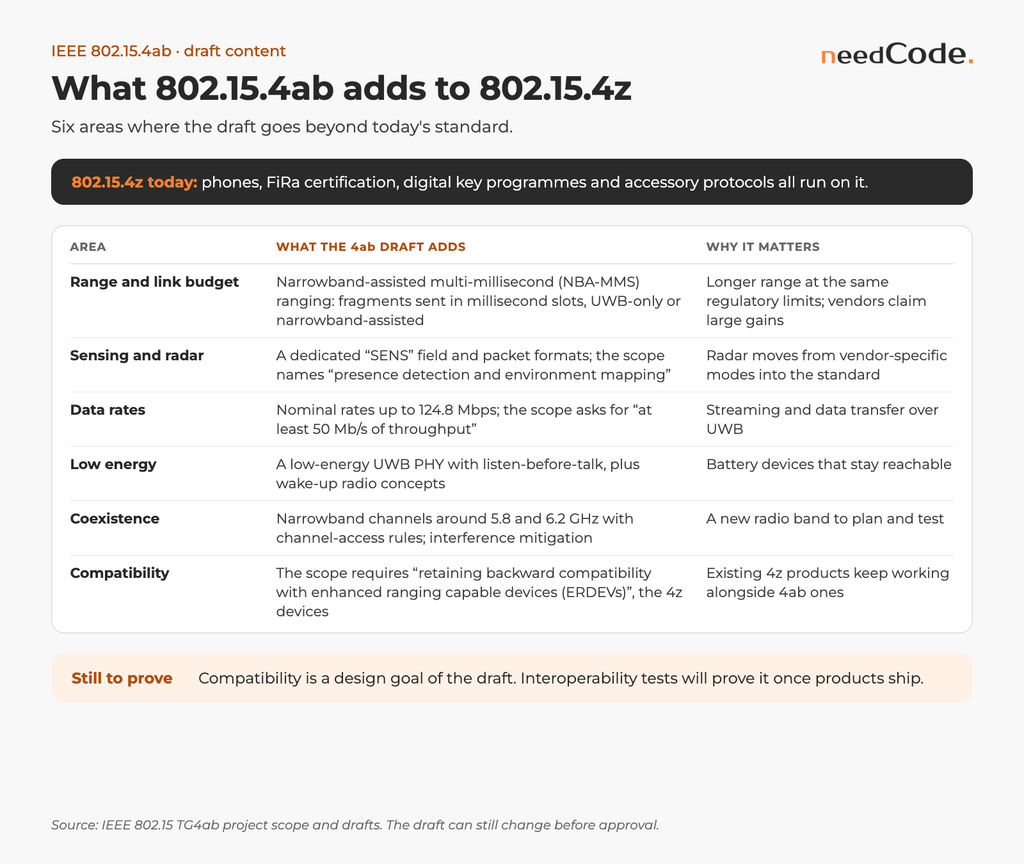
| Area | What the draft adds | Why it matters |
| Range and link budget | Narrowband-assisted multi-millisecond (NBA-MMS) ranging: ranging packets split into fragments sent in millisecond slots, in UWB-only or narrowband-assisted variants | Longer range at the same regulatory limits; vendors claim large gains |
| Sensing and radar | A dedicated “SENS” field and packet formats for sensing and radar; the project scope names “presence detection and environment mapping” | Radar moves from vendor-specific modes into the standard |
| Data rates | Nominal rates up to 124.8 Mbps; the scope asks for “at least 50 Mb/s of throughput” | Streaming and data transfer over UWB |
| Low energy | A low-energy UWB PHY with listen-before-talk, plus wake-up radio concepts | Battery devices that stay reachable |
| Coexistence | Narrowband channels around 5.8 and 6.2 GHz with channel-access rules; interference mitigation | New radio band to plan and test |
| Compatibility | The project scope requires “retaining backward compatibility with enhanced ranging capable devices (ERDEVs)”, the 802.15.4z devices | Existing 4z products keep working alongside 4ab ones |
The project’s “need” statement is explicit: “Compatibility and positive coexistence with legacy ERDEVs is provided to enhance without disruption the capabilities provided by already deployed devices.” That is a design goal of the draft, and it will only be proven by interoperability tests once products ship.
Where the standard stands
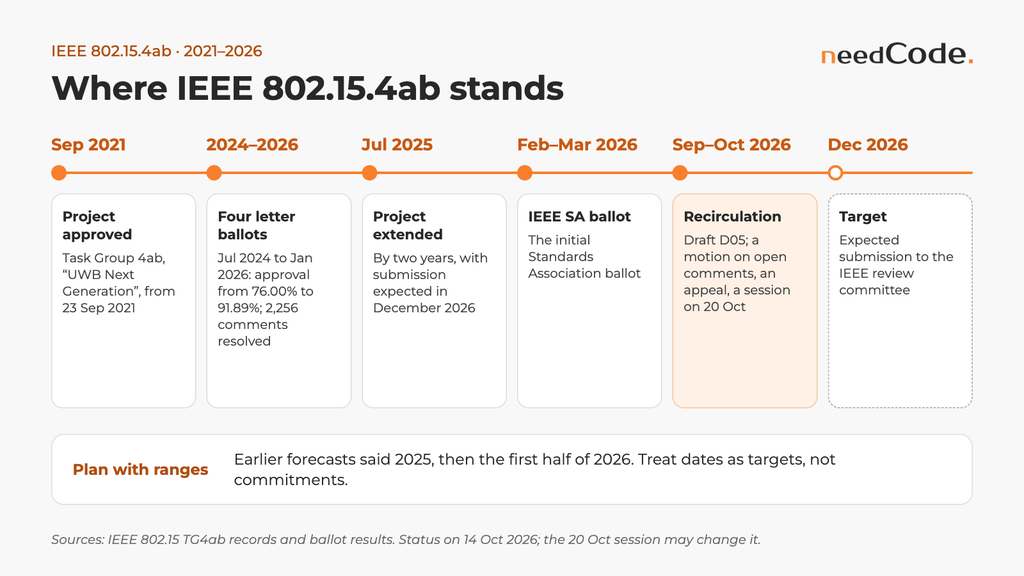
| Date | Milestone |
| 23 September 2021 | Project (PAR) approved; Task Group 4ab, “802.15.4 UWB Next Generation” |
| July 2024 – January 2026 | Four working-group letter ballots, approval rising from 76.00% to 91.89%; 2,256 comments resolved |
| July 2025 | Project extended by two years; expected submission to the IEEE review committee: December 2026 |
| February – March 2026 | Initial IEEE SA ballot |
| September – October 2026 | SA recirculations on draft D05; a procedural motion on unresolved comments, an appeal, and an executive session planned for 20 October 2026 |
Earlier forecasts have slipped. In 2024 LitePoint expected release in 2025. In June 2026 embedUR wrote that the standard was “expected to be officially released in the first half of 2026”. ETSI’s May 2026 report said it is “intended to be published in 2026”. Plan with ranges, not a date.
Who is ready
| Company or body | Public position (as of October 2026) |
| STMicroelectronics | ST64UWB family announced on 10 March 2026 as an “industry-first system-on-chip supporting” 802.15.4ab, with “backward compatibility with IEEE 802.15.4z”; sampling to Tier 1s and OEMs |
| Calterah | A UWB SoC described with Rohde & Schwarz in January 2026 as “the world’s first UWB chip to fully comply” with 802.15.4ab, demonstrated at CES 2026 |
| NXP | Trimension NCJ29D8, “IEEE 802.15.4ab and IEEE 802.15.4z compatible”, listed as preproduction |
| Ceva | UWB IP described in March 2026 as “the industry’s first IEEE 802.15.4ab-compliant UWB IP” |
| FiRa Consortium | October 2025: will “update its specifications to incorporate new features” of 802.15.4ab; no timeline given. FiRa Core 4.0 (December 2025) completes 802.15.4-2024 features without 4ab content |
| Car Connectivity Consortium | No public statement on 802.15.4ab found |
| Qorvo | No public statement on 802.15.4ab found; product pages describe 802.15.4z and 802.15.4-2024 support. Qorvo engineers take part in the task group’s ballot comment resolution |
“First” claims come from vendors and compete with each other. What matters for a product team is that 4ab silicon is reaching samples and that FiRa will build on it, while phones, digital key ecosystems and certification programmes run on 802.15.4z today.
Ship on 802.15.4z now, or wait?
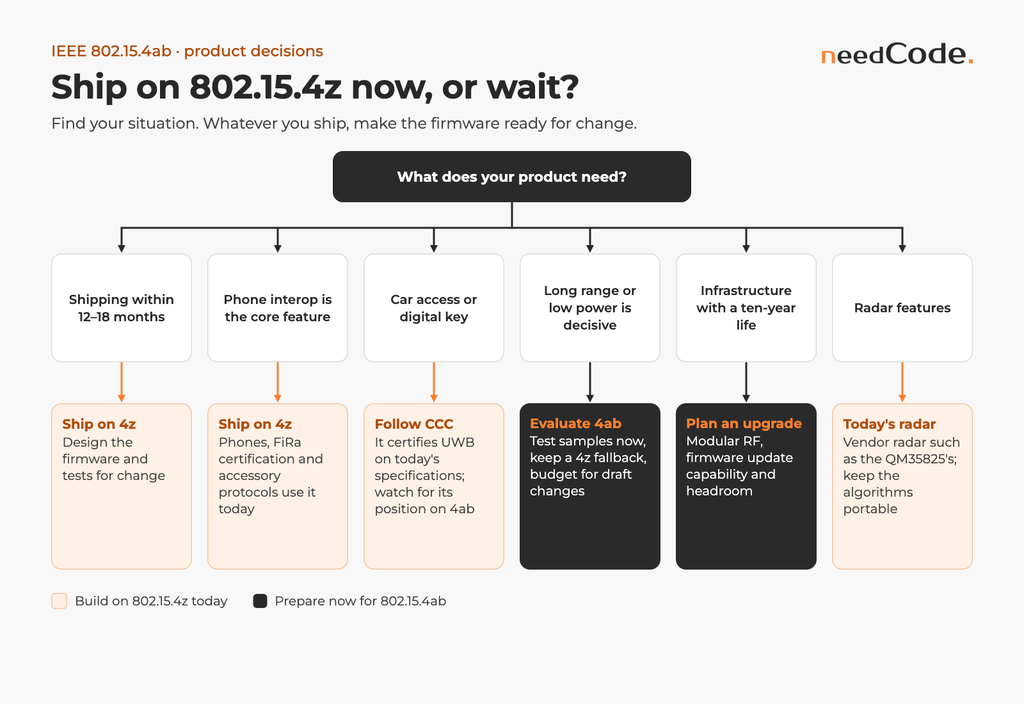
| Your situation | Recommendation |
| Product needed within 12–18 months | Ship on 802.15.4z; design the firmware and tests for change |
| Phone interoperability (iPhone, Android) is the core feature | Ship on 802.15.4z; phones, FiRa certification and the accessory protocols use it today |
| Car access or digital key | Follow the CCC programme, which certifies UWB on today’s specifications; watch for a CCC position on 4ab |
| Long-range or low-power sensors where 4ab’s link budget is decisive | Evaluate 4ab samples now, keep a 4z fallback, and budget for draft changes |
| Infrastructure with a ten-year life (anchors, access points) | Plan an upgrade path: modular RF, firmware update capability and headroom |
| Radar features | Use today’s vendor radar, such as the QM35825’s, and keep the algorithms portable for standard sensing formats later |
Make 802.15.4z firmware ready for change
- Keep the UWB subsystem behind a stable interface. FiRa’s UWB Command Interface (UCI) already separates host and UWB subsystem; Qorvo’s QM35825 is controlled over UCI, wrapped by the Cherry C API. A product built this way can swap the UWB part with less rework.
- Separate session logic from the application. New session types, such as multi-millisecond ranging or sensing, should slot in without touching business logic. As embedUR notes, interleaving ranging and radar “is a scheduling problem that ranging-only firmware never had to solve”.
- Keep signal processing on the host, with a defined input format. Radar and sensing algorithms that read a documented CIR structure can follow the move to standard sensing interfaces.
- Configure with data, not code. Channels, preambles, timing and regional settings belong in configuration that firmware updates can change.
- Leave headroom for updates. Flash and RAM margins, dual-bank images and signed over-the-air updates serve 4ab readiness and the EU Cyber Resilience Act alike.
- Plan the hardware path. Moving to 4ab means new UWB silicon with a narrowband radio. If an upgrade is likely within the product’s life, consider a module footprint or an RF section you can replace.
- Version the interfaces deliberately. Semantic version numbers are not enough for embedded SDKs; document which configuration and data formats each release supports.
A test plan for the transition
- Mixed fleets: 4ab devices must range with the 4z devices already installed, including phones, before you ship them into existing sites.
- Range and link budget: compare 4z and NBA-MMS modes in your real environments, not only in open space.
- Coexistence: the draft adds narrowband transmissions near 5.8 and 6.2 GHz with duty-cycle and channel-access rules. Test next to Wi-Fi in those bands.
- Sensing: validate detection and false alarms on real scenes; our guide to UWB radar on the QM35 describes the method.
- Protocol visibility: keep sniffer and test tooling that decodes both generations as they arrive.
From our engineering work
needCode architects co-designed emerging UWB radar standards and APIs with leading technology companies, and defined the multi-standard architecture of Qorvo’s public QM35 SDK, with FiRa and omlox in one design. Our Modular UWB Sniffer decodes FiRa, CCC Digital Key, Aliro and omlox traffic, with 802.15.4ab on the roadmap.
How needCode helps
We review UWB products for 802.15.4ab readiness: hardware path, firmware architecture, interfaces, update capability and certification plan, and we deliver a decision on what to ship now and what to prepare. We then build the changes into your firmware and test infrastructure, so a move to 4ab silicon becomes a planned upgrade.
Frequently asked questions
Should we wait for 802.15.4ab before designing a UWB product?
Usually not. As of October 2026 the standard is still in IEEE SA balloting, phones and certification programmes run on 802.15.4z, and the draft promises backward compatibility. Ship on 802.15.4z and design the firmware, hardware path and tests for change. Evaluate 4ab samples now if long range or standard radar is decisive for your product.
Is 802.15.4ab backward compatible with 802.15.4z?
That is a stated goal. The approved project scope requires “retaining backward compatibility with enhanced ranging capable devices (ERDEVs)”, meaning 802.15.4z devices, and the draft includes mechanisms for it. Interoperability between real products will need testing once 4ab devices ship.
When will IEEE 802.15.4ab be approved?
No approval date has been set publicly. The project’s official target is submission to the IEEE review committee in December 2026. In October 2026 the draft was in SA ballot recirculation, and an appeal was due before the IEEE 802 executive committee on 20 October 2026. Earlier forecasts of 2025 and early 2026 were missed.
Which UWB chips support 802.15.4ab?
As of October 2026, ST’s ST64UWB family is sampling, Calterah has shown a 4ab SoC, NXP lists the NCJ29D8 as preproduction, and Ceva offers 4ab IP. These are vendor announcements made before the standard’s final approval.
Does Qorvo support 802.15.4ab?
Qorvo had made no public statement about 802.15.4ab products by 14 October 2026. Its QM35825 and automotive QPF5100Q are described as 802.15.4z and 802.15.4-2024 parts, and Qorvo engineers take part in the task group’s work. Ask Qorvo directly about its roadmap for your programme.
Will FiRa certification change with 802.15.4ab?
FiRa announced in October 2025 that it will incorporate 802.15.4ab features into future specifications, without a timeline. Today’s FiRa Core 4.0 certification covers 802.15.4-2024 features. Expect new certifiable features later, and plan budget for recertification when you adopt them.
Sources
- IEEE 802.15: P802.15.4ab PAR extension request (July 2025)
- IEEE 802.15.4ab Task Group page and TG4ab meeting slides, September–November 2026
- IEEE 802.15: P802.15.4ab report to LMSC on SA ballot (November 2025, updated January 2026)
- IEEE 802 LMSC: conditions met for SA ballot (February 2026) and appeal of WG leadership ruling (September 2026)
- IEEE 802.15: Coexistence document for 802.15.4ab
- ETSI TR 103 970 V2.1.1 (May 2026)
- Rohde & Schwarz: white paper on IEEE 802.15.4ab and LitePoint: “UWB Is Here to Stay: Now What?” (2024)
- embedUR: “UWB Beyond Ranging: What IEEE 802.15.4ab Means for Your Firmware” (June 2026)
- STMicroelectronics ST64UWB announcement (March 2026, Microwave Journal copy)
- Rohde & Schwarz and Calterah: 802.15.4ab chip verification (January 2026), Ceva UWB IP (March 2026) and NXP Trimension NCJ29D8
- FiRa Consortium to integrate IEEE 802.15.4ab advancements (October 2025) and FiRa Core 4.0 (December 2025)
- CCC Digital Key certification adds Bluetooth LE and UWB (March 2025)
- Qorvo QM35825 product page and QPF5100Q product page
About needCode
needCode is an independent embedded engineering company from Kraków, Poland, and an official UWB business partner of Qorvo. Its engineers have worked inside Qorvo’s wireless programmes for more than eight years, including on the public QM35 SDK. needCode is certified to ISO 9001:2015 and ISO/IEC 27001:2022 and is a member of the UWB Alliance. This article does not represent Qorvo. All trademarks belong to their respective owners.