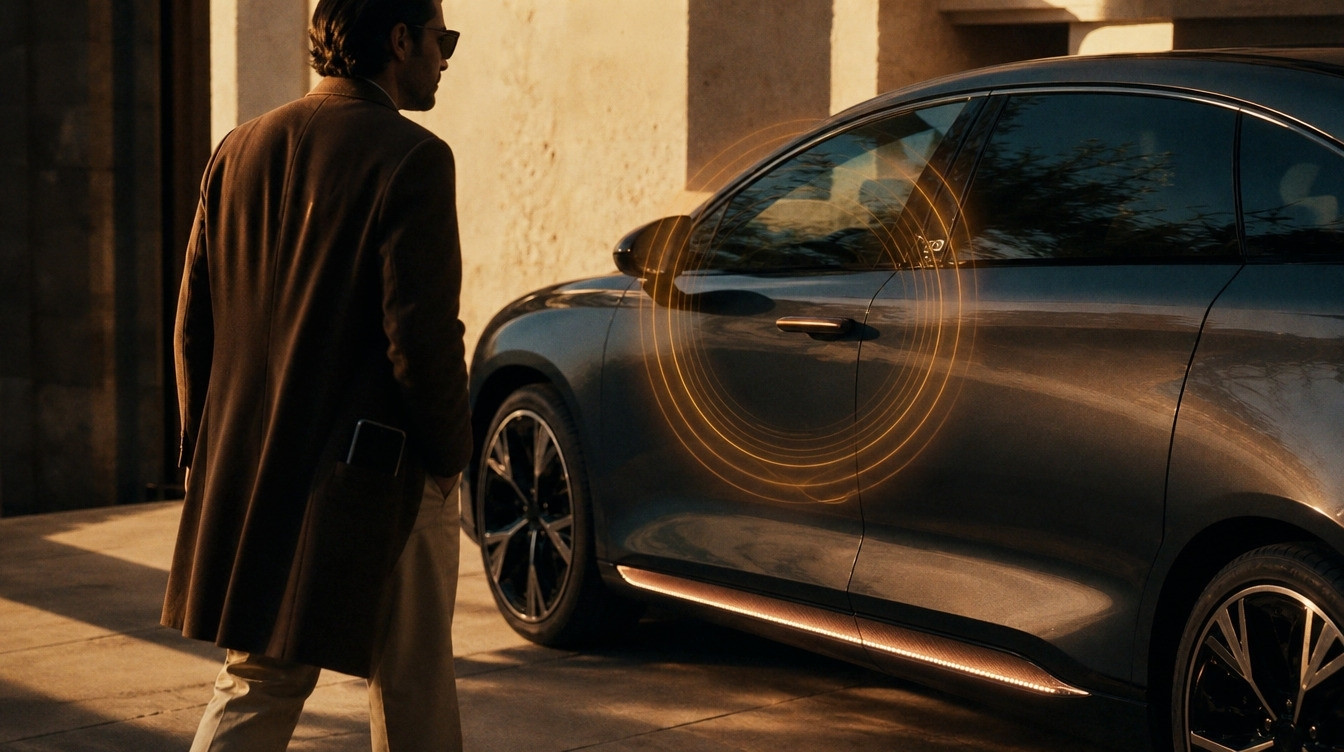
The short version of Channel Sounding vs UWB for vehicle access is that they are not yet competing for the same job. If you are building to CCC Digital Key today, UWB does the secure ranging and Bluetooth does discovery and authentication, and Channel Sounding does not currently replace either. If you are building access that sits outside CCC, or a second tier of a product where a full UWB anchor set cannot be justified, Channel Sounding becomes a serious option.
That distinction gets lost because both technologies answer the same headline question, which is how far away is the key. They answer it with different physics, different security models, and very different levels of ecosystem readiness, and only one of those three differences is about accuracy.
This article sets out what each measures, what the published and measured numbers actually say, where the security argument lands, and a decision framework you can apply to your own programme.
What each technology measures
The Channel Sounding vs UWB comparison starts with physics, because the two do not measure the same thing.
Ultra wideband measures time of flight. It transmits very short impulses across at least 500 MHz of bandwidth and timestamps their arrival, so the distance falls out of the propagation delay directly. The security comes from the scrambled timestamp sequence, a cryptographically generated pattern the receiver knows and an attacker does not, which is what makes the measurement hard to forge rather than merely hard to guess.
Bluetooth Channel Sounding, introduced in Bluetooth Core 6.0, measures phase. In phase based ranging the two devices exchange tones across many frequencies and derive distance from how the phase changes, which the Bluetooth SIG describes as measuring time of flight in a precise way using phase data. A round trip time mode is also defined, trading accuracy for range.
Two consequences follow from that difference and they run through everything below.
First, phase based ranging needs a sequence of measurements across frequencies to resolve ambiguity, so it takes longer and does more post processing than an impulse exchange that resolves in one shot.
Second, the Bluetooth specification does not mandate the distance estimation algorithm. That is deliberate, and the SIG is explicit that it allows vendor flexibility, but the practical effect is that two compliant Channel Sounding implementations can perform very differently. UWB’s timestamping is far more prescribed.
The head to head
| UWB | Bluetooth Channel Sounding | |
|---|---|---|
| Method | Impulse time of flight, over 500 MHz bandwidth | Phase based ranging, plus an RTT mode |
| Specification | IEEE 802.15.4z, FiRa profiles, CCC Digital Key | Bluetooth Core 6.0 and later |
| Typical accuracy | Centimetre level | Sub metre, with a 10 to 30 cm target |
| Range | Up to about 50 m line of sight | 20 to 30 m at sub metre accuracy; RTT mode beyond 50 m at several metres |
| Security primitive | Scrambled timestamp sequence with AES; some parts hold SESIP level 3 | Link layer channel sounding security procedures, still maturing |
| Algorithm defined by | The standard | The vendor |
| Topology | Scales to hundreds or thousands of devices via uplink TDoA | One to one ranging |
| Phone availability | iPhone 11 and later, flagship Android since 2019 | Requires Bluetooth 6.0 silicon, only now reaching handsets |
| Hardware cost | Dedicated radio and anchors | Often reuses a radio the product already has |
| CCC Digital Key status | The defined ranging method | Not currently accepted |
The two rows that decide most vehicle programmes are the last two, and neither is about measurement quality. That is the single most useful thing to know about Channel Sounding vs UWB: teams argue about centimetres and then discover the decision was made by a certification body and a handset installed base.
What the measured numbers say
Published targets and field results are not the same thing, and in a Channel Sounding vs UWB assessment the gap matters, because you will be held to whatever number goes into the specification.
The Bluetooth SIG’s stated ambition for Channel Sounding is 10 to 30 cm accuracy, against roughly 3 to 5 metres for RSSI based proximity and sub metre for angle of arrival methods. Qorvo, which sells both technologies, puts Channel Sounding at sub metre positioning that degrades at the edges of coverage and in multipath, and UWB at centimetre level with better stability.
An independent bench comparison run by Comarch in an ordinary office, with carpets, glass and aluminium doors and live interference from other wireless projects, is more instructive than either. It found UWB gave better stability and better accuracy, and that a less power efficient Bluetooth module produced 20 to 30 percent error at shorter distances rising to 60 percent at longer ones. A better Bluetooth module performed well. That spread between two compliant modules is the vendor algorithm freedom showing up as measured variance.
The power results from the same test are the most counterintuitive part of the comparison, and worth reading carefully.
| Average current | Peak current | |
|---|---|---|
| UWB | 0.75 mA | 98.5 mA |
| Bluetooth CS, accuracy optimised module | 1.8 mA | 31 mA |
| Bluetooth CS, power optimised module | 0.97 mA | 16.9 mA |
UWB drew the lowest average current of the three and by far the highest peak. Channel Sounding’s post processing burden shows up as higher average draw and longer ranging times, which Qorvo describes as producing challenging user experiences, while UWB’s impulse approach initialises faster but demands a supply that can deliver nearly 100 mA in bursts.
For a coin cell fob or a battery powered anchor, that peak figure drives the decoupling design and the cell selection. For a vehicle anchor on the twelve volt rail it is irrelevant. This is a case where the right answer genuinely depends on where the thing is mounted.

Security is where the vehicle access decision is made
Accuracy comparisons dominate the marketing around Channel Sounding vs UWB, and for access control they are the wrong axis.
A vehicle access system does not need to know the distance precisely. It needs to know that the distance it was told cannot be forged. Those are different requirements, and the second one is what relay attacks defeat.
UWB’s answer is mature. The scrambled timestamp sequence makes the ranging exchange cryptographically bound, AES protects the payload, and some UWB parts already carry SESIP level 3 certification. The security model has been examined by the standards bodies and attacked by researchers for years.
Channel Sounding’s answer is younger. The Bluetooth specification defines channel sounding security procedures at the link layer, but the SIG’s own introductory material describes those procedures without publishing the depth of analysis that UWB’s has accumulated. That the specification is actively hardening is itself informative: Bluetooth Core 6.2, released on 4 November 2025, added Channel Sounding amplitude based attack resilience, protecting against a class of RF attack on the ranging measurement.
Read that as a healthy standards process rather than a failure. New secure ranging attracts attackers, the specification responds, and the surface stabilises over time. But if you are specifying a system whose failure mode is a stolen vehicle, the difference between a security model that has been attacked for years and one that is still adding attack classes is a legitimate input to the decision.
Whichever radio you choose, the relay attack resistance design rule is the same: fail closed. If the distance measurement is unavailable or untrusted, require an active gesture rather than falling back to signal strength.
The CCC question settles vehicle access, for now
This is the part that most Channel Sounding vs UWB comparisons omit, and it is the one that determines what you can actually ship.
CCC Digital Key Release 3.0 and later define Bluetooth Low Energy for discovery and authentication and UWB for secure distance measurement. Channel Sounding is not a defined ranging method in that architecture. Qorvo’s assessment is blunt: it may take years before Bluetooth LE Channel Sounding is adopted in automotive for digital car key use cases, because the Car Connectivity Consortium would need to be convinced that it is secure, quick and compatible.
So for an OEM building to CCC Digital Key, the Channel Sounding vs UWB question does not currently arise for the ranging function. UWB is the route to the specification, and that is a certification fact rather than an engineering preference.
Where the question does arise, immediately and usefully:
Aftermarket and non CCC access, where you control both ends and are not bound to the consortium’s architecture.
A second tier of a product line, where the flagship carries UWB anchors and a lower trim needs proximity better than RSSI without the anchor cost.
Adjacent vehicle functions that are not the key: welcome lighting, approach detection, personalisation triggers, tailgate gestures. None of these gate physical security, all of them benefit from distance better than signal strength, and Channel Sounding can serve them on a radio the vehicle already has.
Fleet, rental and car sharing companion devices, where the counterpart is a dedicated tag rather than a phone and you set both ends of the link.

Phone availability is the other quiet constraint
For anything where the user’s phone is the key, the Channel Sounding vs UWB decision is partly made for you by what is in their pocket.
UWB has been shipping in iPhones since the iPhone 11 in 2019 and in flagship Android devices for a similar period, so the installed base is substantial. Channel Sounding requires Bluetooth 6.0 capable silicon, which is only now reaching handsets, and a phone with the radio still needs the platform to expose the capability to applications.
That gap will close. It has not closed yet, and a vehicle programme reaching production in three years is making a bet on where handset penetration will be at that point, not where it is now. The honest framing is that Channel Sounding’s phone story is roughly where UWB’s was around 2020.
Timing: what you are actually betting on
A vehicle programme starting now reaches production in roughly three to five years, which means the Channel Sounding vs UWB decision is a forecast rather than a snapshot. Three variables move in that window and they move at different speeds.
Handset penetration moves fastest, because phones turn over in two to three years. If Bluetooth 6.0 silicon reaches mainstream handsets over the next couple of cycles, Channel Sounding’s installed base problem largely solves itself by the back half of the decade.
Specification acceptance moves slowest. The Car Connectivity Consortium has to be satisfied on security, speed and compatibility before Channel Sounding becomes a defined ranging method, and consortium processes run on multi year cycles with plugfests and interoperability programmes attached. Nothing about handset availability accelerates that.
Security maturity sits in between, and it is observable. Watch which attack classes each Bluetooth core release addresses. A specification that is still adding ranging attack mitigations is a specification whose threat model is still being mapped, which is normal and also a reason not to build the highest assurance function on it yet.
The practical hedge is architectural. Choose silicon capable of both, put the security critical function on UWB now, and design the Bluetooth path so Channel Sounding can be enabled by firmware later without touching the hardware. That costs very little at design time and buys a genuine option.
When to use each
| Use case | Recommended | Why |
|---|---|---|
| CCC Digital Key passive entry | UWB | The defined ranging method; Channel Sounding is not currently accepted |
| Relay resistant vehicle unlock, any architecture | UWB | Mature security model, cryptographically bound ranging, certified parts |
| Precise zone identification, inside versus outside | UWB | Multi anchor localisation, centimetre accuracy |
| Welcome lighting, approach detection, personalisation | Channel Sounding | Distance is useful but not security critical; reuses an existing radio |
| Lower trim proximity better than RSSI | Channel Sounding | Avoids the anchor bill of materials |
| Aftermarket or non CCC access | Either, assess both | You control both ends; run a feasibility study on your geometry |
| Tag based fleet and car sharing | Either, assess both | Both ends are yours, so phone availability stops mattering |
| Coin cell peripheral with a constrained supply | Channel Sounding, probably | Peak current of roughly 17 to 31 mA against nearly 100 mA for UWB |
| Anchor on the vehicle twelve volt rail | UWB | Peak current is irrelevant, accuracy and security are not |
The architecture most programmes land on
Framing Channel Sounding vs UWB as a choice is usually the mistake. The two are complementary and Qorvo makes the same point: coarse positioning from Channel Sounding, fine positioning from UWB.
In a vehicle that pattern already exists, because CCC Digital Key uses Bluetooth for discovery and authentication and UWB for ranging. Adding Channel Sounding to the Bluetooth side extends what the BLE link can do during approach, before the UWB session is established and after it tears down, and it gives you a fallback distance estimate that is far better than signal strength when UWB is marginal.
The design rule for that fallback matters. A Channel Sounding distance is good enough to switch on the welcome lights. It is not good enough to unlock the doors. Keep the security boundary where the security model is strongest and let the weaker measurement drive the convenience features.
Where needCode fits
needCode builds both. The vehicle access system work combines a CCC Digital Key and Aliro credential, time of flight UWB ranging for relay resistant proximity, and multi anchor UWB localisation for door and zone identification, with BLE Channel Sounding as an alternative ranging method using phase based ranging at sub metre accuracy on Nordic nRF54 and nRF53 silicon.
The team works across Qorvo QM33 and QM35, NXP Trimension, STMicroelectronics, Infineon and Silicon Labs parts and legacy DW1000 and DW3000 designs, is a certified Qorvo partner of more than eight years, a Nordic Semiconductor Design Partner for EMEA and a UWB Alliance member, and holds ISO/IEC 27001:2022 and ISO 9001:2015.
Building both is the reason we can give you a straight answer rather than a product recommendation. Most Channel Sounding vs UWB questions resolve in a two to four week feasibility study on your own geometry, phone target list and security requirement, and the answer is frequently a split: UWB for the functions that gate access, Channel Sounding for the ones that do not. Our automotive and SDV practice covers digital key, secure ranging and in cabin sensing as one programme, which is where the radio sharing decisions get made.
To work through which side of the line each of your functions falls on, book a discovery call.
Frequently asked questions
Not currently. CCC Digital Key Release 3.0 and later define Bluetooth Low Energy for discovery and authentication and UWB for secure distance measurement, and Channel Sounding is not a defined ranging method within that architecture. Qorvo’s assessment, from a vendor selling both technologies, is that it may take years before Channel Sounding is adopted in automotive for digital car key use cases, because the Car Connectivity Consortium would need to be convinced it is secure, quick and compatible. For an OEM building to the specification this is a certification constraint rather than a technical preference: choosing Channel Sounding for the ranging function would put the programme outside the specification it is trying to certify against. Channel Sounding can still add value elsewhere in the same vehicle, on functions that are not gating physical access.
The Bluetooth SIG targets 10 to 30 cm for Channel Sounding, against roughly 3 to 5 metres for RSSI proximity, while UWB delivers centimetre level accuracy. In practice the spread matters more than the headline. Qorvo reports Channel Sounding at sub metre accuracy that degrades at coverage edges and in multipath, whereas an independent office comparison by Comarch found UWB gave better stability and accuracy overall, with one Bluetooth module showing 20 to 30 percent error at short distances rising to 60 percent at longer ones while a different module performed well. That variance is a direct consequence of the Bluetooth specification not mandating the distance estimation algorithm, which gives vendors flexibility and gives integrators a benchmarking obligation. Assume you will have to measure candidate modules yourself rather than trusting a datasheet figure.
It depends entirely on whether you care about average or peak. Measured figures from the Comarch comparison put UWB at 0.75 mA average with a 98.5 mA peak, an accuracy optimised Bluetooth Channel Sounding module at 1.8 mA average with a 31 mA peak, and a power optimised Channel Sounding module at 0.97 mA average with a 16.9 mA peak. UWB therefore drew the lowest average current of the three and by far the highest peak, because impulse transmission resolves quickly but demands current in bursts, while phase based ranging spreads its cost across a longer exchange with significant post processing. For a coin cell device the peak figure drives cell selection and decoupling design, which favours Channel Sounding. For an anchor on a vehicle twelve volt rail the peak is irrelevant.
It is improving, and it is younger than UWB’s model. UWB binds the ranging exchange with a scrambled timestamp sequence, protects payloads with AES, and some parts carry SESIP level 3 certification, with years of standards scrutiny and published attack research behind it. Channel Sounding defines security procedures at the link layer and is actively hardening: Bluetooth Core 6.2, released in November 2025, added amplitude based attack resilience for Channel Sounding, addressing a class of RF attack on the measurement itself. That is a healthy standards process rather than a red flag, but if the failure mode of your system is a stolen vehicle, the maturity difference is a legitimate input. Whichever you choose, the design rule is to fail closed: when the distance measurement is unavailable or untrusted, require an active gesture rather than falling back to signal strength.
On the functions that benefit from distance but do not gate physical security, and on products where the UWB anchor cost cannot be justified. Welcome lighting, approach detection, driver personalisation triggers and tailgate gestures all work better with a measured distance estimate than with signal strength, and Channel Sounding can serve them using a Bluetooth radio the vehicle already carries. A lower trim level that needs better than RSSI proximity without a full anchor set is the same argument. Aftermarket and non CCC access systems are a genuine option because you control both ends of the link, as are tag based fleet and car sharing applications where the counterpart is a dedicated device rather than a phone, which removes the handset availability constraint entirely. Keep UWB for anything that unlocks or starts the vehicle.