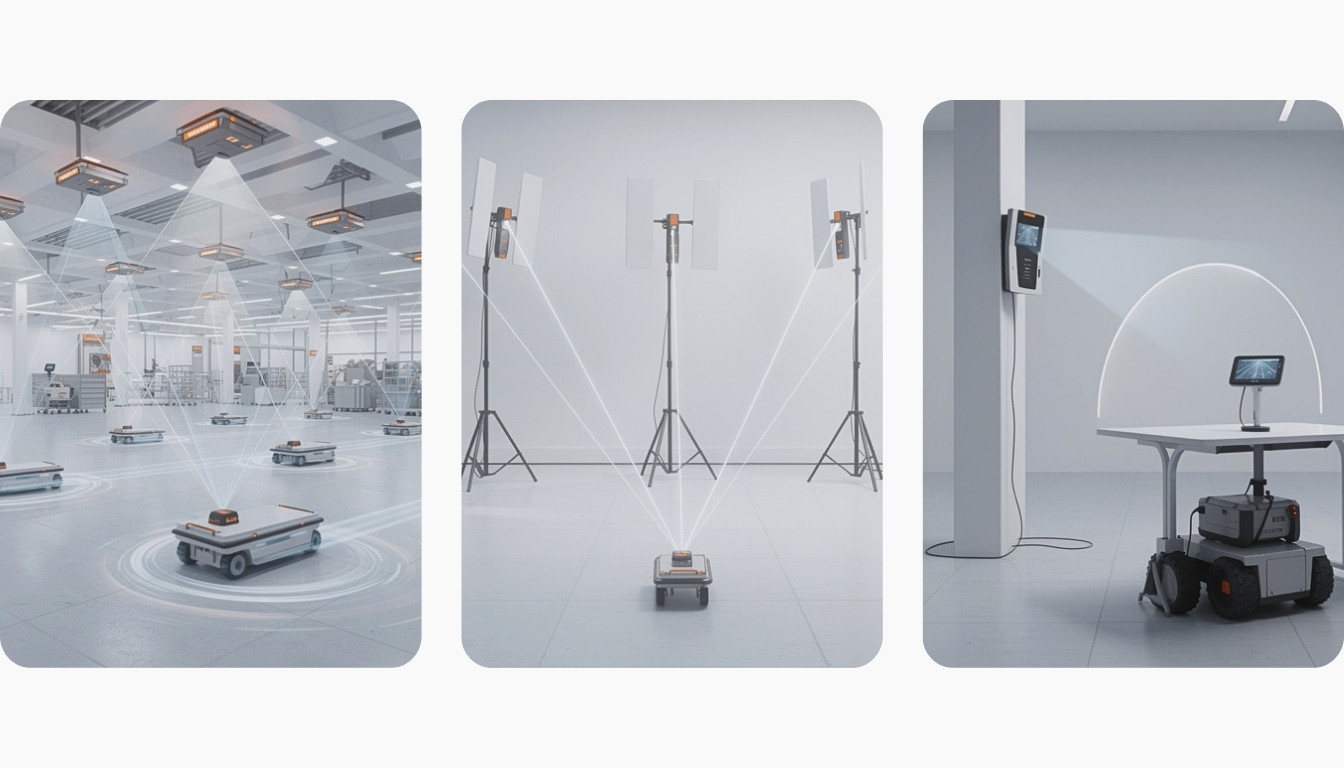
TDoA, AoA and TWR ranked by use case, infrastructure cost and tag scale.
The ranging mode you select at the architecture stage defines almost everything that follows: how many anchors you need, what your tag battery life will be, how many concurrent tags the system supports, and whether your UWB indoor positioning system can reach sub-10 cm accuracy in production. Getting this decision wrong early costs money and time to reverse, and unlike most firmware choices, it is tightly coupled to hardware design.
This article ranks UWB’s three principal ranging modes (Time Difference of Arrival/TDoA, Two-Way Ranging/TWR, and Angle of Arrival/AoA) across six decision dimensions: accuracy, tag scale, tag battery life, anchor infrastructure cost, synchronization complexity, and standard alignment. The aim is a decision framework for selecting the right UWB RTLS architecture, grounded in how these modes behave in deployed systems rather than in spec-sheet ideals.
Quick comparison
| Dimension | TDoA | TWR (DS-TWR) | AoA |
|---|---|---|---|
| Typical production accuracy | 10–30 cm | 5–10 cm | 10–30 cm (distance-dependent) |
| Tag scale per zone | Unlimited | Hundreds | Unlimited (one-way Tx) |
| Tag battery life | Excellent | Moderate | Excellent |
| Anchor synchronization required | Yes (<1 ns) | No | No |
| Minimum anchors for 3D fix | 4 | 3 | 1–2 (with geometry constraints) |
| Infrastructure cost | Higher | Lower | Medium (antenna arrays) |
| FiRa profiles supported | DL-TDoA, UL-TDoA | SS-TWR, DS-TWR | OWR for AoA |
| omlox alignment | Primary mode | RToF variant | Not supported |
| Best environment | Large industrial, logistics | Precision tasks, small/mid sites | Consumer, short-range, access control |
Ranking 1: best for large-scale industrial RTLS (>200 tags)
Winner: TDoA
When you need to scale UWB asset tracking to hundreds or thousands of tags across a large facility (a warehouse, a production floor, a seaport), TDoA is the architecture that grows without infrastructure constraint. Tags transmit short Blink messages at regular intervals. Every anchor in range records the arrival timestamp and forwards it to the location server, which computes a 2D or 3D position via hyperbolic multilateration from at least four synchronized anchors.
The structural advantage is one-directional communication: the tag does not need to know the address of any anchor, and it does not wait for a ranging response. Adding 500 more asset tracking RTLS tags requires zero reconfiguration of the existing infrastructure. Adding more anchors to extend coverage likewise requires no changes to tag firmware. This is why the omlox UWB standard adopted TDoA (specifically UL-TDoA and DL-TDoA) as its primary method.
Sewio, one of the pioneering producers of TDoA-based RTLS, documents the anchor synchronization scheme in detail: Master Anchors broadcast a wireless sync signal, listening anchors align their clocks to sub-nanosecond precision, and cells of synchronized anchors cover the facility in overlapping zones. This wireless synchronization infrastructure is the main cost difference versus TWR.
Infrastructure cost tradeoff: TDoA requires tight anchor clock alignment, typically sub-nanosecond. Getting this synchronization right requires careful anchor placement, a radio survey, and ongoing monitoring. In large facilities, this is worth it. In a 300 m² test lab with 50 tags, it is not.
Accuracy floor: 10–30 cm is the realistic production range under normal conditions. Clean line-of-sight environments with optimal anchor spacing can reach the lower end. Dense NLOS environments (metal racking, moving machinery, reinforced concrete) tend toward the upper end.
Ranking 2: best for accuracy and high-precision tasks
Winner: DS-TWR
Two-Way Ranging, specifically Double-Sided TWR, is the mode that reaches the lowest ranging error in production deployments. The exchange is bidirectional: a tag (initiator) sends a Poll message to an anchor (responder), the anchor replies with a Response, and the tag sends a Final message. This three-message exchange allows both devices to contribute timing measurements, which cancels the clock drift error that makes Single-Sided TWR less accurate.
The difference matters in practice. IntechOpen’s peer-reviewed analysis of UWB positioning methods, covering TWR, TDoA, and PDoA methods, documents DS-TWR achieving ranging errors in the 2–5 cm range under controlled lab conditions, with production deployments typically in the 5–10 cm range across realistic NLOS environments. SS-TWR, using two messages and one-sided clock measurement, introduces drift-induced error that grows with the response delay time.
For applications where accuracy is the binding constraint (robot guidance, precision assembly, pallet alignment in automated warehouses, drone landing) DS-TWR is the correct architecture. Increasing anchor density in a DS-TWR deployment improves position accuracy further by providing more distance measurements for multilateration.
Consumer UWB also relies on TWR. Apple’s U1 and H1 chips implement a FiRa-compatible ranging session using SS-TWR with FiRa’s Contention-Based Ranging profile, and TWR underlies precision finding in AirTag and Find My accessories. For any product that must range against a consumer smartphone, TWR is the relevant mode.
TWR variant comparison:
SS-TWR uses two messages (Poll and Response) and computes Time of Flight from one device’s round-trip measurement. It is simpler to implement but susceptible to clock drift over longer response delays. DS-TWR adds a third message (Final), providing double-sided measurements that cancel clock drift error. For industrial RTLS where accuracy is primary, DS-TWR is the correct choice. For high-update-rate consumer devices where message overhead matters more than maximum accuracy, SS-TWR is acceptable.
Tag scale limit: Each TWR exchange occupies a time slot. The system must schedule exchanges to avoid collisions. Depending on the update rate and scheduling scheme, this typically limits concurrent ranging to hundreds of tags per zone rather than thousands.

Ranking 3: best for consumer devices and access control
Winner: AoA (with caveats)
Angle of Arrival measures the direction of a UWB signal rather than only its flight time. By placing multiple antenna elements at known positions on a receiver, the system measures the phase or arrival time difference of a signal across the array and computes the azimuth (and elevation, with a 2D array) from which the signal came. With a single receiving anchor and known geometry constraints, AoA can localize a tag using fewer fixed reference points than TDoA or TWR.
The UWB Alliance identifies AoA as one of the primary UWB measurement techniques alongside TWR, with particular adoption in smartphone-to-device ranging for item finding, smart home spatial control, and automotive access. PDoA (Phase Difference of Arrival) is a closely related technique that measures the phase difference of a received signal across antenna elements rather than pure arrival time difference; sub-centimeter precision is achievable with PDoA under controlled conditions, which is why it appears in UWB-based access reader hardware.
AoA’s strongest case is short-range consumer and access control scenarios:
- Phone-to-car access, where the system needs to know whether the user is in front of or behind the vehicle
- Room-level indoor navigation, where a single ceiling anchor can determine which quadrant of a room a device is in
- UWB door readers that need to determine which side of a threshold the credential holder is approaching from
AoA limitations at industrial scale: Accuracy degrades with distance faster than TWR, because a small angular error translates to a larger positional error at longer ranges. A 2° angular error at 5 m produces a 17 cm positional error; the same 2° error at 20 m produces a 70 cm error. Antenna array hardware adds cost and complexity per anchor. Azimuth-only arrays require height constraints or elevation antenna rows to compute a full 3D fix. For a warehouse RTLS tracking 400 forklifts, AoA is not the mode.
Ranking 4: best for infrastructure simplicity and fast deployment
Winner: TWR
TDoA requires anchor synchronization infrastructure. AoA requires antenna arrays. TWR requires neither. Three anchors positioned to cover a space, a tag, and a location engine running on a modest server: that is a functional UWB positioning system with no sync hardware and no array hardware.
There is no Master Anchor hierarchy, no wireless sync configuration, no cell boundary management. The tag and anchor exchange ranging messages directly, the anchor reports the distance to the location engine, and the location engine computes position via trilateration from at least three anchor distances.
This simplicity makes TWR the right mode for proof-of-concept deployments, for smaller facilities where infrastructure investment must be minimal, and for situations where a working RTLS needs to be running in days rather than weeks. The infrastructure cost difference is meaningful: a TWR anchor is a single UWB radio on a standard PoE mount, while a TDoA anchor typically requires an additional sync radio or sync cable infrastructure alongside the UWB radio.
The Inpixon breakdown of TDoA versus TWR correctly notes that TWR requires more messages per position update cycle compared to TDoA’s single Blink, but the infrastructure simplification outweighs this for smaller deployments where sync overhead would be the dominant cost.
For a 2,000 m² production facility with 50 assets to track, a TWR system will deploy faster, at lower infrastructure cost, and with lower ongoing maintenance overhead than a TDoA system.

Ranking 5: best for tag battery life
Winner: TDoA (tied with AoA one-way mode)
In TDoA, a tag transmits a single Blink message (typically a few hundred microseconds of UWB airtime) and then sleeps until the next scheduled interval. No receiving, no response processing, no protocol exchange. This is the most power-efficient UWB operating mode possible.
For indoor positioning with UWB tags running at a 100 ms update rate, TDoA can achieve multi-year battery life on a small coin cell or a modest rechargeable, because the tag’s duty cycle is dominated by sleep time with only brief radio-on periods. Battery life scales linearly with update rate: a tag at 1 Hz update rate lives roughly 10× longer than the same tag at 10 Hz.
AoA in one-way transmit mode shares this advantage: the tag sends a short burst and the anchors measure the angle passively. No return message required.
TWR tags consume significantly more power. They must transmit a Poll, hold the radio receiver open during the anchor’s response window, receive the Response, and then transmit a Final message. Over many position cycles, the receiver-on time in TWR is the dominant power consumer. For asset tags that must last two or more years in the field without maintenance, TDoA is the architecture that makes this achievable.
FiRa and omlox alignment: which modes are standardized
The FiRa Consortium defines ranging profiles for SS-TWR, DS-TWR, DL-TDoA, UL-TDoA, and OWR (One-Way Ranging) for AoA. All are specified in the FiRa UC specification with defined message formats, STS configurations, session management procedures, and interoperability test requirements.
omlox UWB, the open industrial positioning standard developed under the omlox consortium, specifies UL-TDoA and DL-TDoA as its primary positioning methods. An omlox hub is a multi-vendor architecture where a tag from one vendor can work with anchors from another within the same TDoA positioning infrastructure: the interoperability is defined at the protocol level.
CCC Digital Key (automotive) uses a hybrid: TWR for proximity measurement and AoA for directional/spatial awareness in phone-as-a-key scenarios.
If your project requires multi-vendor interoperability in an industrial setting, TDoA with omlox UWB or FiRa TDoA compliance is the right direction. If it requires consumer smartphone ranging compatibility, FiRa TWR (for Apple and Android) is the constrained path. If it is an automotive digital key implementation, the CCC spec constrains both.
Hybrid approaches worth considering
TDoA-only and TWR-only systems are not the only options.
TDoA + AoA at chokepoints: High-tag-count floor tracking in TDoA, with AoA-capable readers at dock doors or zone transitions where direction of travel matters. The AoA anchor handles ingress/egress direction; TDoA handles position across the floor. This adds no reconfiguration to existing tags.
TDoA positioning with TWR confirmation: Tags operate in TDoA blink mode for continuous tracking but switch to TWR when a precise position confirmation is needed (at an automated pallet station, a robot docking point, or an access threshold). This adds firmware state machine complexity but delivers TDoA’s scale with TWR’s precision at critical moments.
TWR with zone-based scheduling: TWR’s per-zone tag limit can be extended through more sophisticated time-slot scheduling, dividing a large site into ranging zones, staggering update rates across zones, and using anchor relay configurations. This trades scheduling complexity for the accuracy advantages of TWR across a larger floor area.
Project requirements matrix
| Your requirement | Indicated mode | Notes |
|---|---|---|
| >500 concurrent tags per zone | TDoA | One-way Blink; scales without infrastructure changes |
| Tag battery life >2 years at 100 ms update rate | TDoA or AoA | One-way transmission only |
| Accuracy requirement ≤10 cm | DS-TWR | Double-sided measurement cancels clock drift |
| No anchor synchronization infrastructure budget | TWR or AoA | Both operate without inter-anchor sync |
| Consumer smartphone UWB integration (iPhone/Android) | SS-TWR (FiRa profile) | Apple U1/H1 uses FiRa SS-TWR CBR profile |
| Open industrial standard (omlox UWB) compliance | TDoA | omlox specifies UL-TDoA and DL-TDoA |
| Automotive digital key (CCC) | AoA + TWR hybrid | CCC Phase 2 specifies both modes |
| Fast deployment, minimal infrastructure | TWR | Fewest anchors; no sync hardware required |
| Robotics or AMR guidance (<10 cm accuracy) | DS-TWR | High accuracy; moderate tag scale |
| Industrial asset tracking, site >5,000 m² | TDoA | Sync overhead justified by scale advantage |
| Access control (side-of-threshold detection) | AoA or PDoA | Angular measurement resolves which side |

How needCode approaches mode selection
needCode’s UWB RTLS engineering practice has shipped TDoA, SS-TWR, DS-TWR, and OWR-for-AoA configurations across 9 hardware platform designs, including implementations on the DW3000, QM33, and QM35 chipsets. The selection framework used in practice matches what this article describes: start with the accuracy floor and tag scale requirements, determine whether anchor synchronization infrastructure is feasible in the client’s environment, then evaluate battery life against the required update rate.
For most industrial UWB positioning system projects entering the development pipeline, the first technical question is whether the site is sync-compatible (favoring TDoA) or whether accuracy-per-anchor is the binding constraint (favoring TWR). For consumer and access control products, the question begins with whether the product must range against Apple or Android UWB, which immediately constrains the FiRa session profile.
Having participated in 5+ FiRa interoperability events across two continents, the team has direct, first-hand experience with the edge cases in each ranging mode as defined by the current FiRa UC specification. This is particularly relevant for mode selection because the spec has evolved substantially since 2021, and the FiRa-compliant TDoA session behavior in 2026 differs in important ways from earlier implementations.
needCode builds and supports UWB RTLS systems across TDoA, DS-TWR, AoA, and hybrid ranging architectures. If you are designing a UWB indoor positioning system and want to validate your mode selection before the architecture is locked, we are happy to talk. Book a free discovery call or get in touch.
Frequently asked questions
TDoA (Time Difference of Arrival) computes a tag’s position by measuring when the tag’s transmitted signal arrives at multiple synchronized anchors, then applying hyperbolic multilateration. TWR (Two-Way Ranging) computes distance directly by measuring the round-trip time of a message exchange between a tag and an anchor, then trilateration from multiple distances. TDoA scales to unlimited tags but requires anchor synchronization. TWR requires no sync but limits concurrent tag count by scheduling.
DS-TWR (Double-Sided Two-Way Ranging) achieves the lowest ranging error, typically 2–5 cm in controlled conditions and 5–10 cm in production environments. TDoA accuracy in production is typically 10–30 cm, depending on anchor density and NLOS conditions. AoA accuracy depends heavily on the distance and the antenna array design, and degrades faster with range than TWR.
TDoA wins on battery life. A TDoA tag transmits a single short Blink and sleeps until the next interval. A TWR tag must transmit a Poll, hold the receiver open for the anchor’s Response, and transmit a Final message: a significantly higher duty cycle. At equal update rates, TDoA tags consistently outlast TWR tags.
SS-TWR (Single-Sided TWR) uses two messages (Poll and Response) and computes Time of Flight from one device’s measurement of the round-trip time. It is susceptible to error from clock drift over longer response delays. DS-TWR (Double-Sided TWR) adds a third message (Final), allowing both the initiator and responder to contribute timing measurements that cancel clock drift error. DS-TWR is the higher-accuracy variant and is preferred for precision RTLS.
omlox UWB is an open industrial positioning standard developed under the omlox consortium for multi-vendor RTLS deployments. It specifies TDoA (UL-TDoA and DL-TDoA) as its primary ranging method, enabling tags from one manufacturer to work with anchors from another within the same positioning infrastructure. omlox UWB compliance is relevant for industrial customers who need to avoid single-vendor lock-in.
Further reading
- Basics of UWB Indoor Location Systems (Indoor RTLS): system-level context for UWB RTLS architecture decisions
- UWB Sniffer Buyer’s Guide (2026): protocol analysis tooling for TDoA, TWR, and AoA debugging
- IEEE 802.15.4ab vs IEEE 802.15.4z: how the standard evolution affects ranging mode implementation
- UWB Development Partners (2026): how to evaluate firms before the architecture is locked