Facts checked on 16 October 2026
Short answer
FiRa certification shows a UWB device’s PHY, MAC and link layers conform to FiRa specifications and interoperate with other devices. Only members can certify, at one of four Authorized Test Labs; the listing fee is USD 2,500, or USD 1,000 for a device built on a certified module.
A certified Qorvo chip or module does not certify your product: FiRa decides “on a case-by-case basis” which test results a device can inherit. Most delays start before the lab: PICS errors, missing test access, uncalibrated radios and late firmware changes.
What FiRa certifies
FiRa describes Core certification as two parts: “conformance testing and interoperability testing”. It covers the PHY, MAC and link layers of the UWB subsystem, which connects to the rest of the device through the UWB Command Interface (UCI). Not every specified feature can be certified yet: the Core Certification Program “covers mandatory PHY and MAC features”.
Since Certification Release 2.0, devices certify feature sets “à la carte”. A feature set is a feature component plus one or more device roles. Release 4.0 lists these feature components:
- time-scheduled and contention-based two-way ranging;
- one-way ranging DL-TDoA, UL-TDoA and angle of arrival;
- Hybrid UWB Scheduling and MAC data transfer;
- partner features: CCC Digital Key UWB and Aliro UWB.
Optional features include non-deferred DS-TWR, data transfer with ranging, dynamic and provisioned STS, PHY Security Configuration and Suspend Ranging.
| Release | Date | What it added |
|---|---|---|
| First specifications | April–May 2020 | PHY and MAC technical requirements |
| Certification launch | October 2021 | MAC and PHY conformance |
| FiRa 2.0 specifications | November 2023 | MAC, PHY and UCI 2.0, including untracked indoor navigation |
| Certification Program 2.0 | December 2023 | Feature-set certification; DL-TDoA |
| FiRa Core 3.0 | January 2025 | Hybrid UWB Scheduling, dedicated data transfer, CCC Digital Key UWB |
| FiRa Core 4.0 | December 2025 | UL-TDoA, Suspend Ranging, the full scope of Aliro UWB |
When a new release appears there is an overlap period in which you may certify to either release. A certificate stays valid after its release is superseded.
The test documents
FiRa’s Compliance & Certification Working Group writes the test specifications. Current versions as listed by FiRa:
| Test document | Version | Scope |
|---|---|---|
| PHY Conformance Test Specification | 4.0.0 | Transmitter and receiver tests |
| MAC Conformance Test Specification | 4.0.1 | MAC layer tests |
| Link Layer Conformance Test Specification | 4.0.0 | Link layer tests |
| UCI Extension for Testing | 4.0.0 | Test commands added to UCI |
| USB Virtual Communication (VCOM) Test Specification | 4.0.0 | USB serial link between tester and device |
| Interoperability (IOP) Test Specification | 4.0.1 | Tests against FiRa reference devices |
Members get them at no extra cost; non-members can buy each one for USD 200, or USD 600 for enterprise use, plus USD 25 per order. A separate TRSL document lists the tests in each certification release, and certificates name the TRSL version used.
Qorvo parts on FiRa’s list
| Qorvo device | FiRa release | Certified | Notes from the listing |
|---|---|---|---|
| DWM3001C module | 1.0 | 3 June 2022 | Certified with a dedicated build, “DWM3001C_FIRA_CERTIFICATION_1_0_0” |
| QM35725 | 1.0 | 24 July 2023 | Software R11.33.0 |
| QM35825 | 3.0 | 31 July 2025 | Software R13.0; CCC device and vehicle roles, Hybrid UWB Scheduling, DL-TDoA anchor and tag, two-way ranging, HPRF, dynamic and provisioned STS |
The certificate PDFs add detail: all three are in the category “Chipset”, the QM35725 (CRN23003) and QM35825 (CRN25007) certificates name TRSL 1.8.0 and 3.0.1, and the DWM3001C certificate (CRN22007) records one exemption, “5.2 NRMSE”; NRMSE is the transmit signal quality metric in the PHY tests.
For the DW3_QM33 SDK, Qorvo states compliance rather than certification: “The package is compliant with FiRa™ PHY/MAC specification 2.0”, and a Qorvo engineer wrote that the software “is compliant with the MAC Conformance tool from FiRa (MCTT)”. Compliance is a good starting point; it is not a certificate for your device. Check what the stack implements before choosing feature sets: for SDK v1.0.2, a Qorvo engineer confirmed in February 2025 that “Data transfer is not supported as part of the QM33 SDK”. The QM35 SDK 3.0.0 release notes (July 2025) list FiRa 3.0 and 2.0 as “Compliant” and say the release “primarily targets initial trials, proof-of-concept implementations, and internal evaluations”.
Chip, module or device: what can you inherit?
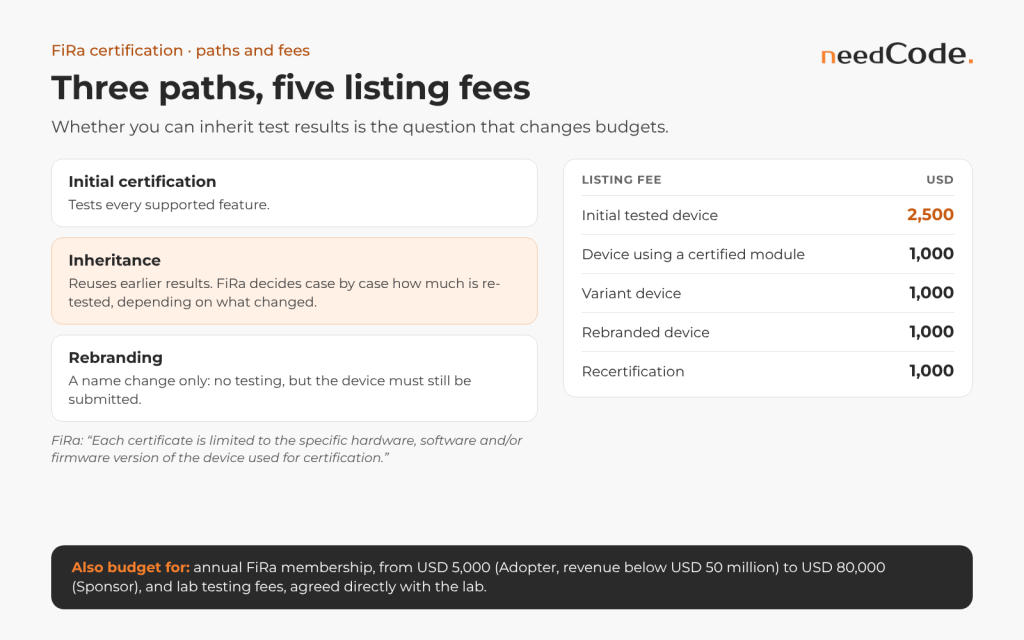
This is the question that changes budgets. FiRa’s FAQ answers it:
- “A device that incorporates a previously-certified device may inherit all or part of its certification test results. Which test results are inherited and how much re-testing is required, if any, is determined by FiRa on a case-by-case basis and depends on the scope of the changes made to the certified device.”
- “Each certificate is limited to the specific hardware, software and/or firmware version of the device used for certification.”
- “You may not claim that your device is FiRa Certified unless the device has been certified.”
FiRa offers three paths. Initial certification tests every supported feature. Inheritance reuses earlier results. Rebranding covers a name change only, with no testing, but the rebranded device must still be submitted.
The DWM3001C listing shows why inheritance is rarely automatic: the module was certified with a dedicated certification build, while your product runs your own firmware with your own features. Thread works differently, as end products on Thread Certified Components can often skip testing; plan FiRa as a separate certification with its own scope.
Read the base certificate first
Ask the supplier for the certificate itself, because FiRa’s public list “may not represent a full listing”. Then check:
- Category and type: “Chipset” or “Module”, and a type such as “Rebranded”, as on the PPM21DQ certificate.
- TRSL version and exemptions: which test list applied and what was exempted.
- Versions: listings separate the end product from the “FiRa UWB Compliant Portion”. The Murata Type 2BP module listing gives “SW version : same as NXP SR150 RFP1”, chip firmware certified two months earlier.
- Features: results exist only for the features and roles that were tested.
| Your situation | Likely path | Listing fee (USD) |
|---|---|---|
| New design or new UWB stack | Initial certification | 2,500 |
| Product built on a certified module | Device using a certified module; inheritance case by case | 1,000 |
| Variant of your certified device | Variant; inheritance case by case | 1,000 |
| Same device under a new name | Rebranded; identify the original device | 1,000 |
| Changed firmware or hardware, or added features | Recertification; results “may be inherited” | 1,000 |
The process, step by step
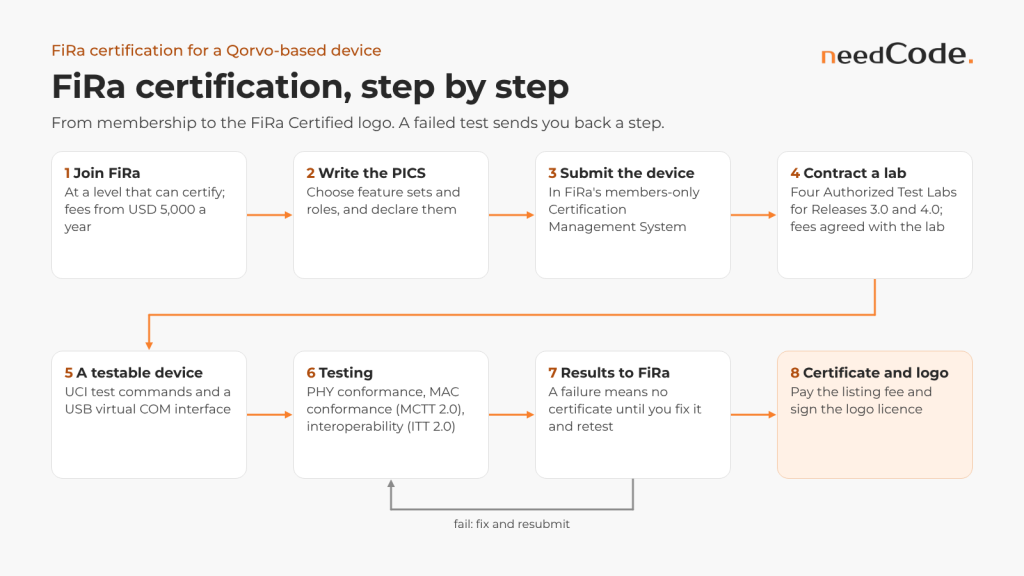
- Join FiRa at a level that can certify: Sponsor, Contributor, Associate, Adopter or Affiliate. FiRa publishes annual fees, from USD 5,000 for an Adopter with revenue below USD 50 million to USD 80,000 for a Sponsor. Affiliate membership has no fee but is limited to companies related by majority ownership to a Sponsor or Contributor. Rights start only once FiRa accepts the application and the fee is paid, and the form binds the company to FiRa’s Bylaws and Intellectual Property Rights Policy.
- Choose feature sets and roles, and write the Protocol Implementation Conformance Statement (PICS) that declares them.
- Submit the device through FiRa’s members-only Certification Management System (CMS) with contact details, device information and the PICS. FiRa’s public pages name only the PICS; none mentions a PIXIT.
- Contract an Authorized Test Lab. FiRa lists four for Releases 3.0 and 4.0: CAICT and SRTC in China, DT&C and TTA in South Korea. All four list every 4.0 feature, from TWR to Aliro UWB. Testing fees are agreed directly with the lab.
- Provide a testable device. FiRa’s test specifications include a UCI extension with test commands and a USB virtual COM interface between the test platform and the device under test. The interoperability tool also needs your settings: “The DUT vendor should provide instructions for how to use the UCI to set all of the parameters.”
- Testing with FiRa Validated Test Tools: PHY conformance on instruments from Keysight, LitePoint, Welzek, Rohde & Schwarz or NI, MAC conformance with NAYUQA’s MCTT 2.0 and interoperability with its ITT 2.0.
- Results go to FiRa. If the device fails, “a Certificate of Conformance will not be issued”; you can fix the failures and resubmit for retesting.
- Certificate and logo. After a pass, pay the listing fee, receive the Certificate of Conformance and sign the license agreement to use the FiRa Certified logo.
| Listing fee | USD |
|---|---|
| Initial tested device | 2,500 |
| Device using a certified module | 1,000 |
| Variant device | 1,000 |
| Rebranded device | 1,000 |
| Recertification | 1,000 |
What the test benches look like
Labs pass an on-site audit to be authorised and may use only validated tools. The set-ups show what your sample must expose:
| Test | Validated tools (4.0) | Set-up |
|---|---|---|
| PHY conformance | Keysight VXT M941xA, LitePoint IQgig-UWB and IQgig-UWB+, Welzek T6290F, R&S CMP 200, NI VST PXIe-5842 | Tester cabled to the device’s RF port; a PC drives the device over UCI |
| MAC conformance | NAYUQA MCTT 2.0 | A PC plus ranging devices that talk to the device over UWB |
| Interoperability | NAYUQA ITT 2.0 | One ITT capture device plus 1 to 8 reference devices |
Comarch, which developed MCTT 2.0 and ITT 2.0 (FiRa now lists NAYUQA as vendor), says the ranging devices “simulate FiRa devices interacting with DUT”, with “between 3 and 5 units” under MAC Test Specification 2.0. The ITT device only captures frames; the tool “will use the UCI to configure the DUT and each reference device”.
The Rohde & Schwarz PHY test list covers packet format, spectral mask, carrier frequency tolerance, pulse timing, baseband impulse response and transmit signal quality (NRMSE), then sensitivity, first path dynamic range, received packet format and a “dirty packet test”, which LitePoint describes as checking “the receiver’s capability to detect malformed packets”.
Preparing a Qorvo-based device for the lab
The tools need UCI with the test extension over USB, a way to reach the RF port, and firmware that will not change after testing.
UCI test mode
Qorvo’s public QM35 SDK shows FiRa’s test extension on Qorvo firmware. Tests run in a session of type 0xD0 (“Test Mode”) using group 0x0D: TEST_CONFIG_SET (0x00), TEST_CONFIG_GET (0x01), TEST_PERIODIC_TX (0x02), TEST_PER_RX (0x03), TEST_RX (0x05), TEST_LOOPBACK (0x06) and TEST_STOP_SESSION (0x07), which Qorvo’s UCI specification calls “Stop PCTT session”. Qorvo’s TX tutorial on QM33 hardware logs the same group: “gid:13, oid:2”.
Order matters. A test command “SHALL be issued only after applying all required configuration parameters”, with the session in SESSION_STATE_IDLE; otherwise the device returns STATUS_ERROR_SESSION_NOT_CONFIGURED (0x15). The illustrative exchange below uses Qorvo’s public definitions: fields are little-endian, a control packet starts with a two-octet header, a reserved octet and the payload length, and the handle comes from SESSION_INIT_RSP (0 in Qorvo’s log).
20 02 00 00                   CORE_GET_DEVICE_INFO_CMD
21 00 00 05 00 00 00 00 D0    SESSION_INIT_CMD: session ID 0, type 0xD0 (Test Mode)
2D 00 00 11 00 00 00 00 02    TEST_CONFIG_SET_CMD: handle 0, 2 parameters
   00 04 E8 03 00 00            NUM_PACKETS = 1000
   01 04 D0 07 00 00            T_GAP = 2000 us
21 03 00 ..                   SESSION_SET_APP_CONFIG_CMD: channel, preamble, SFD, PRF
2D 02 00 ..                   TEST_PERIODIC_TX_CMD: payload = PSDU
4D 02 00 01 00                TEST_PERIODIC_TX_RSP: status 0x00 (OK)
6D 02 00 01 00                TEST_PERIODIC_TX_NTF: NUM_PACKETS frames sent
2D 07 00 00 TEST_STOP_SESSION_CMD| Parameter (ID) | Unit | Qorvo default | Used by |
|---|---|---|---|
| NUM_PACKETS (0x00) | packets | 1000 | Periodic TX, PER RX |
| T_GAP (0x01) | µs, start to start | 2000 | Periodic TX, PER RX |
| T_START (0x02) | µs to SFD found | 450 | PER RX |
| T_WIN (0x03) | µs window, above T_START | 750 | PER RX |
| RANDOMIZE_PSDU (0x04) | 0 or 1 | 0 | Periodic TX, PER RX |
The PSDU can be 0 to 127 octets in BPRF and 0 to 4,095 in HPRF. PER results arrive as counters, from ATTEMPTS and SFD_FOUND to PSDU_DEC_ERROR and STS_FOUND, which show where frames are lost. Keep Qorvo’s separate “Hardware test mode” out of the lab flow: leaving it “triggers a reboot of the device”.
RF access
The validated PHY set-ups are cabled: Rohde & Schwarz connects through a combiner “to the antenna port of the device under test”, and LitePoint wires the TX/RX ports to the tester, with control over “UCI vCOM” and power through GPIO. Qorvo’s TX tutorial uses a QM33120WDK1 board “with antenna removed” and does not recommend the DWM3001CDK or Murata Type 2AB EVB without an over-the-air set-up, because their antennas are on the board. So:
- build conducted samples with a connector at every antenna port under test; AoA designs have several;
- with an integrated-antenna module such as the DWM3001C, agree early whether PHY tests run over the air, and ask FiRa which module results you can inherit;
- let the lab power-cycle and reset the device remotely; the MCTT has a separate DUT connection for automation such as switching the device on and off.
The certification build
The certificate follows the build you choose:
- One image with test mode: the shipped firmware keeps the UCI test group behind the test port, so the certificate names what you ship. This suits end products.
- A dedicated certification image: easier, but each certificate covers the exact version tested, as with “DWM3001C_FIRA_CERTIFICATION_1_0_0”. This suits chips and modules whose customers write their own firmware.
On DW3_QM33 SDK hardware, the test commands live in the UCI application: since SDK 1.0.0, continuous transmission is “no longer possible” with the default CLI application. If a host drives the UWBS over SPI, as Qorvo’s high-speed SPI protocol allows on the QM35, the test build still has to expose UCI on a USB VCOM port. For each sample, archive what UQT’s get_device_info prints: the UCI, MAC, PHY and “uci test” versions and the build identifier.
Pre-conformance on the bench
Rohde & Schwarz markets its validated tester for “preconformance testing”, but a spectrum analyser, a second board and Qorvo’s UWB Qorvo Tools (UQT), provided “as UCI examples”, can catch many PHY problems before the lab. In order:
- Calibration: load_cal, then read back with get_cal; pass if values match the unit’s record. Reload after Qorvo’s loopback self-test, which warns “your default calibration and configuration will be erased”.
- Capabilities: get_cap (CORE_GET_CAPS_INFO); pass if every role, ranging method and STS mode in the PICS is reported.
- Transmitter: one frame per millisecond (–t-gap 1000) into a spectrum analyser set as in Qorvo’s tutorial: RBW = VBW = 1 MHz, average detector, 2 GHz span, 2001 points, 2 s sweep, centre 6.4896 GHz (channel 5) or 7.9872 GHz (channel 9). Pass: the IEEE mask for 2 ns pulses, 10 dB down from 325 MHz and 18 dB down beyond 400 MHz off centre, and the regulatory PSD limit. On the DW3_QM33 SDK, each tx_power_index step is 0.25 dB.
- Frequency: Qorvo’s CW test, which “may be of use as part of crystal trimming procedure”; pass within ±20 ppm, then store xtal_trim.
- Receiver: start PER RX first, as it waits for the first frame, then transmit from a reference board through a calibrated attenuator. Pass: PER below 1% at the target level. At 1,000 packets that is 10 lost frames, so use more near the limit.
- Interoperability: range against another vendor’s device with the PICS configuration, ideally at a Plugfest.
The two test scripts default to 9,000 and 1,000 packets and to different PSDUs, and TEST_PER_RX_CMD carries PSDU data too, so set both. An illustrative sensitivity run, unit under test in one shell and reference board in another:
export UQT_PORT=/dev/ttyUSB0      # unit under test; UQT's default port
get_device_info                   # archive UCI, MAC, PHY and test versions
get_cap                           # compare reported capabilities with the PICS
load_cal -f unit_0042.json        # this unit's calibration
get_cal ant0.ch9.ref_frame0.tx_power_index -fx
# shell 1, unit under test: receiver first, it waits for the first frame
run_fira_test_per_rx -c 9 --num-packets 5000 --t-gap 2000 --psdu 0a.0b.0c
# shell 2, reference board through the attenuator: same channel, timing and PSDU
run_fira_test_periodic_tx -p /dev/ttyUSB1 -c 9 --num-packets 5000 \
    --t-gap 2000 --psdu 0a.0b.0c
Test events and Plugfests: rehearse before the lab
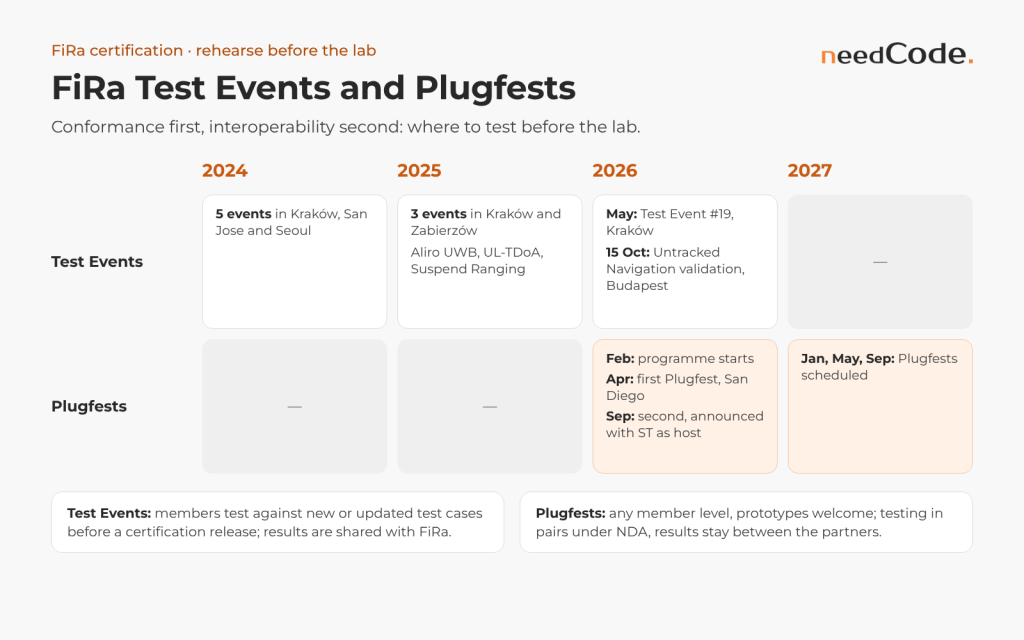
FiRa runs two kinds of events. At Test Events, members test devices against new or updated test cases before a certification release; the results refine the specifications and validate the test tools, and they are shared with FiRa. Many recent ones took place in Poland:
- 2024: five events, in Kraków, San Jose and Seoul;
- 2025: three events, in Kraków and Zabierzów, covering Aliro UWB, UL-TDoA and Suspend Ranging;
- 2026: Test Event #19 in Kraków in May, and an Untracked Navigation Profile Validation Event in Budapest on 15 October.
For an interoperability event in November 2024, FiRa expected devices “to pass MAC Conformance Tests for the DUT supported features in advance”. Conformance first, interoperability second.
Plugfests started in February 2026. Members at any level can attend, prototypes and development boards are welcome, and testing happens in pairs under NDA, with results kept between the partners. The first took place in San Diego in April 2026, a second was announced with ST as host for September 2026, and FiRa has scheduled further Plugfests for January, May and September 2027, hosted by Eforthink in Asia, LitePoint in San Jose and Infineon in Graz.
Registration collects “device roles, supported features, and profile capabilities” for pairing. FiRa warns two weeks ahead if it cannot match you and sends the schedule a week before. It provides no test equipment unless an event states otherwise, so bring your own tools, including a sniffer.
Where the time goes
FiRa publishes no statistics on failures or durations. The programme rules, the test content and Qorvo’s tooling still show where projects lose weeks:
| Symptom | Likely cause | How to confirm | Fix |
|---|---|---|---|
| Lab cannot start PHY tests | No UCI test group or USB VCOM in the build | Open a 0xD0 session and send TEST_CONFIG_SET from a PC | Ship a build with the UCI test group |
| Test commands return 0x15 | Test sent before configuration | UCI log: did each configuration step return 0x00? | Init, test config, app config, then the test |
| Spectrum mask or power fails | Uncalibrated TX power, antenna or matching | Periodic TX into a spectrum analyser | Calibrate per unit; Qorvo states that “you must perform TX power calibration” for regulatory certification |
| Carrier frequency fails | Crystal not trimmed | CW test and frequency counter | Trim xtal_trim per unit |
| Sensitivity fails | TX and RX settings or PSDU differ; RF path loss | PER counters: SFD_FOUND against ATTEMPTS, PSDU_DEC_ERROR | Match settings; check the front end |
| Declared feature fails | PICS claims more than the firmware does | get_cap and SDK release notes against the PICS | Drop the claim or implement it |
| Interoperability failure | Session parameters differ | Compare both devices’ UCI configuration; sniffer capture | Match parameters; retest at a Plugfest |
| Firmware changed after testing | “Any changes made to a previously-certified device will require re-certification” | Shipped version against the certificate | Freeze the build; budget recertification |
A UWB sniffer helps with most of these rows. When a test fails, a capture shows which frame or field broke, instead of a pass/fail line in a report. For interoperability failures, a Qorvo engineer on the forum suggested capturing “the UCI messages used to configure” each device and comparing them.
Planning the timeline
Without public durations, plan by gates, each with an exit check:
- Membership: accepted, paid, CMS login working.
- Scope: release, TRSL version and PICS fixed; inheritance question sent to FiRa.
- Build: certification build tagged, versions archived.
- Pre-conformance: bench results inside the limits, capabilities matching the PICS.
- Lab: booked; samples, cables and UCI instructions agreed.
- Results: at least one fix-and-retest loop planned.
- Listing: fee paid, certificate received.
Gates 3 and 5 can overlap: contract the lab while pre-conformance runs.
Pre-certification checklist
- Membership accepted and paid; IPR Policy reviewed.
- Target release and its TRSL version chosen.
- PICS limited to what the firmware implements; get_cap output matches it.
- Base certificate’s CRN, TRSL version and exemptions reviewed with FiRa.
- Certification build tagged; get_device_info output archived per sample.
- A 0xD0 session accepts TEST_CONFIG_SET with status 0x00 over USB VCOM.
- Conducted samples or an agreed over-the-air set-up; remote power and reset.
- tx_power_index and xtal_trim stored per unit and read back.
- Spectrum inside the mask and the regulatory PSD limit; carrier within ±20 ppm.
- PER below 1% at the target level over several thousand packets.
- One interoperability session against another vendor’s device.
- Written UCI parameter instructions for the lab.
Related certifications are separate
- CCC Digital Key: “FiRa offers certification only for the UWB portion of the CCC Digital Key product.” The CCC programme certifies the whole product and has covered Bluetooth LE and UWB since March 2025.
- Aliro: the same rule applies; FiRa certifies only the UWB portion, and the Connectivity Standards Alliance certifies Aliro 1.0 products, released in February 2026, through its own test labs.
- Radio regulation: FCC, ISED and CE under the Radio Equipment Directive are separate approvals with their own tests. FiRa’s mask is relative; the absolute limit is regulatory, for example −41.3 dBm/MHz under ETSI EN 302 065.
From our engineering work
needCode engineers represented Qorvo at 5+ FiRa interoperability test events on two continents as an active FiRa contributor, and built the MAC layer to the FiRa specification inside Qorvo’s UWB programme. We run FiRa, CCC, CSA and Bluetooth SIG work as one managed stage, which has shortened certification timelines by up to 40%.
How needCode helps
We prepare Qorvo-based devices for FiRa certification: feature and role selection, the PICS, certification firmware with test interfaces, per-unit calibration, pre-conformance runs and sniffer-based debugging. We take prototypes to Plugfests and test events, manage the lab process, and plan recertification for future firmware releases, together with CCC, Aliro and radio approvals where your product needs them.
Frequently asked questions
How does FiRa certification work for a UWB device?
A FiRa member submits the device and its PICS through FiRa’s certification system, contracts one of FiRa’s Authorized Test Labs, and the lab runs conformance and interoperability tests with FiRa-validated tools. If the device passes, the member pays the listing fee and receives a Certificate of Conformance and the right to use the FiRa Certified logo.
If my chip or module is FiRa certified, is my device certified too?
No. FiRa states that a device built on a certified device “may inherit all or part of its certification test results”, decided “on a case-by-case basis”. You may not call your product FiRa Certified until it has been certified itself, and each certificate covers one exact hardware and firmware version.
How much does FiRa certification cost?
Three parts add up: FiRa membership at a level that can certify (from USD 5,000 a year for a small Adopter), the lab’s testing fee, which you agree with the lab, and the listing fee of USD 2,500 for an initial device or USD 1,000 for a device using a certified module, a variant, a rebrand or a recertification.
How long does FiRa certification take?
FiRa publishes no typical duration. In practice the schedule depends on readiness: a correct PICS, test interfaces, calibrated radios and a firmware build frozen for testing. Plan time for at least one fix-and-retest loop.
What are FiRa test events and Plugfests?
Test Events are FiRa working-group events where devices are tested against new test cases before a certification release, with results shared with FiRa. Plugfests, started in 2026, are pairwise interoperability sessions for members, open to prototypes, with results kept confidential between partners.
Does FiRa certification cover CCC Digital Key or Aliro?
Only the UWB portion. CCC certifies Digital Key products and the Connectivity Standards Alliance certifies Aliro products in their own programmes.
What does the test lab need from a Qorvo-based device?
The lab needs UCI with FiRa’s test extension on the USB virtual COM interface, cabled access to each RF port the PHY tests use or an agreed over-the-air set-up, per-unit calibration, a frozen firmware build with recorded versions, and written instructions for setting every parameter through UCI.
What PHY limits should we pre-test against?
FiRa’s pass criteria sit in its members-only PHY test specification, built on IEEE 802.15.4 HRP requirements: a −10 dBr mask from 325 MHz and −18 dBr beyond 400 MHz off centre for 2 ns pulses, ±20 ppm on carrier and chip clock, pulse cross-correlation of at least 0.8 (main lobe) and at most 0.3 (side lobes), and sensitivity at PER below 1%.
Sources
- FiRa Certification Program and Certification FAQ
- FiRa Certification Process Overview (steps and listing fees) and membership information
- FiRa Authorized Test Labs, Validated Test Tools and Test Specifications
- FiRa Certified Devices, with the DWM3001C, QM35725 and QM35825 listings
- FiRa Certification Program 2.0 (December 2023), Core 3.0 (January 2025) and Core 4.0 (December 2025)
- FiRa Plugfests launch (February 2026), Plugfest FAQs and events
- FiRa Test Event on interoperability validation (November 2024) and Core Test Event #19 (May 2026)
- Qorvo Tech Forum: DW3_QM33 SDK v1.0.2 and FiRa compliance (2024) and compliance with the FiRa MCTT (December 2024)
- Qorvo Tech Forum: tutorial on TX spectrum and TX power calibration (2025)
- LitePoint: “UWB Certification: Why it Matters and How it’s Tested” (2022) and Rohde & Schwarz: FiRa certification with the CMP200
- Thread Group: certification
- CCC Digital Key certification update (March 2025) and CSA: Aliro 1.0 (February 2026)
- FiRa: Purchase Specifications (technical and test specifications, versions and prices)
- FiRa certificates CRN22007 (DWM3001C), CRN23003 (QM35725) and CRN25007 (QM35825)
- FiRa listings: Murata Type 2BP, NXP Trimension SR150 RFP1 and Pinpoint PPM21DQ, with the CRN24005 certificate
- FiRa Consortium member application (November 2025)
- FiRa, LitePoint and Comarch webinar: “What you need to know about FiRa Certification for UWB-enabled devices” (March 2022)
- Comarch: MAC Conformance Test Tool case study (2022) and FiRa 2.0 test tools case study (2024)
- LitePoint: FiRa UWB PHY Conformance Test Solution brochure (2021)
- Rohde & Schwarz white paper: High rate pulse ultrawideband physical layer testing and certification (2021)
- Qorvo QM35 SDK on GitLab: UWB Qorvo Tools, FiRa test scripts, CW test, device scripts and QM35825DK calibration file
- Qorvo QM35 SDK: uci_spec_fira.h, UWB Command Interface (UCI) Specification R12.34.0 (July 2025) and Release Notes 3.0.0 (July 2025)
- Qorvo Tech Forum: data transfer in the DW3_QM33 SDK (February 2025)
- tcpdump: LINKTYPE_FIRA_UCI (UCI packet format)
About needCode
needCode is an independent embedded engineering company from Kraków, Poland, and an official UWB business partner of Qorvo. Its engineers have worked inside Qorvo’s wireless programmes for more than eight years, including on the public QM35 SDK. needCode is certified to ISO 9001:2015 and ISO/IEC 27001:2022 and is a member of the UWB Alliance. This article does not represent Qorvo. All trademarks belong to their respective owners.