
Facts checked on 16 October 2026
Short answer
Skyworks completed its combination with Qorvo on 5 October 2026. The company continues as Skyworks; Qorvo’s former entity is now Qorvo Technologies, LLC. Neither the closing announcement nor the related filings mention ultra-wideband (UWB) or Qorvo’s Connectivity and Sensors Group, so no product-line change has been announced.
Public facts are enough to act on: Qorvo narrowed its UWB focus to automotive, industrial and enterprise markets in 2025, and several UWB and QPG parts are now NRND or end of life. Respond with a product-level risk review, not a redesign.
Timeline: what happened and when
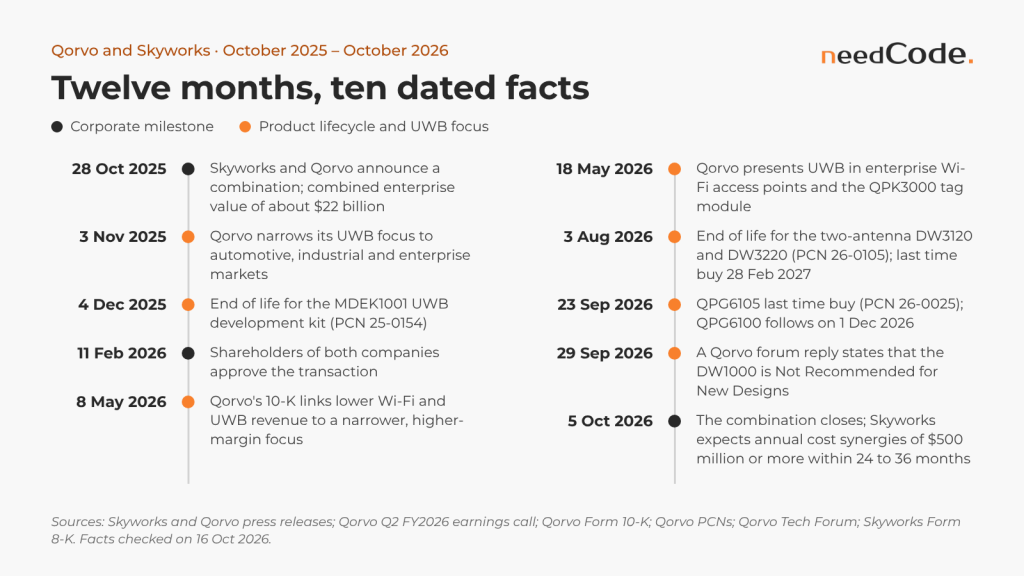
| Date | Event | Source |
|---|---|---|
| 28 Oct 2025 | Skyworks and Qorvo announce a combination valuing the combined enterprise at about $22 billion; Qorvo shareholders to receive $32.50 in cash and 0.960 Skyworks shares per Qorvo share | Skyworks/Qorvo press release |
| 3 Nov 2025 | Qorvo says it is “narrowing our focus in ultra-wideband opportunities to automotive, industrial, and enterprise markets” and “reducing our spend related to mobile and consumer applications” | Q2 FY2026 earnings call |
| 4 Dec 2025 | End of life for the MDEK1001 UWB development kit (PCN 25-0154) | Qorvo PCN |
| 11 Feb 2026 | Shareholders of both companies approve the transaction | Qorvo Form 10-K |
| 8 May 2026 | Qorvo’s annual report links lower Wi-Fi and UWB revenue to its “decision to strategically narrow our focus on a higher margin portfolio” | Qorvo Form 10-K, fiscal 2026 |
| 18 May 2026 | Qorvo presents UWB in enterprise Wi-Fi access points and the QPK3000 tag module | Qorvo press release |
| 3 Aug 2026 | End of life announced for the two-antenna DW3120 and DW3220 (PCN 26-0105); last time buy 28 Feb 2027 | Qorvo product pages |
| 23 Sep 2026 | Last time buy for the QPG6105 (PCN 26-0025); QPG6100 (PCN 26-0071) follows on 1 Dec 2026 | Qorvo product pages |
| 29 Sep 2026 | A Qorvo forum reply states that the DW1000 is Not Recommended for New Designs | Qorvo Tech Forum |
| 5 Oct 2026 | The combination closes; Skyworks expects annualised cost synergies of $500 million or more within 24 to 36 months | Skyworks press release and Form 8-K |
What we know
The deal. Skyworks completed the combination on 5 October 2026 on the announced terms of $32.50 in cash plus 0.960 Skyworks shares for each Qorvo share. Phil Brace continues as chief executive officer and president of Skyworks. The board has eleven seats, three of them held by former Qorvo directors: Robert A. Bruggeworth, Richard L. Clemmer and Christopher R. Koopmans. The surviving Qorvo entity changed its name to Qorvo Technologies, LLC.
The strategy before the deal. On the November 2025 earnings call, Qorvo’s then chief executive said the company was restructuring its Connectivity and Sensors Group (CSG) “to increase our focus on our top opportunities and improve profitability”. He added that Qorvo was narrowing its UWB focus to automotive, industrial and enterprise markets and reducing spend on mobile and consumer applications, which he described as “more fragmented today”. He also mentioned UWB supply to tier-one makers of Wi-Fi 7 access points and collaboration with “a large automotive tier one”.
The numbers. Qorvo’s fiscal 2026 annual report (year ended 28 March 2026) shows CSG revenue falling from $472.5 million to $421.7 million. It attributes the decrease mainly to “a $48.7 million decrease in revenue for our Wi-Fi components and UWB solutions, driven by our decision to strategically narrow our focus on a higher margin portfolio”. In March 2026 Qorvo also recorded CSG impairments of $36.5 million of goodwill and $45.9 million of intangible assets, “due to slower than expected market adoption for certain technologies”.
Continued investment in the focus markets. Qorvo kept shipping UWB products and software for its chosen segments in 2026. It presented UWB built into enterprise Wi-Fi access points with the QPK3000 tag module, and it published an Aliro SDK for the QM35 on GitLab (versions 1.0.0 and 1.1.0, June 2026).
Lifecycle changes. Several older parts are being phased out: the MDEK1001 kit is end of life, the DW1000 is NRND, and the two-antenna DW3120 and DW3220 have an end-of-life notice. The QPG6105 and QPG6100 (PCN 26-0025 and 26-0071) also have end-of-life notices, and the QPG6200J is listed as discontinued.
What we don’t know, and what not to assume
The closing announcement and the Form 8-K filings do not mention UWB or the Connectivity and Sensors Group. No public statement describes how the combined company will organise, prioritise or support Qorvo’s connectivity products. Skyworks has set a cost-synergy target of $500 million or more within 24 to 36 months, but it has not said where those savings will come from.
Two assumptions are equally unsafe:
- “Qorvo UWB is going away.” There is no public basis for this. Qorvo narrowed its UWB focus; it did not exit UWB, and it launched new UWB products and software in 2026.
- “Nothing changes for us.” Integration programmes, cost targets and a narrower focus usually change support priorities, roadmaps and part lifecycles over time. Products outside the stated focus markets should expect to carry more of their own engineering.
Who is most exposed?
| Your product | Exposure | Suggested stance |
|---|---|---|
| UWB in automotive, industrial or enterprise | In Qorvo’s stated focus markets | Monitor PCNs and roadmaps; keep your engineering depth current |
| UWB in consumer or mobile products | Outside the stated focus | Plan for more self-reliance in support, SDK maintenance and certification |
| Products on the DW1000 (including DWM1000 and DWM1001C modules), MDEK1001-based tooling, DW3120 or DW3220 | NRND or end-of-life notices for the chip or kit | Decide now: migrate, buy stock or retire |
| Matter, Zigbee or Thread products on the QPG6100 or QPG6105 | End of life; the QPG6105 last time buy date has passed | Decide now: check remaining stock or migrate |
| Matter, Zigbee or Thread products on the QPG6200L | In production; no public change | Track PCNs and SDK releases; keep certification and OTA capability in-house or with a partner |
A 12-point checklist for Qorvo-based products
| # | Area | Question to answer | Evidence to collect |
|---|---|---|---|
| 1 | Parts | Which Qorvo parts and modules are in every product, and what is their lifecycle status? | BOM export with part numbers, lifecycle status and PCN subscriptions |
| 2 | Parts | Where are you exposed to a last time buy? | Demand forecast against stock and PCN dates |
| 3 | Parts | What is the migration path for each part at risk? | Candidate target parts and porting estimates |
| 4 | Software | Which SDK versions do you ship, and do you have source code or only binaries? | SDK inventory with versions, licences and binary components |
| 5 | Software | Can you rebuild every shipped firmware version from source today? | Reproducible build on a clean machine |
| 6 | Software | Which features depend on vendor examples that may not be maintained? | List of example-derived code and its owners |
| 7 | Support | Who answers your hardest technical questions, and how fast? | Current support channels, escalation path and response times |
| 8 | Support | Where does critical knowledge sit in your team? | Bus-factor map for radio, firmware and certification topics |
| 9 | Compliance | Are you ready for the Cyber Resilience Act? | SBOM, vulnerability handling process, support period, reporting playbook |
| 10 | Compliance | Which certifications would a part or SDK change trigger? | FiRa, CCC, CSA, Bluetooth and CE/RED records with re-test rules |
| 11 | Roadmap | Which standards will your product need in the next three years? | Plan for FiRa 3.0, IEEE 802.15.4ab, Aliro and Matter updates |
| 12 | Governance | Who reviews these answers, and how often? | A named owner and a quarterly review date |
Download the 12-point checklist as a two-page PDF
Items 1, 2 and 9 are urgent for most teams. CRA reporting obligations have applied since 11 September 2026, and an end-of-life notice normally leaves about six months to place a last time buy.
Steps and owners for each item
- Parts. Export the BOM of every variant, including modules and production-test kits, with each part’s status from its Qorvo page, an aggregator and PCNs. Owner: hardware lead.
- Last time buy. For each part in Last Time Buy or NRND, size the buy against demand, stock and open orders. Owner: supply chain manager.
- Migration. List in-family and second-source candidates with the board, firmware and certification changes each needs. Owner: system architect.
- SDK inventory. Record the SDK version, each component’s revision, every binary with its SHA-256 and every licence. Owner: firmware lead.
- Rebuild. Restore each supported release from its archive on a clean machine and compare hashes with the released image. Owner: release engineer.
- Examples. Diff product code against the unmodified SDK example it came from; give each difference an owner and a reason. Owner: firmware lead.
- Support. Measure response times per channel and agree an escalation path for field-critical defects. Owner: engineering manager.
- Knowledge. For radio configuration, calibration, production test, signing keys and certification, name everyone who can work unaided; one name is a risk. Owner: engineering manager.
- CRA. Generate an SBOM for every release in CI, set each product’s support end date (month and year) and rehearse the 24-hour and 72-hour reports. Owner: product security lead.
- Certification. Map each planned change to the certificates it touches. FiRa states that “any changes made to a previously-certified device will require re-certification”, and Matter FastTrack recertification covers only basic software updates. Owner: certification lead.
- Standards. Record which products need FiRa 3.0, IEEE 802.15.4ab, Aliro or newer Matter releases, and which parts support them today. Owner: product manager.
- Governance. Review the risk register quarterly and after every PCN or SDK release; IEC 62402 sets requirements for such obsolescence management. Owner: CTO or head of R&D.
How to monitor PCN and end-of-life notices
Qorvo sends notices through its free PCN alert service. Its PCN policy (POL-000006, revision F) says Qorvo procedures “require 90 day advance notification of Process/Product Changes” and give “6 months advance notice for last time buy and 12 months for last time ship for EOL notifications”, although unavoidable circumstances may shorten them.
Log the same fields from every notice:
- Type: Major, Minor or Obsolescence, and whether form, fit, function or reliability is affected.
- Dates: last time buy and last time ship; the DW3120 and DW3220 pages give only the first, so ask for the second.
- Response: PCN 25-0154 asks for acknowledgement within 30 days; without it, the change counts as accepted.
- Replacement: often none is named, as for the MDEK1001, DW3120, QPG6100 and QPG6105.
Cross-check, because status data lags. On 16 October 2026 the DW1000 page still showed “Production”, although a Qorvo forum reply of 29 September 2026 says it is NRND and that “the website has not been updated yet”. Nexar, an aggregator, returns a normalised lifecyclestatus (EOL, NRND, New, Obsolete or Production) from the manufacturer, a distributor or a third party, plus the raw manufacturerlifecyclestatus. An illustrative query adapted from Nexar’s documentation:
query LifecycleSpec {
  supSearchMpn(q: "DW3220", limit: 2) {
    results {
      part {
        mpn
        specs {
          attribute { shortname }
          displayValue
        }
      }
    }
  }
}
Run it weekly for every BOM line; any change, or any disagreement between the product page, the aggregator and your BOM, opens a review.
Sizing a last time buy
Last time buy orders are non-cancellable and non-returnable, so the quantity is a one-way decision. CALCE research (University of Maryland) frames it as a trade-off between “procurement cost, inventory cost, disposal cost, and penalty cost”: surplus costs storage and scrap; shortage costs broker prices, a redesign or lost sales. An illustrative formula:
LTB = build demand until the replacement ships
    + service spares for the support period
    + yield loss + safety margin
    - usable stock - open orders     (round up to the order multiple)
Illustrative example with assumed figures: a DW3220 anchor, last time buy 28 February 2027.
| Input | Assumption | Parts |
|---|---|---|
| Build demand | 800 a month for 12 months until the redesign ships | 9,600 |
| Service spares | 1% of 20,000 units a year for 5 years | 1,000 |
| Yield loss | 2% of build demand | 192 |
| Safety margin | 20% of build demand | 1,920 |
| Stock and open orders | 1,500 on hand, 1,000 on order | −2,500 |
| Last time buy | Before rounding | 10,212 |
Repeat it for low and high demand and weigh surplus against shortage. Then decide: retire if sales end before the last shipment and stock covers repairs; buy if a last time buy covers the remaining life; migrate if demand, features, certifications or the CRA support period run beyond what you can buy.
The DW3000 datasheet rates WLCSP parts at moisture sensitivity level 1, while QFN parts “are qualified as MSL-1 but packaged/shipped as MSL-3”. Under JEDEC J-STD-020, as summarised by TI, level 1 has unlimited floor life and level 3 allows 168 hours at 30 °C and 60% relative humidity after the dry bag is opened; then parts need baking before reflow. Keep stock in sealed lots and log every bag opening.
Scoring risk per product
Rate likelihood and impact from 1 to 5 on evidence, and multiply. NIST SP 800-30 combines five-level likelihood and impact scales into a risk level; these scales adapt the idea to supply and support.
| Score | Likelihood of disruption within three years | Impact if it happens |
|---|---|---|
| 5 | End-of-life notice, Last Time Buy or Discontinued | No alternative; redesign and full re-certification |
| 4 | Not Recommended for New Designs | Board respin and re-certification |
| 3 | In production, but your market is outside the vendor’s stated focus | Firmware port to a same-SDK part; partial re-test |
| 2 | In production, inside the stated focus markets | Configuration change and regression tests |
| 1 | In production, with a qualified alternative | Nothing within the product’s remaining life |
Act within the quarter on 15 or more, budget mitigation from 8 to 14 and monitor below 8. Illustrative scores: 20 for a DW3220 anchor that needs a respin, 16 for a DW1000 tag and 8 for a QM33120W industrial anchor.
Reviewing SDK licences and source access
For each SDK and binary, check permitted chips, modification and redistribution rights, support, termination, source access and bundled open-source licences. In Qorvo’s public QM35 SDK 3.0.0:
- Its licence agreement grants a “non-exclusive, non-transferable worldwide, revocable, limited” licence for products that operate “exclusively with a Qorvo Device”, and gives no entitlement to support.
- 402 of the 437 files with an SPDX tag use
LicenseRef-QORVO-2, which permits use only “with an integrated circuit developed by Qorvo” or a module containing one. - 76 C files carry no tag: 44 Linux driver files offering GPLv2 “as well as” a Qorvo commercial licence, and 32 Cherry files with a proprietary notice.
- The QM35825 firmware is a binary whose revision (R13.1.0) the release notes list separately from the SDK version.
For DW3000 and QM33 products, developers on Qorvo’s forum reported in 2024 that the DW3xxx driver was available only as a compiled library for Cortex-M4 and M33. One post names the SDK v1.1.1 FiRa stack as libuwbstack_bundle_fira_arm-cortex-m4-hard_floating_rtos_R12.7.0-00405-gb33c5c42726c.a. Record the core, float ABI and build identifier in such names: they limit your choice of host MCU.
An illustrative first pass, run in the SDK root:
# SPDX identifiers, counted
grep -rhoE "SPDX-License-Identifier: [^*]+" --exclude-dir=.git . \
  | sed 's/[[:space:]]*$//' | sort | uniq -c | sort -rn
# C sources without a tag: read their headers by hand
find . -path ./.git -prune -o -type f -name '*.[ch]' -print0 \
  | xargs -0 grep -L "SPDX-License-Identifier"
# Hash every binary you ship
find . -path ./.git -prune -o -type f \( -name '*.a' -o -name '*.bin' \) \
  -print0 | xargs -0 sha256sum
Then run a licence scanner such as ScanCode Toolkit. The QM35 licence texts do not mention source escrow; if your support period depends on vendor binaries, negotiate source access and have counsel review the terms.
Archiving firmware you can rebuild
Reproducible-builds.org calls a build reproducible when “any party can recreate bit-by-bit identical copies of all specified artifacts” from the same source, environment and instructions. For each release still in the field, archive:
- the source at exact commits, such as a manifest from
west manifest --freeze, in which “every project’s revision is a SHA”; - the toolchain as a container image pinned by digest, not by tag;
- the vendor SDK as downloaded, its licence texts, and every binary with its hash and revision;
- the build command,
SOURCE_DATE_EPOCH, the SBOM and ELF files with symbols; - calibration and production test scripts, and log-decoding files; the QM35 Zephyr README says readable QTRACE output needs a
qtrace_strings.bin“matching with used firmware”.
Signing keys stay in their own custody, outside the archive. Vendor manifests need freezing too: the QM35 SDK 3.0.0 Zephyr port pins nRF Connect SDK by the tag v2.6.0, a name rather than a hash. An illustrative capture for that version, whose Zephyr (v3.5.99-ncs1) still needs west spdx --init:
west manifest --freeze -o manifest-frozen.yml
export SOURCE_DATE_EPOCH=$(git -C app log -1 --pretty=%ct)
west spdx --init -d build
west build -p=always -b nrf52840dk_nrf52840 -d build app
west spdx -d build        # app.spdx, zephyr.spdx, build.spdx
sha256sum build/zephyr/zephyr.hex > SHA256SUMS
To test the archive, restore it on a clean machine, rebuild and compare the SHA-256 with the released image; only an identical hash passes. If it differs, diffoscope shows where. Embedded timestamps and absolute paths can both cause differences: SOURCE_DATE_EPOCH addresses the first for tools that honour it, and GCC’s -ffile-prefix-map makes builds “location independent”.
Second-source options and migration effort
Start inside the Qorvo family, where SDKs and design rules carry over. Another vendor means a new integration: code under the QM35 licence or LicenseRef-QORVO-2 must be replaced, not ported.
| Qorvo part (status, 16 Oct 2026) | Within Qorvo | Outside Qorvo | Main effort |
|---|---|---|---|
| DW1000 (NRND per Qorvo’s forum) | DW3000, QM33 or QM35, as Qorvo recommends | An IEEE 802.15.4z part, such as the NXP SR150 (FiRa certified, per NXP) | New driver API, STS, channels 5 and 9, calibration, certification |
| DW3110 (Production) | QM33110W: same WLCSP 3.1 × 3.4 mm outline, DW3_QM33 SDK and design guide APH 301 | As above | Pin compatibility is not stated: check the ball map; re-test |
| DW3120, DW3220 (Last Time Buy) | QM33120W: two antenna ports with PDoA, same outline as the DW3120 | As above; the SR150 has dual receivers for AoA | New layout for the QFN DW3220; PDoA calibration |
| QM35825 (Production) | None needed while in production | Another device controlled over FiRa UCI | Qorvo-specific commands, Cherry API code, firmware updates, calibration |
| QPG6100, QPG6105 (Last Time Buy) | QPG6200L (Production); no replacement named | Other Matter SDK platforms, such as nrfconnect, silabs/efr32, nxp or ESP32 | Platform layer, factory data, OTA, CSA re-certification |
On a UCI host, standard messages are the portable part; Android’s UWB framework “works with any UCI version implemented by the UWB vendor on the device”. UCI also reserves group identifiers for vendor use, so count how much host code depends on them. In Matter, application code sits above a platform layer; Qorvo’s port in src/platform/qpg covers BLE, storage, factory data, OTA and Thread, which a move must redo.
Validate a substitute like the original: same antennas, distances, channels and phone or anchor types, with enough ranging exchanges per point to compare percentiles, not only means, in both directions.
Typical failures and how to confirm them
| Symptom | Likely cause | How to confirm | Fix |
|---|---|---|---|
| A PCN is found months late | Alerts go to someone who left | Compare subscriptions with the BOM | Shared mailbox; log acknowledgements |
| A rebuilt image differs from the shipped one | Floating revisions, toolchain drift, timestamps or paths | Compare frozen manifests; run diffoscope | Pin SHAs and image digests; set SOURCE_DATE_EPOCH |
| Licence report shows no GPL on a Linux host | Licence text without SPDX tags | Grep headers; run a full-text scanner | Record licences by hand |
| Two vendors’ devices exchange data one way only | Session parameters differ | Capture UCI configuration on both sides | Match parameters; test both roles |
The last row reflects a user report on Qorvo’s forum (NXP SR150 and QM33120).
What a 2–4 week product assessment covers
A structured assessment turns the checklist into decisions. In needCode’s Product Assessment, the deliverables are:
- an inventory of Qorvo parts and SDK versions per product, with lifecycle status;
- a risk map covering parts, software, support, certification and security;
- a CRA and RED gap list;
- a 90-day plan with the first actions, owners and dates;
- a short readout for leadership.
The assessment works from your repositories, BOMs and release history. It does not need Qorvo’s involvement, although it often produces better questions for your Qorvo or Skyworks contacts.
Our perspective as a Qorvo partner
needCode is an official UWB business partner of Qorvo, and our engineers have worked inside Qorvo’s wireless programmes for more than eight years. We expect Qorvo’s teams to keep investing in the markets they have named. Our advice is simple: the chip roadmap is Qorvo’s, but the product roadmap, its security and its certifications are yours. Teams that own the engineering around the chip, including firmware, tests, certification and maintenance, are the ones least affected by any vendor’s change of priorities.
How needCode helps
- Product Assessment (2–4 weeks): inventory, risk map, CRA/RED gap list and a 90-day plan.
- Feature & Upgrade projects: migrations from DW1000 to DW3000, QM33 or QM35, and adoption of new SDK and Zephyr releases with regression gates.
- Sustain & Secure retainer: maintenance under SLA, security releases and regression testing on every release.
- Long-term team: an embedded engineering team inside your release process, the model we have run with Qorvo.
Frequently asked questions
Did Skyworks acquire Qorvo?
Skyworks completed its combination with Qorvo on 5 October 2026. The combined company operates as Skyworks, and Qorvo shareholders received $32.50 in cash and 0.960 Skyworks shares for each Qorvo share. Qorvo’s former entity was renamed Qorvo Technologies, LLC.
Is Qorvo discontinuing UWB?
There is no public statement that it is. In November 2025 Qorvo narrowed its UWB focus to automotive, industrial and enterprise markets and reduced spending on mobile and consumer applications. It continued to launch UWB products and software in 2026, while specific legacy parts such as the DW1000 moved to NRND or end of life.
What happens to Qorvo’s product support and SDKs after the merger?
No change has been announced. Plan for continuity on two fronts: keep track of PCNs and SDK releases, and make sure your own team or a partner can maintain, rebuild and certify your firmware without depending on a single external contact.
Which Qorvo UWB parts are being phased out?
As of October 2026: the MDEK1001 development kit is end of life (last shipments 15 December 2026), the DW1000 is Not Recommended for New Designs, and the DW3120 and DW3220 have an end-of-life notice with a last time buy on 28 February 2027. Check Qorvo’s product pages and PCNs for parts in your own BOM.
Should we redesign our product away from Qorvo?
Not on the strength of the merger alone. Decide product by product with a risk review: lifecycle status of the parts you use, your access to the software you ship, your support channel and your compliance obligations. Most teams need a migration plan for specific parts, not a change of vendor.
What are Qorvo’s UWB focus markets?
Automotive, industrial and enterprise, according to Qorvo’s November 2025 earnings call. Qorvo also cited UWB supply for Wi-Fi 7 enterprise access points and work with a large automotive tier one.
How much notice does Qorvo give before a last time buy?
Qorvo’s PCN policy gives 6 months’ notice for the last time buy, 12 months for the last time ship and 90 days for process or product changes, though unavoidable circumstances may shorten them. Recent end-of-life notices for UWB and QPG parts set the last time buy six to seven months after the announcement.
Can we reuse Qorvo SDK code on another vendor’s chip?
Not code under Qorvo’s licences: the QM35 SDK licence covers products that operate “exclusively with a Qorvo Device”, and LicenseRef-QORVO-2 permits use only with a Qorvo integrated circuit. Open-source parts, such as the GPLv2 Linux driver, follow their own licences. Plan to replace the vendor layers.
Which QPG parts have end-of-life notices?
As of 16 October 2026, Qorvo’s pages show the QPG6105 (PCN 26-0025, last time buy 23 September 2026) and the QPG6100 (PCN 26-0071, last time buy 1 December 2026) in Last Time Buy, the QPG6200J as discontinued and the QPG6200L in production.
Sources
- Qorvo: “Skyworks and Qorvo to combine to create $22 billion U.S.-based leader” (28 Oct 2025)
- Skyworks Form 8-K on completion (Oct 2026) and press release exhibit
- Qorvo: “Skyworks completes combination with Qorvo” (5 Oct 2026)
- Qorvo Form 8-K: Merger Sub II renamed Qorvo Technologies, LLC
- Qorvo Form 10-K for fiscal 2026
- Qorvo Q2 FY2026 earnings call transcript (3 Nov 2025)
- Qorvo PCN 25-0154: MDEK1001 end of life
- Qorvo DW3120 product page (PCN 26-0105) and DW3220 product page
- Qorvo Tech Forum: “Qorvo DW1000: Recommended for New Designs?”
- Qorvo: UWB in enterprise Wi-Fi access points and the QPK3000 (18 May 2026)
- Qorvo QM35 SDK projects on GitLab (including qm35-aliro-sdk)
- New Electronics: Qorvo introduces the QPG6200L
- Qorvo PCN policy (POL-000006, revision F), product change notifications and product lifecycle states
- Qorvo QPG6105 product page (PCN 26-0025), QPG6100 (PCN 26-0071), QPG6200J and QPG6200L
- Qorvo product pages: DW1000, DWM1000, DWM1001C, DW3110, QM33110W, QM33120W and QM35825
- Nexar: “Supply: Lifecycle information for parts”
- Feng, Singh and Sandborn: “Lifetime Buy Optimization to Minimize Lifecycle Cost” (CALCE, 2007)
- DW3000 datasheet v1.1 (distributor copy) and TI SLVA840: MSL ratings and reflow profiles
- NIST SP 800-30 Rev. 1: Guide for Conducting Risk Assessments
- IEC 62402:2019 Obsolescence management
- Qorvo QM35 SDK 3.0.0 on GitLab: repository at tag 3.0.0, licence agreement, LicenseRef-QORVO-2, release notes, Zephyr west.yml and Zephyr app README
- Qorvo Tech Forum: “DW3XXX dwt_uwb_driver Library”, FiRa coordinator thread naming the SDK v1.1.1 stack library and DW3_QM33 SDK v1.0.2 release
- ScanCode Toolkit documentation
- Zephyr: west manifest (–freeze), nRF Connect SDK’s Zephyr v3.5.99-ncs1 docs on west spdx and west build, and the nRF Connect SDK v2.6.0 west.yml
- Reproducible Builds: definition, SOURCE_DATE_EPOCH and diffoscope
- GCC: -ffile-prefix-map and Docker: pull an image by digest
- FiRa Certification FAQ and Matter Handbook: FastTrack recertification FAQ
- European Commission: Cyber Resilience Act summary
- NXP Trimension SR150 product page and Qorvo Tech Forum: QM33120 and NXP SR150 compatibility
- Android: UWB HAL interface
- Matter SDK: Device Layer design notes, platform ports and Qorvo platform build file
About needCode
needCode is an independent embedded engineering company from Kraków, Poland, and an official UWB business partner of Qorvo. Its engineers have worked inside Qorvo’s wireless programmes for more than eight years, including on the public QM35 SDK. needCode is certified to ISO 9001:2015 and ISO/IEC 27001:2022 and is a member of the UWB Alliance. Statements about Qorvo and Skyworks in this article are based on the public sources listed; needCode does not represent either company. All trademarks belong to their respective owners.