The phone is becoming the car key

The standard decides who ships it right

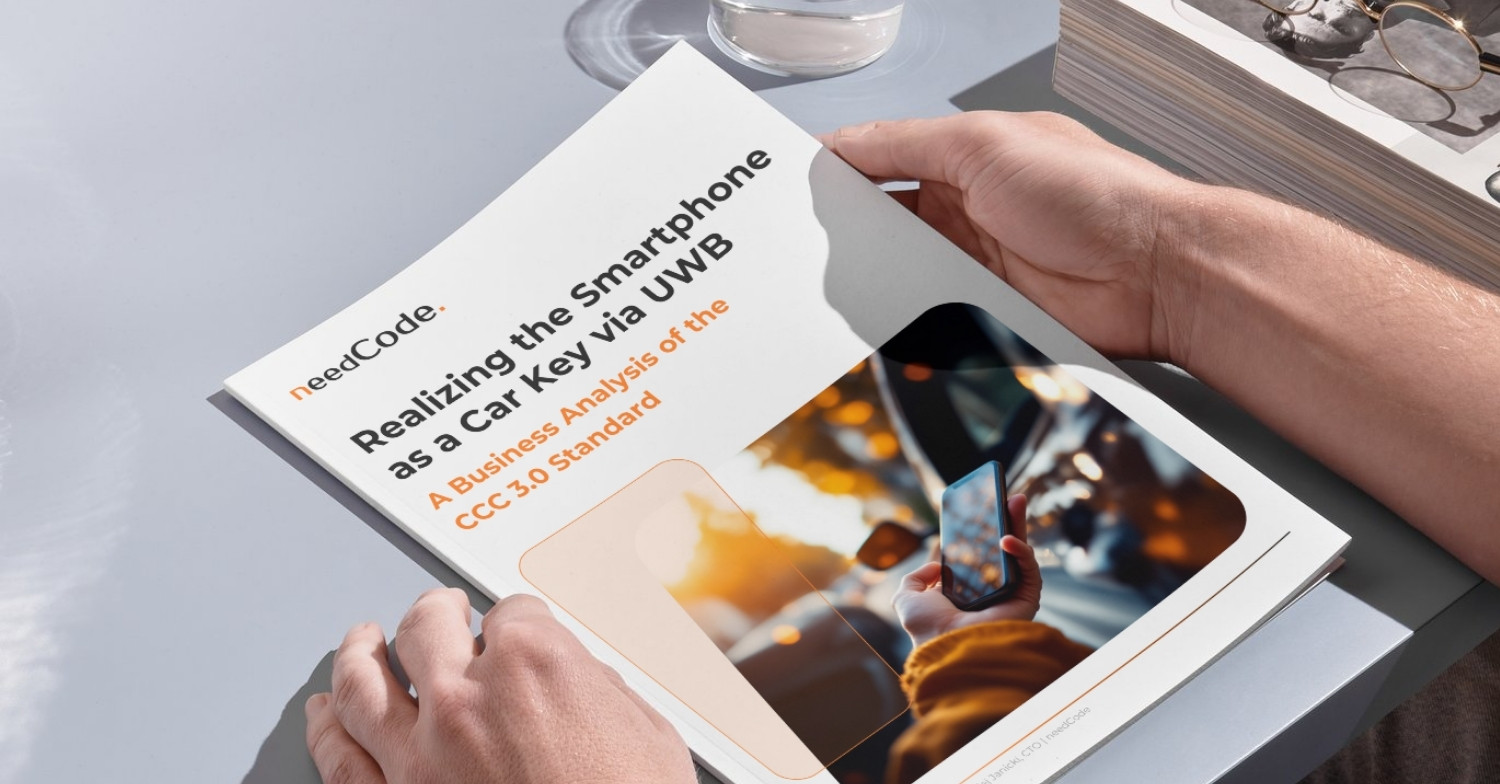
A business and technical analysis of CCC Digital Key 3.0: why secure, passive vehicle access requires NFC, BLE, and UWB working as one system, how UWB Time-of-Flight ends the relay-attack era, and what the key lifecycle means for OEMs, Tier-1s, and silicon vendors.

Written by needCode's CEO and CTO. No fluff, no vendor pitch inside: architecture, security model, lifecycle, and ecosystem adoption.
needCode IoT

We work with Industry Leaders

Passive entry is a solved UX problem and an unsolved engineering brief

Drivers already expect to walk up, get in, and drive off with the phone in a pocket. What they do not see is the choreography behind that moment: a mandatory NFC baseline, a BLE link that discovers the vehicle and manages the session, a UWB ranging exchange that proves the phone is physically where it claims to be, and a Secure Element that keeps the key material out of reach of the operating system. CCC Digital Key 3.0 defines how these parts interoperate across car brands and phone ecosystems. This e-book walks through the specification from a product owner's chair: what each layer does, why the standard demands all of them, and where the engineering risk actually sits when a roadmap says "digital key" and means it.

What you will find inside

A decision-grade tour of Digital Key 3.0, from radio roles to key lifecycle to ecosystem adoption, written for teams planning secure vehicle access products.

Key Takeaways from the E-book:

  • Understand the three-radio architecture: the distinct roles of NFC, BLE, and UWB in CCC Digital Key 3.0, and why the standard requires their orchestration rather than allowing a single-radio shortcut.
  • See how UWB neutralizes relay attacks: Time-of-Flight secure ranging measures physical distance in a way that cannot be spoofed, turning passive entry from the weakest link into a security feature.
  • Follow the key through its whole life: provisioning, owner pairing, sharing with other users, suspension, and termination, and what each phase demands from the OEM backend and the mobile ecosystem.
  • Understand the Secure Element's role: where key material lives, how the secure channel is established, and why the PKI trust chain is the part of the system a product team cannot improvise.
  • Read the adoption landscape: how OEMs and the mobile ecosystem are rolling out Digital Key, and what that timing means for Tier-1 and semiconductor roadmaps.
  • Look past the key itself: how the UWB infrastructure installed for vehicle access can be reused for child presence detection, in-car payments, kick sensing, V2X, automated charging alignment, and personalized convenience.

From specification to product: key insights from the analysis

The following insights carry the e-book's argument, from the physics of secure ranging to the ecosystem dynamics an access roadmap depends on.

Three Radios, One Choreography:

CCC Digital Key 3.0 is not "UWB replaces BLE" or "BLE replaces NFC". It is a division of labor: NFC provides the standardized baseline for access, BLE handles discovery, connectivity, and session management, and UWB delivers the precise, secure ranging that makes passive entry trustworthy. The e-book explains why the standard mandates this orchestration and what it means for firmware architecture, power budgets, and certification scope when all three must coexist in one product.

Relay Attacks End Where Physics Begins:

Signal-strength-based passive entry can be relayed: attackers extend the radio link and the car believes the key is nearby. UWB Time-of-Flight measures the literal travel time of the signal, and because the speed of light cannot be accelerated, the measured distance cannot be faked. The e-book details how ToF-based secure ranging changes the threat model for vehicle access and why it is the reason UWB sits at the center of Digital Key 3.0.

The Secure Element Is the Product's Backbone:

A digital key is only as trustworthy as the place its secrets live. The e-book covers the Secure Element's role in Digital Key 3.0: how key material is provisioned into certified hardware, how the secure channel between phone and vehicle is established, and how the PKI trust chain binds OEM, device maker, and vehicle together. For semiconductor and Tier-1 readers, this is the chapter that separates a compliant product from a liability.

The Key Lifecycle Is Where UX Meets Security:

Owner pairing, sharing a key with a family member, suspending a lost phone, terminating access when a car is sold: each of these is a security-critical operation with a user experience attached. The e-book maps the full lifecycle defined by the standard, from provisioning to termination, and shows where OEM backend design and mobile ecosystem behavior decide whether the lifecycle feels seamless or becomes a support queue.

The Key Is the Entry Point, Not the Endgame:

The UWB anchors a vehicle carries for Digital Key are a precise ranging infrastructure that happens to open doors. The e-book closes with the reuse argument: the same infrastructure can support child presence detection, in-car payments, kick sensing, V2X interactions, automated charging alignment, and personalized convenience. For SDV and infotainment planners, this reframes the digital key from a feature cost into a platform investment.

One UWB investment, six returns

The e-book's closing analysis: what the digital key's UWB infrastructure can do once it is already in the car.

01

Child Presence Detection
UWB sensing can detect occupants, including a child left in the cabin, using the ranging infrastructure already installed for access. A safety capability with regulatory tailwind, delivered without adding a dedicated sensor set.

02

In-Car Payments
Precise, secure ranging gives payment flows what they need most: certainty about who is transacting and from where. The e-book outlines how digital-key infrastructure extends toward in-car commerce.

03

Kick Sensing
Hands-free trunk and door actuation driven by precise localization instead of dedicated kick sensors. Another module removed from the BOM, another use of ranging the car already performs.

04

V2X Interactions
A vehicle that can measure precise distance to phones and devices around it has a building block for vehicle-to-everything scenarios. The e-book sketches where Digital Key infrastructure meets V2X.

05

Automated Charging Alignment
Precise ranging can guide a vehicle into alignment with charging hardware automatically. A convenience feature for drivers today and a prerequisite for autonomous charging tomorrow.

06

Personalized Convenience
When the car knows which key holder is approaching and from which side, personalization follows: settings, profiles, and context-aware behavior triggered before the door opens.

Planning a digital key or secure access product?

The e-book gives you the map. If you want the territory, needCode builds CCC digital key and secure ranging products: session and secure ranging implementation, relay-attack-resistant distance bounding, and credential handling on automotive-grade silicon.

Frequently Asked Questions (FAQ)

For product and engineering leaders in SDV and infotainment programs, Tier-1 suppliers building access modules, semiconductor teams positioning silicon for secure ranging, and smart access companies watching the automotive playbook. It is business-first in framing and technically concrete where the architecture demands it.

Enough to be useful, not enough to require an RF background. The e-book explains the NFC, BLE, and UWB roles, Time-of-Flight secure ranging, the Secure Element, and the key lifecycle at a depth that lets a product owner challenge an architecture proposal and lets an engineer confirm the plan holds.

Yes. Relay-attack mitigation through UWB Time-of-Flight, the Secure Element's role in protecting key material, secure channel establishment, and the PKI trust model are core chapters of the analysis, not a sidebar.

Not within CCC Digital Key 3.0. The standard defines a system in which NFC, BLE, and UWB each carry a distinct responsibility, and the e-book explains why that orchestration exists: the combination is what delivers both interoperability across ecosystems and security against relay attacks.

Free e-book: Smartphone-as-a-Car-Key via UWB

A business and technical analysis of CCC Digital Key 3.0 for teams building the future of vehicle access.

Access Your Complimentary E-Book

Please provide your details to receive immediate access to "Smartphone-as-a-Car-Key via UWB".

We value your privacy. By submitting this form, you consent to receive relevant business communications from needCode. You may unsubscribe at any time.

Your expert partner in UWB integration Empowering Innovation, from Concept to Deployment

At needCode, we don't just integrate technology; we empower innovation.

As a trusted Qorvo Partner, we bring deep expertise in the Aliro standard, UWB technology, and specifically, Qorvo's QM35825 module. We are a leading system integrator and the go-to company for UWB implementation, helping manufacturers like you navigate the complexities of cutting-edge wireless technology.
needCode Qorvo ioT

Choose needCode for:

Specialized Expertise:

We possess unparalleled knowledge of Aliro, UWB, and the QM35825, ensuring optimal performance for your products.

Proven Partnership:

Our strong, established relationship with Qorvo means you benefit from direct access to the latest advancements and dedicated support.

End-to-End Solutions:

We provide comprehensive integration services that accelerate your time-to-market and de-risk your development process.
© 2026 needCode. All rights reserved.