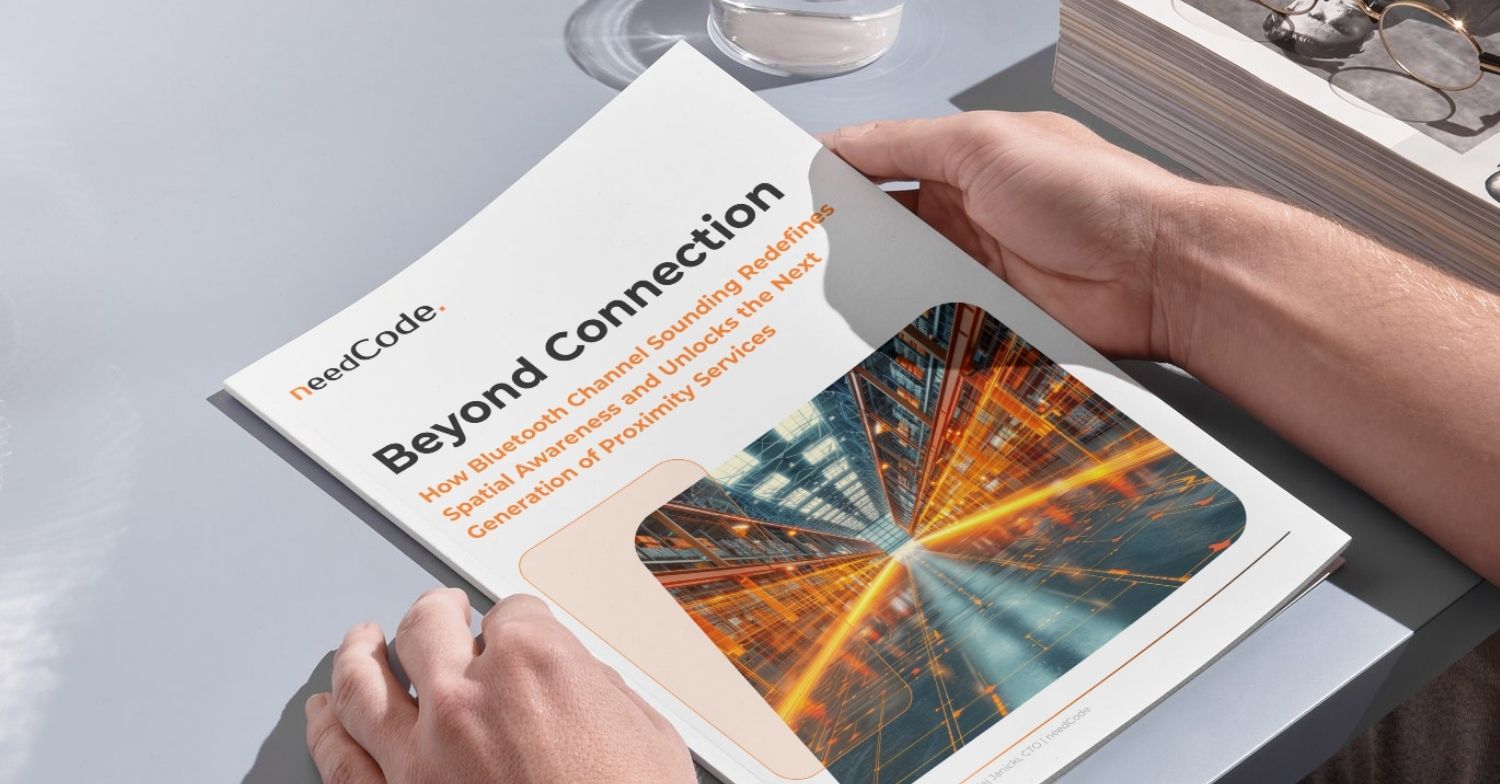
Beyond Connection

How Bluetooth Channel Sounding Redefines Spatial Awareness and Unlocks the Next Generation of Proximity Services

Bluetooth 6.0 turns the world's most ubiquitous wireless protocol into a centimeter-level ranging technology. Written by needCode's CEO and CTO, and backed by our own power and accuracy measurements on real Channel Sounding silicon, this e-book explains what the shift from signal-strength guesswork to verifiable distance means for digital key, in-cabin experiences, RTLS, and the next generation of proximity services.

needCode IoT

We work with Industry Leaders

From Ambiguous Signal Strength to Verifiable Distance

For years, Bluetooth's potential in location services was capped by RSSI, a signal-strength method with 3-to-5-meter accuracy at best, and one that relay attacks can trivially deceive. Channel Sounding replaces that probabilistic guesswork with deterministic measurement. It combines Phase-Based Ranging (PBR) and Round-Trip Time (RTT) to deliver centimeter-level, cryptographically verifiable distance on standard Bluetooth silicon. This e-book maps what that unlocks, commercially and technically.

Key Takeaways from the E-book:

  • Understand the two techniques behind the shift: Phase-Based Ranging for precision and Round-Trip Time for security, and why their dual-method flexibility lets a low-cost tracker and a high-security car key share one standard.
  • See the three strategic pillars of Channel Sounding's business value: democratized precision on an ecosystem shipping nearly 5 billion units per year, relay-attack-resistant security, and leverage of the existing BLE supply chain and regulatory framework.
  • Map the highest-value applications per vertical: automotive digital key and in-cabin personalization, industrial RTLS and geofencing, and consumer "Find My" and context-aware smart home.
  • Review real measured data: needCode's own power-profiling and static-accuracy evaluation of Channel Sounding on Nordic's nRF54L15, including the interval-versus-power trade-off.
  • Get a framework for action: roadmap re-evaluation, ecosystem partnerships, and why the first movers will define user expectations in spatially aware products.

From Specification to Strategy: Key Technical Insights

The following insights are core to the e-book, from the physics of the new ranging methods to the ecosystem timelines an executive roadmap depends on.

PBR + RTT: Precision and Security in One Standard

Phase-Based Ranging measures distance from the phase shift of signals across multiple RF channels; Round-Trip Time measures the literal time-of-flight. Because the speed of light cannot be spoofed, RTT provides a cryptographically secure foundation that effectively nullifies relay attacks. The e-book explains how the dual-method design lets developers tailor implementations by product tier, from battery-first trackers (PBR) to security-mandated digital car keys (RTT).

The Hybrid BLE CS + UWB Architecture for Digital Key

The most compelling automotive model is a hybrid: low-power Bluetooth handles discovery, coarse ranging, and wake-up; UWB activates only for the final, ultra-precise authorization. The e-book details this power-optimized architecture, a critical factor for both the vehicle and the driver's smartphone, and shows how automotive-qualified silicon like NXP's KW47, with its dedicated localization compute engine, is built to enable it.

Measured, Not Promised: Channel Sounding on Real Silicon

needCode evaluated Channel Sounding on Nordic's nRF54L15 DK, and the e-book publishes the numbers. Static accuracy remained consistent from 25 cm to 130 cm with sub-centimeter precision achievable in controlled conditions (mean error 0.41 to 1.21 cm), and increasing the CS interval from 5-10 ms to 30-60 ms cut sounding-phase power consumption by roughly 46-48%. These measurements ground the strategic claims in verified hardware behaviour.

The Ecosystem Clock: Silicon, APIs, and the Apple Question

The Bluetooth 6.0 spec is final, leading vendors (NXP, Nordic Semiconductor) sampled Channel Sounding silicon in parallel with standardization, and Android 16's RangingManager API abstracts ranging across CS, UWB, and Wi-Fi RTT for every Android developer. The open strategic risk is Apple's unconfirmed roadmap, a platform asymmetry the e-book analyses as the single greatest near-term factor for consumer-facing scale.

Why Read This E-book?

A strategic and technical guide for product leaders in automotive, industrial, and consumer electronics who need to decide, this planning cycle, what Channel Sounding means for their roadmap. Download it to:

01

Understand the paradigm shift from RSSI's 3-to-5-meter guesswork to verifiable, centimeter-level distance, and which product experiences that difference makes possible for the first time.

02

Evaluate Channel Sounding against UWB honestly: where CS's ecosystem scale commoditizes precision, where UWB retains peak-performance advantages, and where hybrid architectures beat both alone.

03

Plan against real ecosystem timelines: specification status, silicon sampling, mass-production horizons, and the Android 16 RangingManager API, including the strategic risks the hype omits.

04

Ground your decisions in measured data: needCode's own nRF54L15 power and accuracy evaluation, including the CS-interval trade-off between ranging rate and battery life.

05

Act on a concrete framework: audit your portfolio for integration opportunities, engage silicon vendors and the intelligence layer, and capture the first-mover advantage in spatially aware products.

Inside: needCode's Own Lab Evaluation

This e-book doesn't just cite the specification. It publishes needCode's own experimental evaluation of Channel Sounding power and accuracy on real silicon.

Power Profiling on the nRF54L15

Measured at 1.8 V on Nordic's nRF54L15 DK: at a 5-10 ms CS interval, the initiator drew 1.93 mA and the reflector 2.00 mA during the sounding phase; increasing the interval to 30-60 ms cut both to 1.05 mA, a reduction of roughly 46-48%, with no measurable change in scanning or advertising phases. The interval is a genuine design lever for battery-first products.

Static Accuracy, 25-130 cm

Across fixed distances from 25 cm to 130 cm, mean ranging error stayed between 0.41 cm and 1.21 cm with tight standard deviations (σ ≤ 0.13 cm): consistent, stable, and sub-centimeter in controlled conditions. The e-book presents the full results table and methodology.

What the Numbers Mean for Your Product

The conclusions section translates the measurements into design guidance: how to trade ranging cadence against power budget, what "centimeter-level" realistically means outside the lab, and why early in-house validation of ranging algorithms is where adopters should invest first.

Frequently Asked Questions (FAQ)

Channel Sounding is the headline capability of the Bluetooth 6.0 Core Specification: it adds secure, centimeter-level distance measurement to Bluetooth Low Energy using two techniques in concert, Phase-Based Ranging (PBR), which measures phase shifts across RF channels, and Round-Trip Time (RTT), which measures literal time-of-flight. Together they replace RSSI's 3-to-5-meter signal-strength estimates with verifiable distance on standard Bluetooth silicon.

It was written by needCode's CEO, Bartek Kling, and CTO, Maciej Janicki, combining the strategic framing with needCode's hands-on engineering evaluation of Channel Sounding on real hardware. needCode is a wireless connectivity engineering partner with deep BLE and UWB depth, including the first certified Bluetooth mesh stack heritage and a dedicated power lab.

Yes. A dedicated Experimental Evaluation chapter publishes needCode's own power and static-accuracy measurements of Channel Sounding on Nordic's nRF54L15 DK, including per-distance mean error (0.41 to 1.21 cm from 25 to 130 cm), standard deviations, and the roughly 46-48% sounding-phase power reduction from increasing the CS interval. The methodology is included.

The e-book treats this honestly: Channel Sounding commoditizes centimeter-level ranging by riding Bluetooth's ecosystem of nearly 5 billion units shipped annually and its existing regulatory framework, while UWB retains advantages where absolute peak precision and performance are required. In high-stakes automotive access, the most compelling model is hybrid, with BLE CS for discovery, coarse ranging, and wake-up, and UWB for the final secure authorization. The e-book details that architecture.

Yes. Automotive digital key is its most immediate high-value application. The Car Connectivity Consortium is already considering Channel Sounding for its digital key specifications, and the RTT technique provides the relay-attack resistance that access systems require. The e-book covers the hybrid CS+UWB architecture, wake-up logic, in-cabin personalization, and enhanced child-presence directions for SDV and infotainment teams.

The Bluetooth 6.0 specification was finalized in Q3 2024, and leading silicon vendors, including NXP and Nordic Semiconductor, sampled Channel Sounding-capable SoCs and MCUs in parallel with standardization, with industry consensus on mass production following. The e-book maps the hardware timeline, the Android 16 RangingManager API as the software catalyst, and the planning window it creates for product launches.

Platform asymmetry: Android has a clear public path via the RangingManager API, while Apple's support for Channel Sounding remains unconfirmed, which effectively halves the addressable market for consumer-facing applications until Apple clarifies its roadmap. A secondary risk is the maturity of distance-calculation algorithms, which the e-book argues early adopters should validate in-house.

Product and technology leaders in automotive (SDV, infotainment, digital key), semiconductor companies planning Channel Sounding enablement, and industrial and consumer device makers evaluating precision ranging: CTOs, system architects, and R&D leads who need both the strategic picture and measured technical evidence in one document.

Free e-book: Beyond Connection

How Bluetooth Channel Sounding Redefines Spatial Awareness and Unlocks the Next Generation of Proximity Services

Access Your Complimentary E-Book

Please provide your details to receive immediate access to "Beyond Connection: How Bluetooth Channel Sounding Redefines Spatial Awareness and Unlocks the Next Generation of Proximity Services" and learn how to position your organization for the next generation of proximity services.

We value your privacy. By submitting this form, you consent to receive relevant business communications from needCode. You may unsubscribe at any time.

Your expert partner in UWB integration Empowering Innovation, from Concept to Deployment

At needCode, we don't just integrate technology; we empower innovation.

As a trusted Qorvo Partner, we bring deep expertise in the Aliro standard, UWB technology, and specifically, Qorvo's QM35825 module. We are a leading system integrator and the go-to company for UWB implementation, helping manufacturers like you navigate the complexities of cutting-edge wireless technology.
needCode Qorvo ioT

Choose needCode for:

Specialized Expertise:

We possess unparalleled knowledge of Aliro, UWB, and the QM35825, ensuring optimal performance for your products.

Proven Partnership:

Our strong, established relationship with Qorvo means you benefit from direct access to the latest advancements and dedicated support.

End-to-End Solutions:

We provide comprehensive integration services that accelerate your time-to-market and de-risk your development process.

Let's work on your next project together

Book a demo and discovery call with our CEO
to get a look at:
Strategic Expertise
End-to-End Solutions
Advanced Technology
Custom Hardware Devices
Bartek Kling
Bartek Kling / CEO
© 2026 needCode. All rights reserved.

Manufacturing

Modern manufacturing machines are typically equipped with IoT sensors that capture performance data. AIoT technology analyzes this sensor data, and based on vibration patterns, the AI predicts the machine's behavior and recommends actions to maintain optimal performance. This approach is highly effective for predictive maintenance, promoting safer working environments, continuous operation, longer equipment lifespan, and less downtime. Additionally, AIoT enhances quality control on production lines.

For example, Sentinel, a monitoring system used in pharmaceutical production by IMA Pharma, employs AI to evaluate sensor data along the production line. The AI detects and improves underperforming components, ensuring efficient machine operation and maintaining high standards in drug manufacturing.

Logistics & supply chain

IoT devices - from fleet vehicles and autonomous warehouse robots to scanners and beacons - generate large amounts of data in this industry. When combined with AI, this data can be leveraged for tracking, analytics, predictive maintenance, autonomous driving, and more, offering greater visibility into logistics operations and enhancing vendor partnerships.

Example: Amazon employs over 750,000 autonomous mobile robots to assist warehouse staff with heavy lifting, delivery, and package handling tasks. Other examples include AI-powered IoT devices such as cameras, RFID sensors, and beacons that help monitor goods' movement and track products within warehouses and during transportation. AI algorithms can also estimate arrival times and forecast delays by analyzing traffic conditions.

Retail

IoT sensors monitor movement and customer flow within a building, while AI algorithms analyze this data to offer insights into traffic patterns and product preferences. This information enhances understanding of customer behavior, helps prevent stockouts, and improves customer analytics to drive sales. Furthermore, AIoT enables retailers to deliver personalized shopping experiences by leveraging geographical data and individual shopping preferences.

For instance, IoT sensors track movement and customer flow, and AI algorithms process this information to reveal insights into traffic patterns and product preferences. This ultimately leads to better customer understanding, stockout prevention, and enhanced sales analytics.

Agriculture

Recent research by Continental reveals that over 27% of surveyed farmers utilize drones for aerial land analysis. These devices capture images of crops as they are and transmit them to a dashboard for further assessment. However, AI can enhance this process even further.

For example, AIoT-powered drones can photograph crops at various growth stages, assess plant health, detect diseases, and recommend optimal harvesting strategies to maximize yield. Additionally, these drones can be employed for targeted crop treatments, irrigation monitoring and management, soil health analysis, and more.

Smart Cities

Smart cities represent another domain where AIoT applications can enhance citizens' well-being, facilitate urban infrastructure planning, and guide future city development. In addition to traffic management, IoT devices equipped with AI can monitor energy consumption patterns, forecast demand fluctuations, and dynamically optimize energy distribution. AI-powered surveillance cameras and sensors can identify suspicious activities, monitor crowd density, and alert authorities to potential security threats in real-time, improving public safety and security.

For example, an AIoT solution has been implemented in Barcelona to manage water and energy sustainably. The city has installed IoT sensors across its water supply system to gather water pressure, flow rate, and quality data. AI algorithms analyze this information to identify leaks and optimize water usage. Similarly, smart grids have been introduced to leverage AI to predict demand and distribute energy efficiently, minimizing waste and emissions. As a result, these initiatives have enabled the city to reduce water waste by 25%, increase renewable energy usage by 17%, and lower greenhouse gas emissions by 19%.

Healthcare

Integrating AI and IoT in healthcare enables hospitals to deliver remote patient care more efficiently while reducing the burden on facilities. Additionally, AI can be used in clinical trials to preprocess data collected from sensors across extensive target and control groups.

For example, intelligent wearable technologies enable doctors to monitor patients remotely. In real-time, sensors collect vital signs such as heart rate, blood pressure, and glucose levels. AI algorithms then analyze this data, assisting doctors in detecting issues early, developing personalized treatment plans, and enhancing patient outcomes.

Smart Homes

The smart home ecosystem encompasses smart thermostats, locks, security cameras, energy management systems, heating, lighting, and entertainment systems. AI algorithms analyze data from these devices to deliver context-specific recommendations tailored to each user. This enables homeowners to use utilities more efficiently, create a personalized living space, and achieve sustainability goals.

For example, LifeSmart offers a comprehensive suite of AI-powered IoT tools for smart homes, connecting new and existing intelligent appliances and allowing customers to manage them via their smartphones. Additionally, they provide an AI builder framework for deploying AI on smart devices, edge gateways, and the cloud, enabling AI algorithms to process data and user behavior autonomously.

Maintenance (Post-Release Support)

When your product is successfully launched and available on the market we provide ongoing support and maintenance services to ensure your product remains competitive and reliable. This includes prompt resolution of any reported issues through bug fixes and updates.

We continuously enhance product features based on user feedback and market insights, optimizing performance and user experience.

Our team monitors product performance metrics to identify areas for improvement and proactively addresses potential issues. This phase aims to sustain product competitiveness, ensure customer satisfaction, and support long-term success in the market.

Commercialization (From MVP to Product

Our software team focuses on completing the full product feature range, enhancing the user interface and experience, and handling all corner cases. We prepare product software across the whole lifecycle by providing all necessary procedures, such as manufacturing support and firmware upgrade.

We also finalize the product's hardware design to ensure robustness, scalability and cost-effectiveness.

This includes rigorous testing procedures to validate product performance, reliability, and security. We manage all necessary certifications and regulatory compliance requirements to ensure the product meets industry standards and legal obligations.

By the end of this phase, your product is fully prepared for mass production and commercial deployment, with all documentation and certifications in place.

Prototyping (From POC to MVP)

Our development team focuses on implementing core product features and use cases to create a functional Minimum Viable Product (MVP). We advance to refining the hardware design, moving from initial concepts to detailed PCB design allowing us to assemble first prototypes. Updated documentation from the Design phase ensures alignment with current project status. A basic test framework is established to conduct preliminary validation tests.

This prepares the product for real-world demonstrations to stakeholders, customers, and potential investors.

This phase is critical for validating market readiness and functionality before proceeding to full-scale production.

Design (From Idea to POC)

We meticulously select the optimal technology stack and hardware components based on your smart product idea with detailed use cases and feature requirements (Market Requirements Document / Business Requirements Document). Our team conducts thorough assessments of costs, performance metrics, power consumption, and resource requirements.

Deliverables include a comprehensive Product Requirements Document (PRD), detailed Software Architecture plans, an Initial Test Plan outlining validation strategies, Regulatory Compliance Analysis to ensure adherence to relevant standards, and a Proof of Concept (POC) prototype implemented on breakout boards.

This phase aims to validate the technical feasibility of your concept and establish a solid foundation for further development.

If you lack a validated idea and MRD/BRD, consider utilizing our IoT Strategic Roadmap service to gain insights into target markets, user needs, and desired functionality. Having a structured plan in the form of an IoT Strategic Roadmap before development begins is crucial to mitigate complications in subsequent product development phases.