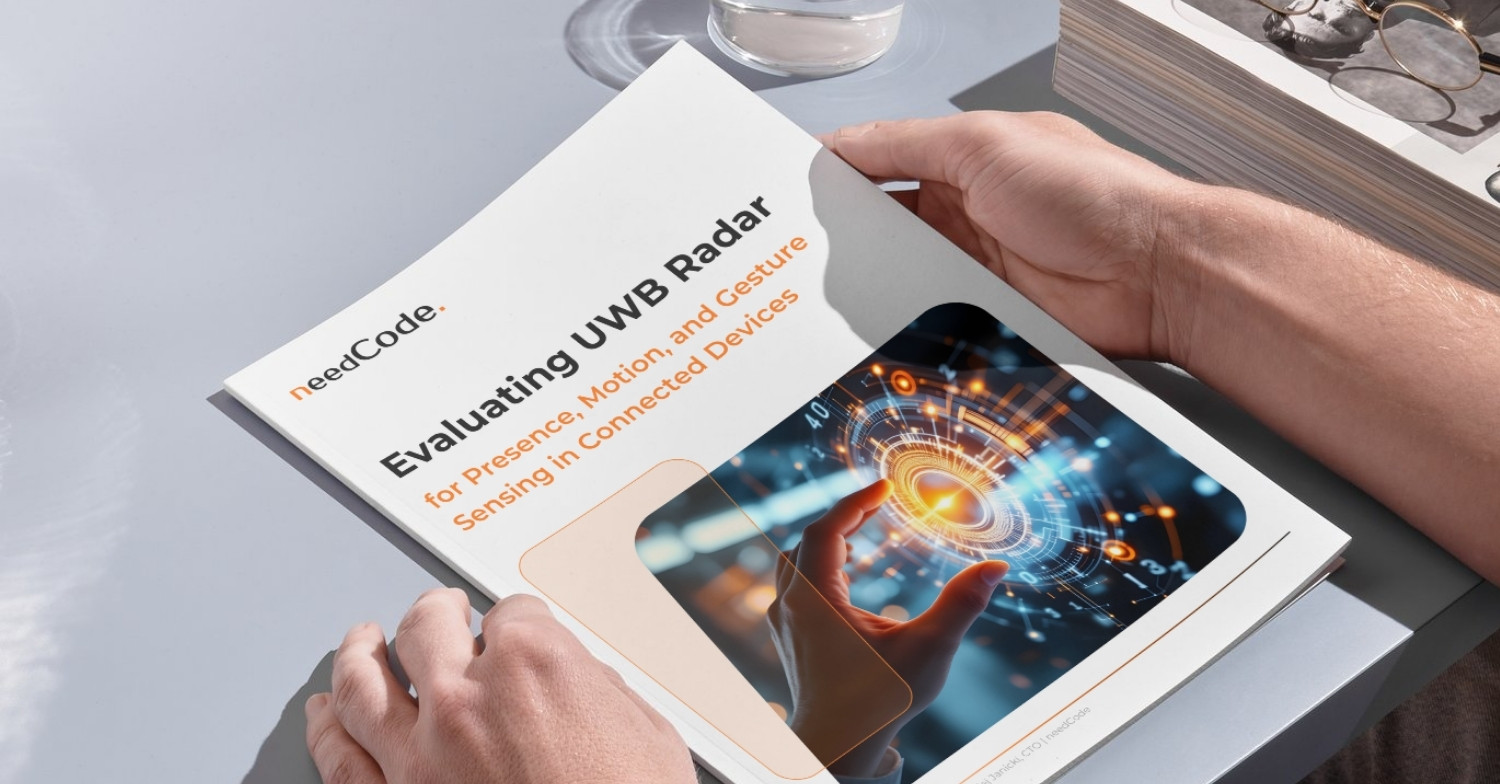
Evaluating UWB Radar

for Presence, Motion, and Gesture Sensing in Connected Devices

The UWB radio your product already carries for secure ranging can also see. Written by needCode's CEO and CTO, this e-book evaluates UWB radar for presence, motion, and gesture sensing: how one chip serves both digital key and in-cabin monitoring, why it detects a breathing infant under a blanket where cameras and 60 GHz radar fail, and how it delivers presence detection without capturing a single image.

needCode IoT

We work with Industry Leaders

Incumbent Sensors Are Hitting a Wall

Across strategic industries, the established sensing technologies force unacceptable compromises. Cameras trade privacy for function and fail in poor light, behind obstructions, and with an infant hidden under a blanket. PIR sensors detect motion, not presence, so a person sitting still disappears. 60 GHz FMCW radar struggles to penetrate car seats and thick fabrics. Wearables depend on patient compliance. This e-book evaluates the technology that closes these gaps: UWB radar, a sensing mode of the same radio that already powers secure digital key, delivering presence, motion, vital-sign, and gesture detection without a camera.

Key Takeaways from the E-book:

  • Understand UWB's dual-mode capability: the same chip performs secure, CCC-standardized ranging and radar sensing, so digital-key infrastructure can be reused for in-cabin monitoring instead of adding a separate sensor stack.
  • See why UWB radar leads for Child Presence Detection: material penetration through seats and blankets plus sensitivity to the micro-movements of breathing, against the documented failure modes of cameras and 60 GHz radar, in the context of Euro NCAP requirements.
  • Learn the "see without seeing" paradigm: reliable presence detection that captures no personally identifiable visual data, solving the stationary-occupant problem of PIR and the privacy problem of cameras in one move.
  • Map the capability gaps vertical by vertical: automotive, Industry 4.0, smart buildings, and healthcare, each analysed as incumbent limitation versus UWB solution.
  • Assess the sensing pipeline: how Channel Impulse Response (CIR) analysis turns raw radar reflections into presence, occupancy, vital-sign, and gesture classification.

One Radio, Two Capabilities: Key Technical Insights

The following insights are core to the e-book, from the physics of radar-mode sensing to the infrastructure economics that make it commercially compelling.

Reuse the Digital Key Radio for Sensing

The strategic unlock of UWB radar is that it is not a new sensor. The same UWB anchors a vehicle carries for CCC digital key and relay-attack-resistant access can operate in radar mode for child presence detection, occupant monitoring, and gesture control. The e-book details this dual-use architecture and what it means for bill of materials, integration effort, and the business case of in-cabin sensing.

Why Penetration Decides CPD

Child Presence Detection is a life-critical application shaped by Euro NCAP, and it exposes the physics of each candidate technology. Cameras are line-of-sight and cannot detect an infant hidden under a blanket; 60 GHz FMCW radar's high-frequency signals are easily blocked by car seats and thick fabrics. UWB's ability to penetrate these materials and detect the subtle micro-movements of breathing is why the e-book positions it as the robust choice for the most critical life-presence scenarios.

CIR Analysis: How a Ranging Radio Becomes a Radar

The e-book explains the sensing pipeline built on Channel Impulse Response analysis: how reflections of UWB pulses are processed into presence, motion, respiration, and gesture signatures, and what that demands from firmware and algorithms. This is the engineering layer where a datasheet capability becomes a reliable product feature.

Market Validation Across Verticals

The analysis is grounded in where UWB is already winning: automakers such as Audi and Porsche integrating UWB into next-generation vehicle platforms for secure access, and omlox-based industrial RTLS validated in deployments by industrial leaders. The e-book uses these proof points to separate what is deployable now from what is emerging.

Why Read This E-book?

01

Evaluate UWB radar against every incumbent: cameras, PIR, 60 GHz FMCW radar, Wi-Fi sensing, and wearables, with the capability gaps of each named precisely.

02

Build the infrastructure-reuse business case: how dual-mode UWB turns the digital-key investment into a sensing platform, changing the economics of in-cabin and in-building monitoring.

03

Plan for Child Presence Detection requirements: what Euro NCAP-driven CPD demands from a sensing technology, and why penetration and breathing-detection sensitivity are the deciding criteria.

04

Deliver presence detection without privacy compromise: the "see without seeing" paradigm for smart buildings, hotels, healthcare, and every space where a camera is unacceptable.

05

Understand the engineering path: the CIR-based sensing pipeline, the firmware and algorithm work involved, and what separates a demo from a certified, shipping sensing product.

Inside: Capability Gaps and UWB Solutions, Vertical by Vertical

The e-book's core chapter analyses four industries where incumbent sensing fails, and shows precisely how UWB's physical properties close each gap.

Automotive

Cameras fail CPD on privacy, lighting, and line of sight; 60 GHz radar fails on penetration; key fobs and BLE fall to relay attacks. UWB answers all three: CCC-standardized secure ranging for access, and radar-mode detection of breathing through seats and blankets for Euro NCAP-grade child presence detection.

Industry 4.0

LiDAR and vision are blinded by dust, smoke, and steam, and a worker obscured by a pallet becomes invisible to safety systems. UWB-based RTLS thrives in these conditions: resistant to multipath from metal shelving, independent of line of sight, and interoperable through the omlox standard for multi-vendor fleets.

Smart Buildings & Secure Spaces

PIR detects motion, not presence, so a stationary occupant switches the lights off; cameras are unethical or illegal in the most sensitive spaces. UWB radar detects the micro-movements of breathing without capturing any visual data: reliable, privacy-preserving presence detection for building automation.

Healthcare & Elder Care

Wearables fail on compliance, especially for patients with cognitive decline; Wi-Fi sensing lacks the resolution for respiration and heartbeat. A single in-room UWB sensor monitors breathing rate and detects falls with no action required from the patient, preserving dignity in a way cameras never could.

Frequently Asked Questions (FAQ)

UWB ranging measures the distance between two active UWB devices, the mode behind digital key and RTLS. UWB radar uses the same radio to transmit pulses and analyse their reflections from the environment, detecting the presence, motion, micro-movements, and gestures of people who carry no device at all. The e-book explains both modes and the Channel Impulse Response (CIR) analysis that powers the radar side.

Yes, and this is the e-book's central commercial argument: because ranging and radar are two modes of the same UWB radio, the anchors a vehicle already carries for CCC digital key can also perform in-cabin sensing such as child presence detection, occupant monitoring, and gesture control. That dual use changes the bill-of-materials and integration economics of adding sensing to a product that already has UWB.

The deciding factor is material penetration: 60 GHz FMCW radar's high-frequency signals are easily blocked by car seats and thick blankets, which is exactly where a sleeping infant may be hidden. UWB's lower-frequency, wide-spectrum pulses penetrate these materials and remain sensitive to the micro-movements of breathing, which the e-book argues makes UWB the robust technology for the most critical life-presence scenarios under Euro NCAP-driven requirements.

UWB radar senses presence, motion, and vital signs without capturing any personally identifiable visual data: it detects that a person is present and breathing, not what they look like. The e-book calls this the "see without seeing" paradigm, and it is what makes reliable presence detection deployable in bathrooms, hotel rooms, patient rooms, and secure corporate areas where cameras are unethical, often illegal, or a security liability.

Four verticals in depth, each as a capability-gap analysis: automotive (secure access, CPD, in-cabin sensing), Industry 4.0 (RTLS and human-robot collaboration safety where LiDAR and vision fail), smart buildings and secure spaces (privacy-preserving presence detection), and healthcare and elder care (contactless vital-sign monitoring and fall detection). Robotics and humanoid teams will find the Industry 4.0 and sensing chapters directly applicable.

Yes. Gesture recognition is one of the radar-mode capabilities the e-book evaluates alongside presence, motion, and vital-sign detection: the same CIR-based pipeline that detects breathing can classify deliberate hand movements, enabling touchless control in vehicles and connected devices.

It was written by needCode's CEO, Bartek Kling, and CTO, Maciej Janicki. needCode is a wireless connectivity engineering partner and the largest dedicated UWB team in Central Europe, a certified Qorvo partner active in FiRa and the UWB Alliance, with UWB sensing and ranging engineering as core practice.

Product and technology leaders in SDV, infotainment, and automotive safety; semiconductor companies positioning UWB silicon for sensing; and robotics, building-automation, and healthcare-device teams evaluating presence detection: CTOs, system architects, and R&D leads who need a rigorous, vendor-honest evaluation of UWB radar against the incumbents.

Free e-book: Evaluating UWB Radar

for Presence, Motion, and Gesture Sensing in Connected Devices

Access Your Complimentary E-Book

Please provide your details to receive immediate access to "Evaluating UWB Radar for Presence, Motion, and Gesture Sensing in Connected Devices" and learn how one UWB radio can serve both secure access and privacy-preserving sensing.

We value your privacy. By submitting this form, you consent to receive relevant business communications from needCode. You may unsubscribe at any time.

Your expert partner in UWB integration Empowering Innovation, from Concept to Deployment

At needCode, we don't just integrate technology; we empower innovation.

As a trusted Qorvo Partner, we bring deep expertise in the Aliro standard, UWB technology, and specifically, Qorvo's QM35825 module. We are a leading system integrator and the go-to company for UWB implementation, helping manufacturers like you navigate the complexities of cutting-edge wireless technology.
needCode Qorvo ioT

Choose needCode for:

Specialized Expertise:

We possess unparalleled knowledge of Aliro, UWB, and the QM35825, ensuring optimal performance for your products.

Proven Partnership:

Our strong, established relationship with Qorvo means you benefit from direct access to the latest advancements and dedicated support.

End-to-End Solutions:

We provide comprehensive integration services that accelerate your time-to-market and de-risk your development process.

Let's work on your next project together

Book a demo and discovery call with our CEO
to get a look at:
Strategic Expertise
End-to-End Solutions
Advanced Technology
Custom Hardware Devices
Bartek Kling
Bartek Kling / CEO
© 2026 needCode. All rights reserved.

Manufacturing

Modern manufacturing machines are typically equipped with IoT sensors that capture performance data. AIoT technology analyzes this sensor data, and based on vibration patterns, the AI predicts the machine's behavior and recommends actions to maintain optimal performance. This approach is highly effective for predictive maintenance, promoting safer working environments, continuous operation, longer equipment lifespan, and less downtime. Additionally, AIoT enhances quality control on production lines.

For example, Sentinel, a monitoring system used in pharmaceutical production by IMA Pharma, employs AI to evaluate sensor data along the production line. The AI detects and improves underperforming components, ensuring efficient machine operation and maintaining high standards in drug manufacturing.

Logistics & supply chain

IoT devices - from fleet vehicles and autonomous warehouse robots to scanners and beacons - generate large amounts of data in this industry. When combined with AI, this data can be leveraged for tracking, analytics, predictive maintenance, autonomous driving, and more, offering greater visibility into logistics operations and enhancing vendor partnerships.

Example: Amazon employs over 750,000 autonomous mobile robots to assist warehouse staff with heavy lifting, delivery, and package handling tasks. Other examples include AI-powered IoT devices such as cameras, RFID sensors, and beacons that help monitor goods' movement and track products within warehouses and during transportation. AI algorithms can also estimate arrival times and forecast delays by analyzing traffic conditions.

Retail

IoT sensors monitor movement and customer flow within a building, while AI algorithms analyze this data to offer insights into traffic patterns and product preferences. This information enhances understanding of customer behavior, helps prevent stockouts, and improves customer analytics to drive sales. Furthermore, AIoT enables retailers to deliver personalized shopping experiences by leveraging geographical data and individual shopping preferences.

For instance, IoT sensors track movement and customer flow, and AI algorithms process this information to reveal insights into traffic patterns and product preferences. This ultimately leads to better customer understanding, stockout prevention, and enhanced sales analytics.

Agriculture

Recent research by Continental reveals that over 27% of surveyed farmers utilize drones for aerial land analysis. These devices capture images of crops as they are and transmit them to a dashboard for further assessment. However, AI can enhance this process even further.

For example, AIoT-powered drones can photograph crops at various growth stages, assess plant health, detect diseases, and recommend optimal harvesting strategies to maximize yield. Additionally, these drones can be employed for targeted crop treatments, irrigation monitoring and management, soil health analysis, and more.

Smart Cities

Smart cities represent another domain where AIoT applications can enhance citizens' well-being, facilitate urban infrastructure planning, and guide future city development. In addition to traffic management, IoT devices equipped with AI can monitor energy consumption patterns, forecast demand fluctuations, and dynamically optimize energy distribution. AI-powered surveillance cameras and sensors can identify suspicious activities, monitor crowd density, and alert authorities to potential security threats in real-time, improving public safety and security.

For example, an AIoT solution has been implemented in Barcelona to manage water and energy sustainably. The city has installed IoT sensors across its water supply system to gather water pressure, flow rate, and quality data. AI algorithms analyze this information to identify leaks and optimize water usage. Similarly, smart grids have been introduced to leverage AI to predict demand and distribute energy efficiently, minimizing waste and emissions. As a result, these initiatives have enabled the city to reduce water waste by 25%, increase renewable energy usage by 17%, and lower greenhouse gas emissions by 19%.

Healthcare

Integrating AI and IoT in healthcare enables hospitals to deliver remote patient care more efficiently while reducing the burden on facilities. Additionally, AI can be used in clinical trials to preprocess data collected from sensors across extensive target and control groups.

For example, intelligent wearable technologies enable doctors to monitor patients remotely. In real-time, sensors collect vital signs such as heart rate, blood pressure, and glucose levels. AI algorithms then analyze this data, assisting doctors in detecting issues early, developing personalized treatment plans, and enhancing patient outcomes.

Smart Homes

The smart home ecosystem encompasses smart thermostats, locks, security cameras, energy management systems, heating, lighting, and entertainment systems. AI algorithms analyze data from these devices to deliver context-specific recommendations tailored to each user. This enables homeowners to use utilities more efficiently, create a personalized living space, and achieve sustainability goals.

For example, LifeSmart offers a comprehensive suite of AI-powered IoT tools for smart homes, connecting new and existing intelligent appliances and allowing customers to manage them via their smartphones. Additionally, they provide an AI builder framework for deploying AI on smart devices, edge gateways, and the cloud, enabling AI algorithms to process data and user behavior autonomously.

Maintenance (Post-Release Support)

When your product is successfully launched and available on the market we provide ongoing support and maintenance services to ensure your product remains competitive and reliable. This includes prompt resolution of any reported issues through bug fixes and updates.

We continuously enhance product features based on user feedback and market insights, optimizing performance and user experience.

Our team monitors product performance metrics to identify areas for improvement and proactively addresses potential issues. This phase aims to sustain product competitiveness, ensure customer satisfaction, and support long-term success in the market.

Commercialization (From MVP to Product

Our software team focuses on completing the full product feature range, enhancing the user interface and experience, and handling all corner cases. We prepare product software across the whole lifecycle by providing all necessary procedures, such as manufacturing support and firmware upgrade.

We also finalize the product's hardware design to ensure robustness, scalability and cost-effectiveness.

This includes rigorous testing procedures to validate product performance, reliability, and security. We manage all necessary certifications and regulatory compliance requirements to ensure the product meets industry standards and legal obligations.

By the end of this phase, your product is fully prepared for mass production and commercial deployment, with all documentation and certifications in place.

Prototyping (From POC to MVP)

Our development team focuses on implementing core product features and use cases to create a functional Minimum Viable Product (MVP). We advance to refining the hardware design, moving from initial concepts to detailed PCB design allowing us to assemble first prototypes. Updated documentation from the Design phase ensures alignment with current project status. A basic test framework is established to conduct preliminary validation tests.

This prepares the product for real-world demonstrations to stakeholders, customers, and potential investors.

This phase is critical for validating market readiness and functionality before proceeding to full-scale production.

Design (From Idea to POC)

We meticulously select the optimal technology stack and hardware components based on your smart product idea with detailed use cases and feature requirements (Market Requirements Document / Business Requirements Document). Our team conducts thorough assessments of costs, performance metrics, power consumption, and resource requirements.

Deliverables include a comprehensive Product Requirements Document (PRD), detailed Software Architecture plans, an Initial Test Plan outlining validation strategies, Regulatory Compliance Analysis to ensure adherence to relevant standards, and a Proof of Concept (POC) prototype implemented on breakout boards.

This phase aims to validate the technical feasibility of your concept and establish a solid foundation for further development.

If you lack a validated idea and MRD/BRD, consider utilizing our IoT Strategic Roadmap service to gain insights into target markets, user needs, and desired functionality. Having a structured plan in the form of an IoT Strategic Roadmap before development begins is crucial to mitigate complications in subsequent product development phases.