
If you have built test automation for a web application, a REST API, or a desktop product, you have a useful set of skills and a misleading set of expectations.
The skills transfer. The expectations do not. Wireless embedded systems are a fundamentally different testing target, and teams that approach them with a “we automated our backend, how hard can this be” mindset typically discover, several months in, that they have underestimated the problem badly.
This article is for the engineering leaders making that calculation right now. It is not an argument against automation — quite the opposite. It is an honest description of why this domain is harder than the ones you may have automated before, what specifically makes it harder, and what that actually means for a realistic project plan. Knowing what you are walking into is the difference between an automation programme that succeeds and one that stalls at the eighteen-month mark with little to show for it.

You are testing physics, not just software
The first thing that makes wireless testing distinctive is that the system under test is not entirely software. A REST API lives in a deterministic execution environment: the same input produces the same output, every time, on any machine that runs the same code. A wireless device does not. Its behaviour depends on antenna radiation patterns, transceiver timing, power amplifier thermal effects, clock drift, and the over-the-air collisions that happen when other 2.4 GHz devices in the room transmit at the same time as yours.
Some of this can be simulated. Tools like Zephyr’s native simulator, BSIM, and BabbleSim can exercise BLE host-side logic without real hardware, and they are genuinely useful for fast component-level tests. But the RF physics layer cannot be faithfully emulated in software. Certain failure modes — timing drift, clock jitter, spurious emissions, link-layer retransmission storms — only appear on physical silicon. This means your test infrastructure has to include real hardware, controlled and observed under reproducible conditions, in addition to the software-only test layers that catch faster, simpler bugs.
The implication for project planning is that you are not building a test framework. You are building two test frameworks — a software-only one and a hardware-in-the-loop one — and the latter requires physical infrastructure, RF expertise, and a kind of operational discipline that pure-software teams have rarely needed to develop.
The state space is genuinely enormous
Wireless protocols are state machines of remarkable complexity. Bluetooth alone defines hundreds of procedures: connection establishment, encryption negotiation, bonding, MTU exchange, data length extension, connection parameter updates, and many more. Each procedure can interact with firmware edge cases, host-side scheduling on the connected phone, or RF interference in ways that are difficult to anticipate.
The practical consequence is that you cannot achieve “complete coverage” in any meaningful sense. The state space is too large. What you can do — and what a mature test strategy is built around — is identify the scenarios most likely to cause failures in the field, the regressions most likely to be introduced by your team’s typical code changes, and the corner cases that have already bitten you once and must never bite you again. This is engineering judgement, not exhaustive enumeration, and it is one of the harder skills to develop.
For comparison, automating a REST API often involves writing a test for every endpoint and a few negative cases. Automating a BLE peripheral involves making informed decisions about which of several hundred protocol procedures matter most for your product, your customers, and your release cadence. The first is a checklist exercise. The second is a design problem.
Hardware-in-the-loop is real engineering infrastructure
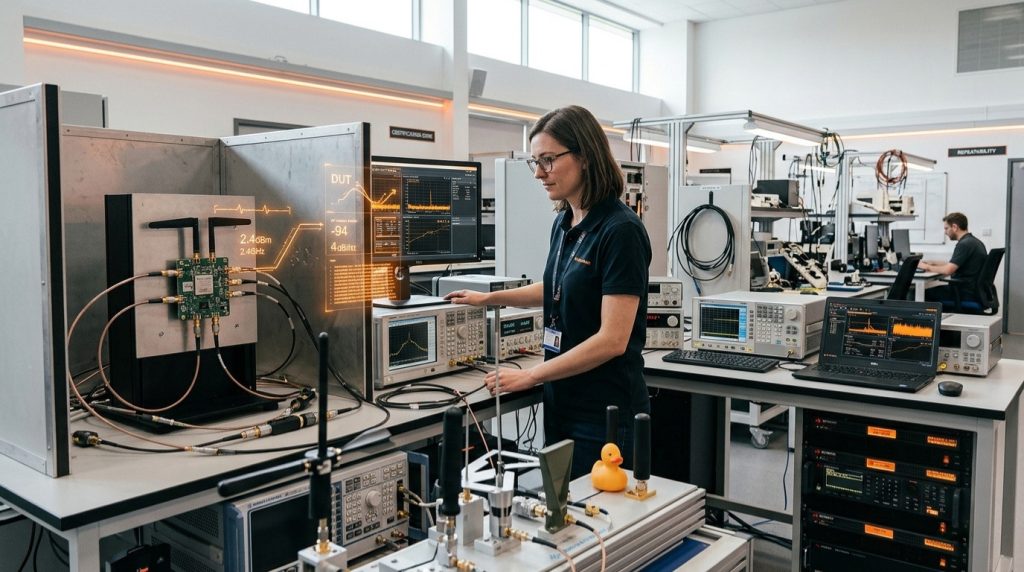
When you build a CI pipeline for a web application, you spin up containers in a cloud environment. When you build a CI pipeline for a wireless embedded product, you build a physical test rig. That rig contains USB programmers for flashing firmware, HCI dongles to play the role of a peer device, RF attenuators to control signal strength, shielded enclosures to isolate the test environment from ambient interference, sometimes a spectrum analyser, sometimes a power measurement instrument, and almost always some custom test hardware specific to your product.
This is genuine engineering infrastructure, and it requires the same discipline as any other production system. The configuration must be version-controlled. The setup must be documented. The health of the rig must be monitored, because a flaky test rig damages development velocity at least as much as a flaky test does. Engineers must be able to provision a new rig from scratch in a reasonable time, because the project will eventually need more than one — for parallel test execution, for hardware variants, for redundancy.
None of this is impossible. It is, however, work that has no analogue in pure-software automation, and teams that have not done it before tend to underestimate the time it takes to get right. A reasonable rule of thumb is that the test bench design and construction is roughly comparable in effort to the test framework software itself. Plan accordingly.
You need expertise that few teams have in-house
Wireless test automation sits at the intersection of embedded systems, wireless protocol specifications, scripting and framework design, CI/CD engineering, and RF measurement. The combination is unusual. Most firmware engineers have never built test infrastructure. Most test automation engineers have never debugged an over-the-air protocol exchange. Most CI/CD specialists have never integrated a hardware bench into a pipeline. The people who can do all four well exist, but they are rare, and hiring them is hard.
This is the most common reason that internal automation initiatives stall. A team starts with enthusiasm, hits the first hardware-integration problem, discovers that nobody on the team has the relevant experience, and either reduces scope drastically or quietly deprioritises the project. The work does not fail loudly. It fades.
The pragmatic response is to be honest about which expertise the team has and which it does not. If the gap is in framework design or CI integration, hiring or training can close it. If the gap is in the entire end-to-end discipline — and it often is — then the realistic options are to spend a year or two developing it internally, or to engage a specialist who has built this kind of infrastructure before and can transfer the knowledge alongside the deliverable. Both paths are valid. The path that does not work is pretending the gap is not there.
Environment design is itself a discipline
In a software-only test environment, deterministic execution is more or less free. In a wireless test environment, it is something you have to engineer. RF channels are shared media. Other devices transmit on them. Temperature affects clock drift. Cable losses change with handling. Even the placement of the test rig in the lab matters: a rig sitting next to a window receives different ambient interference than one in an interior room.
A test environment that produces consistent, comparable results across runs requires deliberate design. Shielded enclosures isolate the device from ambient RF. Programmable attenuators present controlled signal levels. Deterministic test topologies eliminate one source of variance after another. None of this is exotic, but all of it is unfamiliar to teams whose previous test environments were just a CI runner in a cloud.
The investment is worthwhile. A controlled test environment produces results that are not just repeatable but trustworthy: when a test fails, you can be confident that something in the device under test changed, not that someone walked past with a Bluetooth headset. That trust is what makes the automated suite valuable. Without it, the team learns to ignore failures, and the suite becomes decorative.

Test infrastructure itself requires ongoing maintenance
There is one more dimension of the difficulty that deserves its own discussion, because it is almost always missed in initial planning: the test infrastructure itself requires ongoing maintenance, and that maintenance is non-trivial.
In a software-only test environment, the infrastructure is mostly self-maintaining. Cloud CI providers handle their own machines. Containers are immutable and recreate themselves on demand. When something breaks, the fix is usually a configuration update committed to a repository, and the broken state never persists for long because the infrastructure regenerates from a known-good template every time it runs.
A wireless test bench does not work that way. The HCI dongles age out and need replacing. The USB programmers occasionally need firmware updates. The RF cables develop subtle losses that drift over time and eventually cross the threshold where they affect test results. The shielded enclosure gaskets wear and let in ambient interference. The PCs that run the test orchestration accumulate operating system updates that occasionally break tooling. None of these failures are catastrophic individually, and none of them happen often, but cumulatively they require ongoing engineering attention to keep the bench operational and producing trustworthy results.
A reasonable benchmark is that maintaining a hardware test bench takes roughly the equivalent of a part-time engineer once it is in production use, plus larger investments at major lifecycle events such as adding new hardware variants or migrating to a new generation of test equipment. This is not a problem in itself — it is just a real cost that needs to be planned for and staffed accordingly. Teams that fail to plan for it discover, six or twelve months after deploying their first bench, that the test failures they are seeing are not regressions in the firmware but slow degradations in the bench itself, and that nobody has been assigned to keep the infrastructure healthy.
What this means for your timeline
None of this is meant to be discouraging. It is meant to be calibrating. A wireless test automation programme is a real engineering project, and treating it as one is the precondition for it succeeding.
In practical terms, that calibration looks like this. The first useful results — fast component tests running in CI on every commit — can come within a few weeks of starting, because they require no hardware and no RF environment. Hardware-in-the-loop integration tests, with a working bench and a stable framework, take a few months. End-to-end automation of the full product stack, including mobile applications and cloud backends, takes longer still, and reaches mature stability over a year or two of incremental work. Long-term stability, performance benchmarking, and certification automation are then layered on as the foundation matures.
Compared to a backend automation project, that timeline is longer. Compared to the cost of not doing it — measured in production bugs, slow releases, customer churn, and the technical debt that accumulates in a codebase nobody trusts to refactor — it is short. The difficulty is not a reason to avoid the work. It is a reason to start it earlier, with realistic expectations, and with the right expertise on the project.
needCode builds production-grade automated test infrastructure for embedded wireless products. We have delivered test systems across BLE mesh, multi-protocol IoT, LTE-connected devices, and BLE mobile applications, and we know exactly what the timeline looks like because we have walked it many times. If you are scoping an automation programme and want a realistic plan, we are happy to talk.
Book a free discovery call or get in touch
Further reading
- Anatomy of a Production OTA Pipeline — concrete example of the hardware-aware pipeline complexity this article warns about
- Documentation as a Product: How Good SDKs Treat Docs as Code — same “treat infrastructure as engineering” frame the article calls for
- Semantic Versioning Isn’t Enough for Embedded SDKs — discipline that depends on the hard-won automation this article describes building
- BLE Over-the-Air Firmware Updates: How to Ship Updates That Don’t Brick Devices — the production reliability the test automation protects