
The most common reason wireless test automation programmes fail is not a lack of conviction or budget. It is starting in the wrong place.
Teams that try to build a complete test pyramid in one sweep — component tests, integration tests, end-to-end automation, performance benchmarks, stability suites, all wired into a CI/CD pipeline — almost always lose momentum somewhere in the middle, because each layer depends on the layer below it being solid, and each layer has its own learning curve. By the time the foundation is stable, the team has spent six months without a shippable result, leadership patience is wearing thin, and the project loses its sponsorship.
The teams that succeed take the opposite approach. They build a small, working slice of the pyramid first, get it producing real value in the development workflow, and then expand outward layer by layer. Each step delivers visible benefit. Each step makes the next step cheaper. And because every layer is wired into CI from the moment it is built, the value compounds rather than waiting for a big-bang launch.
This article walks through that incremental path in the order that actually works. It is not a prescription — every team’s product, codebase, and constraints are different — but it is a structure that has played out successfully across a wide range of wireless embedded engagements, and it is a good default when the team is trying to figure out where to put its first dollar.
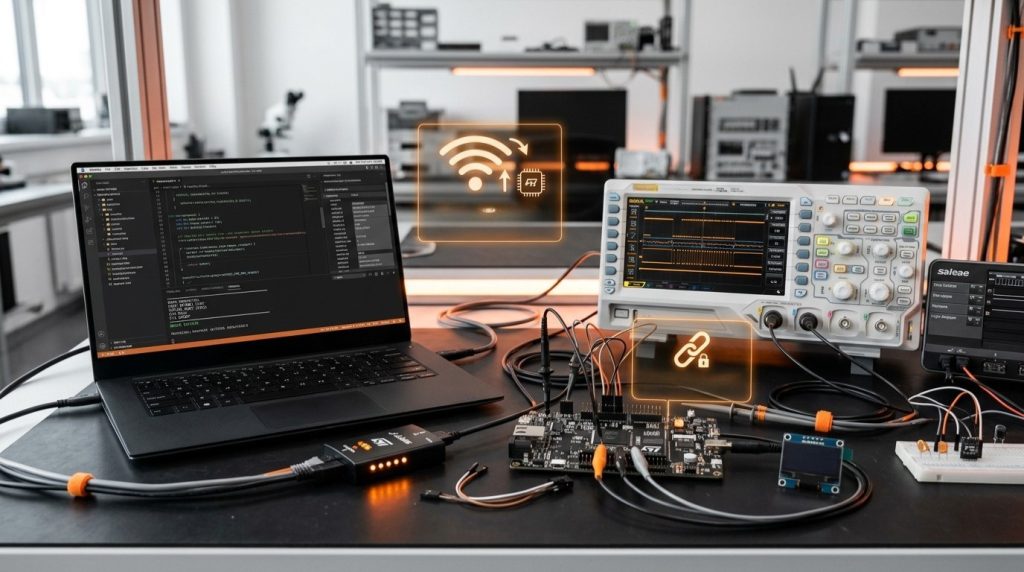
Start at the bottom of the pyramid, not the top
The intuition many teams have is to start with end-to-end tests, because end-to-end tests look like the manual tests they already run. The intuition is wrong. End-to-end tests are slow, sensitive to environmental noise, and expensive to debug when they fail. They are valuable, but they are the wrong place to start, because building reliable end-to-end automation requires a stable foundation underneath it — and you do not have that foundation yet.
Start instead with component tests. Identify the most critical firmware modules in your product — the connection state machine, the security layer, the protocol logic that handles the procedures most likely to break — and write deterministic tests against mocks. Replace the radio with a software stub. Replace the host with a controllable peer. Run these tests in seconds, on every commit, with no hardware in the loop. They will catch logic errors, state machine bugs, and boundary conditions early, when the engineer who introduced them still remembers what they were doing.
The reason to begin here is not just that component tests are easier. It is that they immediately change the development workflow. Engineers see test results within minutes of pushing a change. They start writing tests alongside features because the feedback loop is fast enough to make it worthwhile. The team’s relationship with testing shifts from “thing we do at the end” to “thing the CI tells us about now.” That cultural shift is the most valuable output of the first phase, and it sets up everything that follows.
Wire it into CI from day one
There is a temptation, in the early phase, to treat the test suite as something to develop locally and integrate with CI later. Resist it. The benefit of automated testing comes not from the tests existing but from the tests running automatically and producing visible results that the team responds to. A test suite that runs on one engineer’s machine has a fraction of the value of the same suite running on every commit.
Wire the component tests into a basic CI pipeline immediately, even if the pipeline does nothing more than run the build and the fast tests on every push. The infrastructure does not need to be elaborate. What matters is that there is a single source of truth about whether the code is currently in a passing state, and that this source of truth is consulted automatically rather than relying on someone to remember to run the tests.
Once that loop is closed, the team starts seeing the data. The first failing CI run after a previously passing one tells you, with no ambiguity, exactly which commit broke something. The cost of finding that information manually — by bisecting through a week of changes after a manual regression run — is what manual testing has been hiding from you. The first time CI catches a regression in seconds rather than days, the value proposition of the entire programme becomes self-evident, and the conversation with leadership becomes much easier.
Add integration tests with a hardware test peer
Once component tests are stable and integrated, the next step is integration testing on real hardware. This is the layer where you stop simulating the radio and start using it. The infrastructure investment is real but bounded: a small number of physical devices under test, a hardware test peer (typically an HCI dongle running a Python-controlled BLE host stack, or the equivalent for whatever protocol you use), and a test rig that connects them in a controlled, reproducible setup.
Cover the most common operational paths first. Provisioning. Connection establishment. Data exchange across the primary GATT services or equivalent. Reconnection after induced link loss. These are the scenarios that exercise the largest portion of your firmware in the most realistic way, and they catch the broadest class of integration bugs.
Wire these tests into the CI pipeline as well, but on a slightly different cadence. They run on merges to shared branches rather than every commit, because they take longer and require hardware availability. The pipeline is now two-tiered: fast software tests on every push, slower hardware-in-the-loop tests on every merge. The team gets quick feedback on most changes and deeper validation on integration points, which is exactly the right shape for the development workflow.
This is also the point at which the test rig becomes real engineering infrastructure rather than a pile of hardware on a desk. Version-control the configuration. Document the setup so a second rig can be assembled from scratch by someone who did not build the first. Monitor the rig’s health. A flaky test rig damages velocity at least as much as a flaky test does, and the cure for both is the same: treat the infrastructure with the same discipline as the production code.
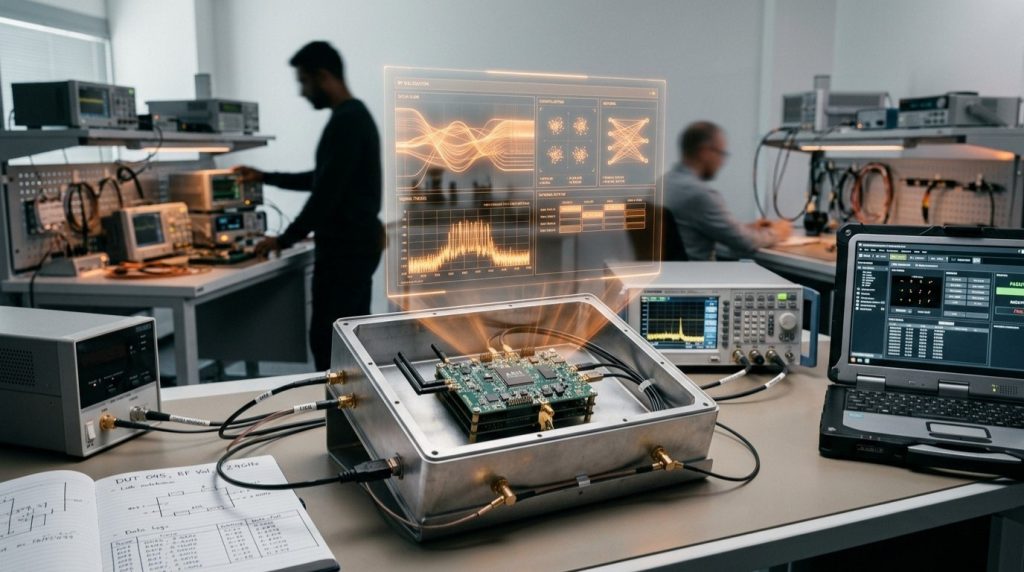
Establish a nightly pipeline before expanding per-commit coverage
The next instinct is often to push end-to-end tests into the per-merge pipeline. Resist that one too, at least at first. End-to-end tests have characteristics — longer execution time, sensitivity to environmental noise, dependency on multiple system components being simultaneously in a known state — that make them uncomfortable to run on every merge. If they fail intermittently, they erode confidence in the entire pipeline. If they take an hour to run, they slow down the merge process and engineers start finding ways around them.
The pragmatic home for end-to-end automation, at least initially, is the nightly pipeline. Each night, an automated job provisions the complete product ecosystem — embedded firmware, mobile application, backend services, frontend if applicable — and runs the full end-to-end test suite. The results become the team’s daily health report. Engineers arrive each morning knowing whether the integrated system is in good shape or whether something introduced the previous day broke a cross-component interaction.
The nightly cadence gives end-to-end tests room to mature. Flakiness can be diagnosed and fixed without blocking active development. Test scenarios can be expanded incrementally. Once the suite has been stable for several weeks, individual tests can be promoted into the per-merge pipeline, where their value is highest. But the migration happens after stability is proven, not before, and that ordering protects the trustworthiness of the merge gate during the period when the end-to-end suite is still finding its feet.
Add the release pipeline once the foundation is reliable
By the time the nightly suite is stable, the team has all the ingredients for a proper release pipeline: fast software tests, hardware integration tests, end-to-end validation, and a CI infrastructure capable of running them on demand. The release pipeline is the layer that ties them together and produces a signed, deployable firmware binary only after every gate has passed.
The discipline of automating the release is more important than it sounds. It transforms a release from a stressful, multi-day human ordeal into a routine pipeline run. It makes the release criteria explicit and objective: the release ships when the pipeline says it can, not when a committee feels comfortable. And it eliminates the “release freeze” culture that builds up in teams where releasing is scary, because a well-automated pipeline makes releasing boring in the best possible way.
Releases become more frequent because they are cheaper. They become safer because they are tested more thoroughly than any human could test them. The release process stops being a bottleneck and starts being an asset.
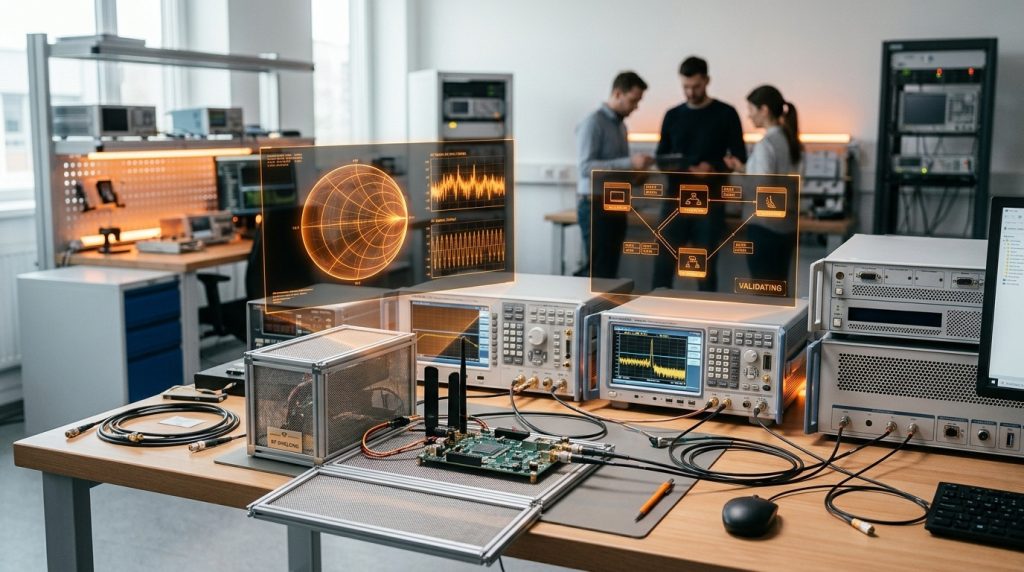
Long-term and specialised tests come last
Stability tests, performance benchmarks, large-scale tests, and competitive analysis suites all sit at the top of the pyramid. They are valuable, sometimes strategically so, but they only pay off once the foundation underneath them is solid. Running long-term stability tests on a firmware build that is not yet validated by integration tests is a waste of both the test infrastructure and the analysis time, because most of what you find is bugs that the lower layers should have caught first.
When the foundation is stable, schedule these tests on the cadence that matches their value. Stability and performance suites can run weekly, or automatically on every release candidate. The results feed into a metrics dashboard that tracks key performance indicators across firmware versions: connection establishment time, throughput percentiles, memory headroom after seventy-two hours of operation, reconnection rate after induced link drops. Any metric that drifts outside its historical range triggers an alert. The team gains a quantitative view of product quality over time that is impossible to obtain from manual testing at any cost.
Certification automation, security testing, and competitive benchmarking each follow the same pattern: useful, sometimes critical, but most effective once the layers below them are producing reliable signal.
Common pitfalls worth flagging explicitly
A few patterns recur often enough across teams attempting this kind of programme that they are worth flagging explicitly, because each of them is easier to avoid than to recover from.
The first is investing heavily in tooling before validating that the workflow change is being adopted. A team can build an exquisite component test framework that nobody writes tests for, because the cultural shift toward writing tests alongside features has not happened yet. The framework becomes the bottleneck blamed for the lack of adoption, when in fact the issue is upstream: engineers are not yet seeing test results as part of their development loop. The cure is to invest in the workflow integration first — a working CI pipeline that produces visible results — and let the demand for better tooling emerge from people actually using the system.
The second is over-engineering the test rig in the first iteration. The temptation is to build the test bench that supports every future use case the team can imagine. The result is a complex piece of infrastructure that takes months to commission and is brittle to changes in any of its components. A better approach is to build the simplest bench that supports the immediate need, get it producing results, and let the future use cases drive incremental additions when they actually arise. A test rig is much easier to extend than to redesign, so starting small and growing incrementally is almost always the right move.
The third is allowing flaky tests to remain in the merge gate. A flaky test — one that fails intermittently for reasons unrelated to the code change being tested — corrodes trust in the entire pipeline. Engineers learn to retry on failure rather than investigate, and from there it is a short step to ignoring failures altogether. The discipline that protects against this is unforgiving: a test that flakes is either fixed within a defined window or removed from the gate. There is no third option that preserves the value of the suite, and teams that try to find one usually end up with a pipeline that nobody trusts.
The fourth is treating test code as second-class. Test code is production code. It deserves the same review standards, the same refactoring discipline, and the same architectural thought as the firmware it tests. A test suite that grows organically without engineering rigour becomes a maintenance burden of its own, and eventually the team starts skipping tests because updating them costs more than rewriting them. This is a slow-motion failure mode that is genuinely hard to reverse once the test code has accumulated enough debt.
The investment is real, and so is the return
The pragmatic path is incremental, not heroic. It does not require a six-month foundational project before any value is delivered. It requires picking the right first slice, wiring it into CI immediately, and expanding from there in an order that lets each new layer build on the stability of the one below.
The teams that follow this path tend to find that the value shows up earlier than they expected, the cultural shift it produces is more important than they expected, and the cumulative effect after a year or two — the speed of releases, the confidence in refactoring, the absence of weeks-long pre-release crunches — is genuinely transformative for how the team works. The investment is real. So is the return. And the return starts compounding the moment the first commit triggers the first automated test.
needCode designs and delivers automated test systems for embedded wireless products end-to-end: analysis, planning, framework implementation, hardware test bench construction, and CI/CD integration. We have walked this incremental path many times across BLE mesh, multi-protocol IoT, LTE-connected devices, and BLE mobile applications. If you are deciding where to put the first dollar, we are happy to help you scope it.
Book a free discovery call or get in touch
Further reading
- Anatomy of a Production OTA Pipeline — the release pipeline this article advocates building once the foundation is reliable
- Documentation as a Product: How Good SDKs Treat Docs as Code — same “treat test code as production code” frame applied to docs; both arguments share the discipline this article calls for in the “Common pitfalls” section
- Semantic Versioning Isn’t Enough for Embedded SDKs — release discipline that depends on having the pipeline this article walks you toward
- BLE Over-the-Air Firmware Updates: How to Ship Updates That Don’t Brick Devices — production reliability that the four-tier pipeline protects