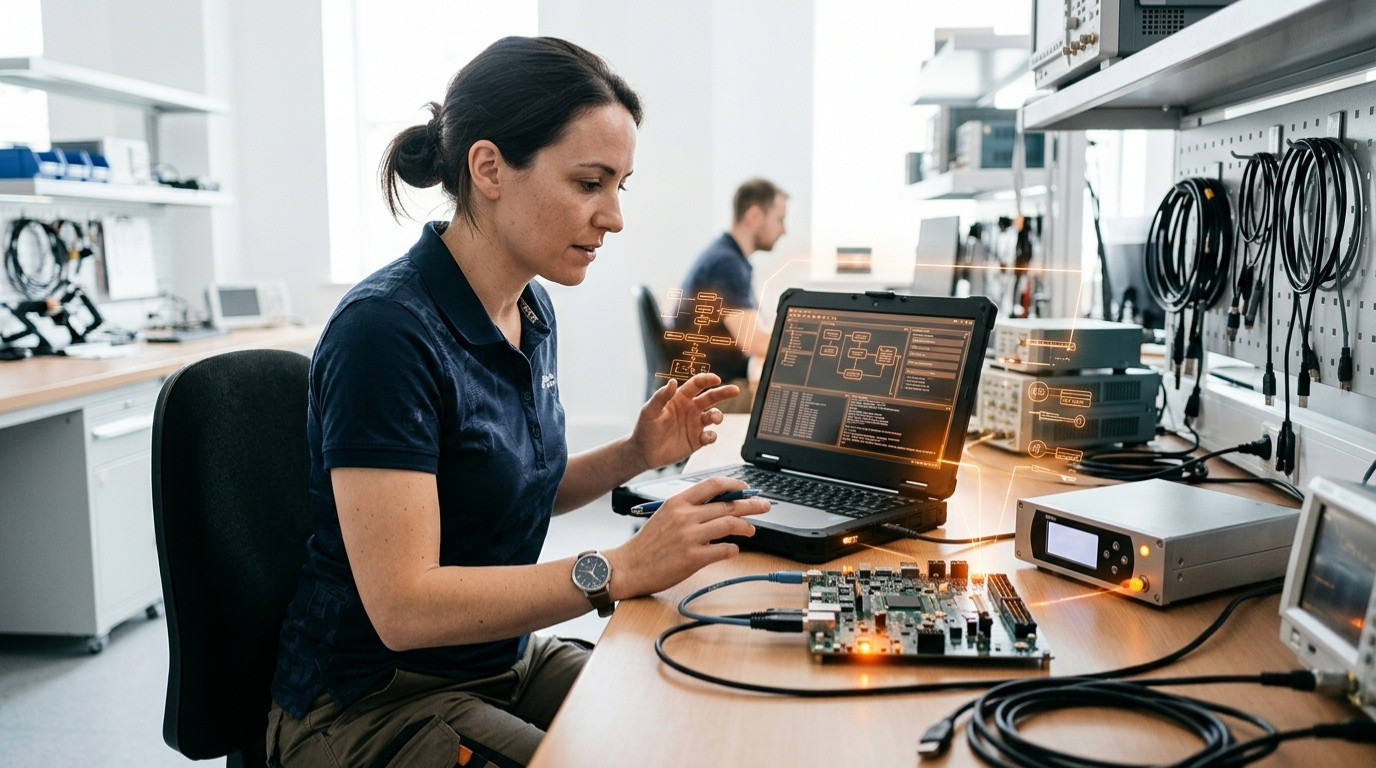
There is a particular ritual in Bluetooth product development that anyone who has been through it remembers vividly.
It is the manual qualification regression: sitting in front of a Windows machine running the Profile Tuning Suite, clicking through hundreds of test cases over the course of a week or two, interpreting results that range from cryptic to genuinely ambiguous, and re-running the cases that fail or hang or produce results that need a senior engineer’s judgement to interpret. The ritual happens before every certification submission, sometimes more than once, and for many teams it is the single longest manual activity in the entire release cycle.
This article is about why that ritual exists, why it is mostly avoidable, and what it looks like to replace it with an automated process that runs overnight and catches qualification regressions on the day they are introduced rather than weeks later when someone finally has time to run the tests.
What Bluetooth qualification actually is
Before discussing automation, it is worth being clear about what we are automating, because the terminology in this corner of the industry can be confusing. Bluetooth qualification is the formal process by which a product is verified to comply with the Bluetooth specification. The Bluetooth Special Interest Group — the standards body that owns the specification — operates a qualification programme that any product using the Bluetooth name and logo must complete. Products that do not pass qualification cannot legally be marketed as Bluetooth devices, regardless of how well they actually work.
The qualification process has several components, but the technical core of it is testing. The specification defines hundreds of test cases, organised by profile and by feature. A device claiming to support a particular profile must pass the relevant test cases for that profile. The test cases probe specific protocol behaviours: this profile must respond to that procedure with this message under those conditions, in that timing window, with these field values. The cases are exhaustive in the sense that they collectively define what conformance to the specification means.
To run these test cases, the Bluetooth SIG provides a tool: the Profile Tuning Suite, almost universally referred to as PTS. PTS is a Windows application that you connect to the device under test through a Bluetooth interface — usually a USB Bluetooth dongle that PTS controls — and that drives the device through the test cases. For each case, PTS sends specific stimuli to the device, observes the device’s responses, and reports whether the responses match what the specification requires. The test report it generates becomes part of the qualification submission to the SIG.
So far this all sounds reasonable. The painful part is what running PTS actually involves in practice.
Why manual PTS is so painful
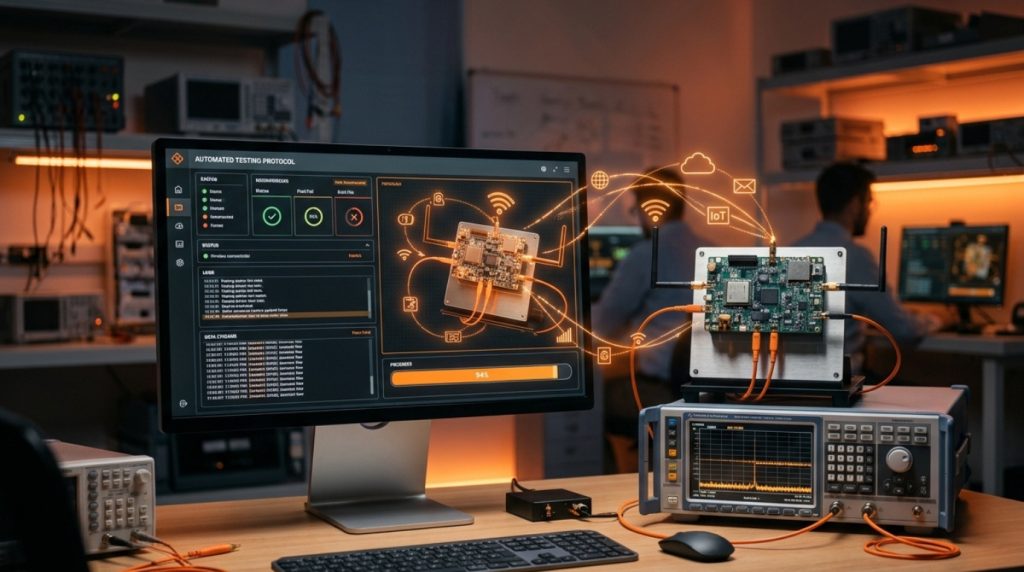
Imagine you are a firmware engineer responsible for the Bluetooth qualification of your product. You sit down in front of the PTS application. You select a profile — say, the Generic Attribute Profile — and PTS shows you a list of test cases for that profile. There are dozens, sometimes hundreds, depending on which features your product supports. You select the first test case and click Run. PTS prompts you to put the device under test into a specific state — perhaps “configure the device to advertise as a peripheral with bondable mode enabled” — and waits for you to confirm the device is ready.
You configure the device. Click Confirm. PTS runs the test case. After a few seconds, it produces a result. If the result is Pass, you move to the next case. If it is Fail, you read the failure message, try to understand which protocol exchange went wrong, decide whether the failure is a real bug or a test-environment artifact, and either log the failure or re-run the case. If it is Inconclusive — a remarkably common outcome — you need to investigate why and decide what to do.
Now multiply this by several hundred test cases per profile, several profiles per product, and the inevitable re-runs that happen when the device is reset between cases or when an unrelated piece of test infrastructure misbehaves. The total elapsed time for a full qualification regression on a non-trivial product runs into weeks of an experienced engineer’s time. The work is tedious, error-prone, and requires enough specialist knowledge that you cannot easily delegate it to a junior tester or a contractor.
The result is that qualification regressions happen rarely — typically once per release, sometimes once per certification submission — and they happen at the worst possible time, when the team is already racing toward a release deadline. Specification regressions introduced weeks earlier are discovered during the regression run, debugged under time pressure, and fixed in haste. The whole process is a structural disaster, and it is widely accepted in the industry as just how things are.
The myth that PTS cannot be automated
The reason PTS is still mostly run manually is largely cultural rather than technical. PTS was designed as a Windows application with a graphical user interface, and for years the assumption was that this design implied manual operation. The application’s user interface drove the test selection, the test execution, the prompts to the operator, and the result interpretation. The presumption was that a human had to be in the loop because the application expected one.
This presumption is incorrect, and recognising why it is incorrect is the key to automation. PTS is a Windows application, but Windows applications can be driven programmatically. Windows UI automation frameworks — including the built-in UI Automation API, as well as third-party tools — let scripts find buttons, click them, read text fields, and observe state changes in any Windows application, including PTS. The fact that PTS was designed for human operators does not mean a script cannot be a fully convincing operator.
The other half of the automation puzzle is on the device side. Manual PTS sessions require the operator to put the device into specific states between test cases. To automate the operator-side, you need a way to put the device into those states programmatically — which is exactly what a well-designed serial API on the device provides. The test orchestrator that drives PTS through UI automation also drives the device through its serial API, so the entire test sequence — set device state, run PTS test case, capture result, set next device state, run next test case — happens without any human intervention.
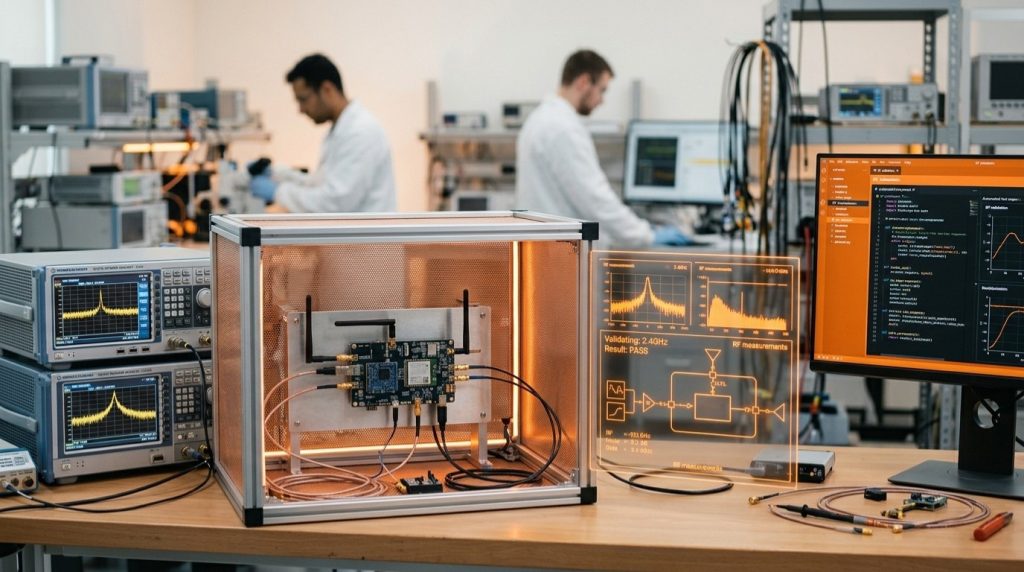
Once you accept that PTS can be automated, the architecture becomes straightforward. A test orchestrator runs on the same Windows PC as PTS. The orchestrator selects a test case in PTS, configures the device under test through its serial API to be in the right state, signals PTS to start the case, waits for PTS to complete, reads the result from the PTS output, and moves to the next case. The orchestrator handles the entire test matrix — every profile, every test case, every device state — without ever requiring an engineer to touch the keyboard.
What this looks like in practice
In a properly automated PTS setup, the test runner kicks off in the evening and produces a full qualification report by morning. A regression run that took a senior engineer two weeks of full-time work now takes one night of unattended machine time. The economics of qualification testing change qualitatively. You can afford to run the full regression on every release candidate, on every nightly build, even on every merge to the main branch if the test rig has the throughput. Specification regressions become detectable on the day they are introduced.
This is not a marginal improvement. It is the difference between qualification being a release-blocking, weeks-long event and qualification being a property of the codebase that is continuously verified. The cultural shift that follows is significant: engineers stop fearing changes that touch Bluetooth code, because the qualification suite catches regressions immediately. The team stops budgeting weeks of senior engineer time for pre-certification scrambles. Certification submissions become routine rather than dramatic.
There is also a quality dimension that is easy to underestimate. Manual PTS regressions are inconsistent across runs because human operators get tired, make mistakes, and exercise judgement differently on ambiguous cases. Automated regressions are consistent: the same test produces the same result every time, the criteria for passing are defined in code, and the result history is preserved verbatim across runs. The team’s relationship with the qualification data shifts from “we ran the tests, here’s what we remember” to “here is the full result history across the last hundred runs, which can we drill into.” That data, once it exists, becomes useful for debugging, for trend analysis, and for diagnosing intermittent test failures that no individual run would have surfaced.
Beyond Bluetooth
The pattern of “specification body provides a manual test tool, the team replaces manual operation with automated orchestration” is not unique to Bluetooth. The same approach applies to several other wireless certification regimes that wireless embedded teams encounter routinely. Thread certification involves a test tool that can be driven similarly. Matter certification — the increasingly important standard for smart home devices — has a test framework that explicitly supports automated execution. Zigbee certification follows the same general structure. Wi-Fi Alliance certification programmes increasingly expose hooks for automation.
In each case, the principle is the same: the certification test suite represents formalised conformance to the specification, and automating its execution turns conformance from a release-time question into a continuous one. The implementation details differ — different test tools, different control interfaces, different result formats — but the architectural pattern of orchestrator plus device-side test API generalises cleanly.
A team that has invested in PTS automation has built infrastructure that will pay off again the next time a new wireless protocol is added to the product, because the same orchestrator design and the same device-side serial API support the new protocol’s certification suite with relatively modest extension. Certification automation, like a test control plane, is infrastructure with compounding returns.
The regression that never happens
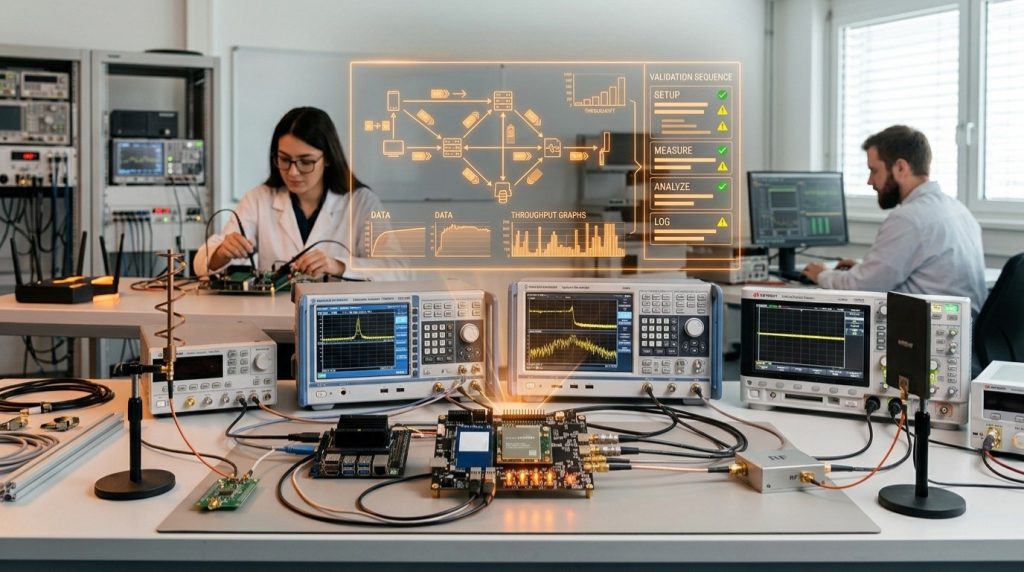
Perhaps the most underappreciated benefit of automated qualification testing is the regression that never happens — the specification compliance bug that gets caught the day it is introduced, fixed within hours, and never comes anywhere near a certification submission. Manual qualification testing finds these bugs eventually, but it finds them weeks later when the original change has been built upon by other work and the cost to revert or fix is high. Automated testing finds them when the change is fresh, the engineer who made it is still at their desk, and the cost to fix is minimal.
Over time, this changes the culture around Bluetooth changes in the codebase. Engineers stop being cautious about touching protocol code, because the cost of an inadvertent regression is hours of work rather than weeks. Refactoring becomes safe. Performance improvements become possible. The codebase stays healthier for longer, which compounds into a faster release cadence and a more competitive product.
The reason most teams have not made this transition is not that the automation is impossible — clearly it is not, since teams have done it. The reason is that the cost of the manual process is borne by the people running the regression, who are typically not the people deciding where to invest engineering effort. The decision to automate qualification testing is therefore an organisational decision as much as a technical one: someone has to recognise that the weeks of senior engineer time spent on every regression run are a real cost, and that the investment to eliminate it pays back many times over the life of the product.
For the teams that have made the decision, the answer is unambiguous. Manual PTS is a relic. The path to overnight qualification testing is well-trodden, the technical components are well-understood, and the cultural and operational benefits of making the move are large. The transition is not free, but it is an investment that compounds for as long as the product remains in development — which, for any successful Bluetooth product, is years.
needCode designs and delivers automated test systems for embedded wireless products, including PTS automation and certification orchestration for Bluetooth Mesh, BLE peripherals, and other wireless qualification regimes. We have replaced multi-week manual regressions with overnight automated runs across multiple production engagements. If your release cadence is constrained by manual qualification testing, we are happy to talk through what changing that would involve.
Book a free discovery call or get in touch
Further reading
- What Makes a Wireless SDK Different from an MCU SDK — the certification landscape this automation sits inside, including BLE Qualified Design listings and their SDK version dependencies
- Bluetooth Low Energy — needCode’s BLE stack and qualification infrastructure this post’s automation approach is built around
- End-to-End Testing — the broader HIL and automated test infrastructure that PTS automation extends
- Anatomy of a Production OTA Pipeline — the release pipeline that qualification automation feeds into as a continuous gate