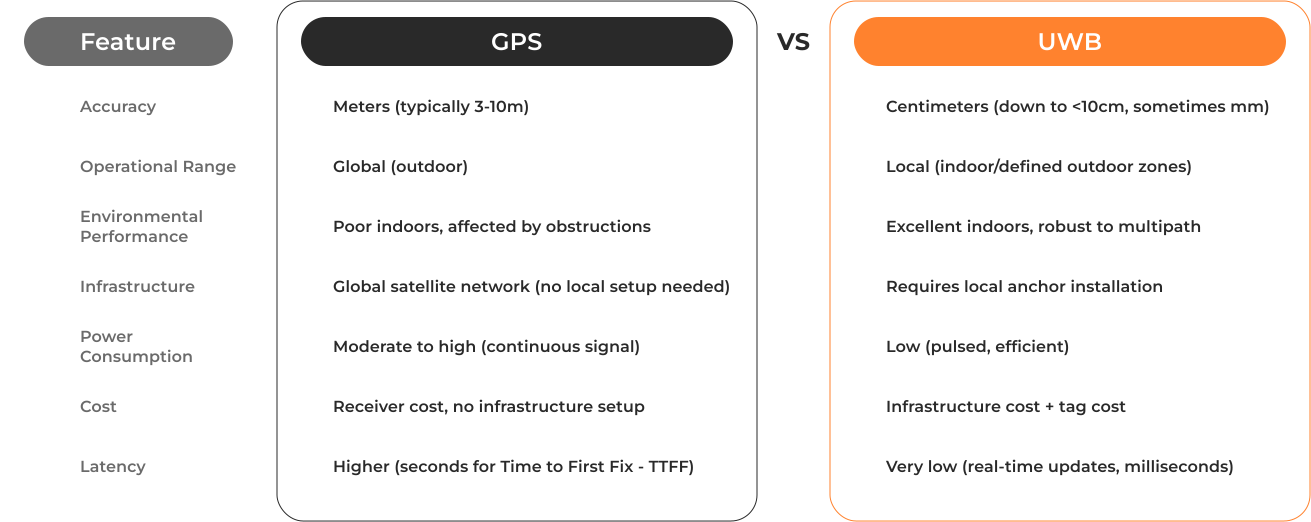
Businesses require precise location data for optimal operations and safety. While GPS excels outdoors, Ultra-Wideband (UWB) is superior indoors, offering extreme accuracy and reliability where GPS falters due to signal limitations. This distinction is crucial for determining the best tracking technology for specific business needs.
Strategic Positioning: Understanding UWB and GPS
Our goal here is to meticulously compare UWB and GPS to highlight their distinct capabilities. Understanding these differences isn’t just academic; it’s critical for making informed business decisions that impact everything from asset management to employee safety. We’ll pinpoint the specific scenarios where one technology significantly outperforms the other.
UWB and GPS: Core Definitions
At its heart, GPS (Global Positioning System) is a satellite-based navigation system that provides location, velocity, and time synchronization. It relies on a constellation of satellites orbiting Earth, transmitting signals to receivers on the ground.
UWB (Ultra-Wideband), on the other hand, operates fundamentally differently. Instead of relying on satellites for broad-area coverage, it’s a short-range radio technology that uses extremely short electrical pulses across a very wide spectrum of frequencies. This unique approach allows it to provide highly precise spatial awareness and real-time location in more localized environments. Understanding when to leverage the global reach of GPS versus the pinpoint accuracy of UWB is key to optimizing your tracking solutions.
Global Positioning System (GPS) – Fundamentals and Applications
GPS functions by receiving signals from multiple satellites. Each satellite transmits precise timing and orbital data. Your GPS receiver calculates its distance to each satellite by measuring the time delay of these signals. By knowing the exact positions of at least four satellites and their distances, the receiver can pinpoint its own location through a process called trilateration. This complex calculation determines a precise position on or above the Earth’s surface.
Key GPS Features
- Global Coverage: GPS offers near-ubiquitous coverage across the globe, making it ideal for vast geographic areas.
- Range: It excels in outdoor environments where there’s an unobstructed line of sight to satellites.
- Accuracy: Typically, GPS provides accuracy within a few meters. However, this can vary significantly depending on factors like atmospheric conditions, satellite geometry, and signal interference.
- Environmental Impact: Buildings, dense foliage, and urban canyons are major impediments. They can block or reflect satellite signals, leading to degraded accuracy or complete signal loss.
Typical GPS Applications
You’ll find GPS underpinning a wide range of applications:
- Navigation in cars and for pedestrians.
- Logistics and fleet management, tracking vehicles across regions.
- Geodetic surveying and precision mapping for outdoor projects.
- Tracking for outdoor sports and recreation.
GPS Limitations
Despite its widespread use, GPS has significant drawbacks for certain business needs:
- Poor Indoor Precision: This is GPS’s most critical limitation. Signals struggle to penetrate buildings, leading to highly inaccurate or unavailable positioning indoors.
- Energy Consumption: GPS receivers typically require consistent power, which can be a limiting factor for battery-dependent devices that need long operational times.
- Time to First Fix (TTFF): There’s often a delay in acquiring an initial position lock, especially after a prolonged period of inactivity or movement.
- Line-of-Sight Dependency: GPS needs a clear view of the sky to receive satellite signals, making it unsuitable for subterranean or heavily obstructed environments.
Ultra-Wideband (UWB) – Fundamentals and Potential
UWB operates on a fundamentally different principle than GPS. Instead of continuous signals, it sends out a series of very short, low-power radio pulses. These pulses spread across a very wide frequency band, making them highly resistant to interference.
UWB determines location using two primary methods:
- Time of Flight (ToF): By measuring the time it takes for a UWB pulse to travel between a transmitting tag and multiple stationary anchors (reference points), the system can precisely calculate distances.
- Angle of Arrival (AoA): This method uses multiple antennas on an anchor to detect the direction from which a UWB signal arrives, enabling precise angular positioning.
This approach requires a local infrastructure of UWB anchors strategically placed within the desired tracking area, communicating with mobile tags (the devices or assets being tracked).
Key UWB Features
UWB’s unique operational model provides several compelling advantages:
- Very High Precision: UWB delivers accuracy down to centimeters, and in ideal conditions, even millimeters. This level of precision is unmatched by GPS.
- Multipath Immunity: Because UWB pulses are so short and broadband, they are highly resilient to signal reflections (multipath interference) that plague other radio technologies, ensuring reliable positioning even in complex indoor environments.
- Low Energy Consumption: UWB devices can achieve very low power consumption due to their pulsed nature, making them suitable for battery-powered tags that need to operate for extended periods.
- Security: The low power spectral density and wide bandwidth of UWB signals make them inherently difficult to intercept or jam, enhancing security for sensitive applications.
Typical UWB Applications
UWB’s capabilities make it ideal for high-precision, real-time business applications:
- Real-Time Location Systems (RTLS): Essential for tracking assets and personnel in industrial settings like factories and warehouses, hospitals, and large offices.
- Precision asset and tool tracking: Knowing the exact location of critical equipment or tools on a manufacturing floor or construction site.
- Indoor navigation: Providing accurate wayfinding in complex structures such as shopping centers, airports, and large corporate campuses.
- Keyless entry systems: Found in modern automotive applications and secure building access, offering highly secure and precise proximity detection.
- Athlete tracking: Monitoring precise movements and performance in indoor sporting venues.
- Mobile applications: Enabling highly accurate proximity-based features like secure contactless payments or peer-to-peer data sharing (e.g., Apple’s AirDrop).
UWB Considerations for Implementation
While powerful, UWB requires strategic deployment and an understanding of its integration:
- Required Local Infrastructure: Unlike global satellite-based systems, UWB operates by relying on a network of strategically placed anchors within the target environment. This necessitates an initial setup phase to install these reference points.
- Evolving Standards: UWB technology is undergoing rapid development, with ongoing efforts to standardize protocols and ensure interoperability across various devices. This dynamic evolution also presents opportunities for future advancements and broader adoption.
- Signal Propagation in Challenging Environments: While UWB excels at penetrating many common obstructions, extremely dense or highly reflective materials can influence signal performance. Effective system design and anchor placement are key to mitigating these effects and ensuring robust operation in diverse architectural layouts.
UWB vs. GPS: Direct Comparison
When Ultra-Wideband Technology is the Superior Tracking Option
The choice between UWB and GPS boils down to your specific operational needs. For broad-area outdoor tracking, GPS remains an indispensable tool. However, for a growing number of business-critical applications, UWB’s precision and reliability deliver significant advantages.
Optimal Scenarios for UWB
UWB shines in demanding environments and applications where traditional GPS simply falls short:
- Real-Time Location Systems (RTLS) in indoor environments: If you need to track assets, vehicles, or personnel within a factory, warehouse, hospital, or office building, UWB is the definitive solution. It works seamlessly where GPS signals can’t penetrate.
- Precision Asset and Personnel Tracking: When every centimeter counts for operational efficiency, safety compliance, or inventory accuracy—think tool management on a manufacturing line or worker safety zones—UWB provides the necessary granularity.
- Indoor Navigation: For large, complex facilities like airports, convention centers, or multi-floor office buildings, UWB enables accurate, real-time indoor navigation systems, guiding people and optimizing traffic flow.
- Access Control and Security Systems: Applications requiring extremely high precision for secure entry, geofencing, or asset protection benefit immensely from UWB’s low latency and fine-grained proximity detection.
- AR/VR Applications: For augmented or virtual reality experiences that seamlessly blend digital content with the physical world, UWB offers the precise, real-time positioning required for true immersion and interactive engagement.
Scenarios Where GPS Remains Dominant
While UWB takes the lead in precision indoor tracking, GPS still holds its crown in other areas:
- Global Outdoor Navigation: For any application requiring broad-area, open-sky positioning, GPS is the practical and established choice.
- Applications where lower accuracy is acceptable: If meter-level precision is sufficient for your outdoor asset tracking or logistics needs, GPS is often more cost-effective due to its lack of required local infrastructure.
- When local infrastructure installation is impossible or impractical: In remote outdoor areas or temporary setups where deploying UWB anchors isn’t feasible, GPS provides a readily available solution.
Conclusion
Choosing between UWB and GPS isn’t about one being universally “better” than the other; it’s about selecting the right tool for the job. While GPS remains foundational for global outdoor navigation, UWB stands out as the superior technology for businesses requiring high-precision, real-time, and robust location services, particularly within indoor environments. By understanding their fundamental differences and aligning them with your specific operational demands, you can make a strategic technology choice that drives real business value.
If you are looking for a UWB solutions company, then read our article on Top 10 Ultra-Wideband (UWB) Development Companies