Free e-book: IEEE 802.15.4ab vs IEEE 802.15.4z
Free e-book: IEEE 802.15.4ab

IEEE 802.15.4ab vs IEEE 802.15.4z

From Secure Ranging to a Unified UWB Platform

Stop designing UWB systems around first-generation constraints. This whitepaper provides a system-level framework for understanding how IEEE 802.15.4ab extends Ultra-Wideband from short, secure ranging exchanges into a scalable, multi-mode wireless platform.

needCode IoT

We work with Industry Leaders

What IEEE 802.15.4ab Changes in UWB System Architecture

The competitive advantage no longer lies in simply supporting secure ranging. The real challenge is architecting UWB systems that remain robust, power-efficient, and extensible as deployments scale.

This whitepaper explains how IEEE 802.15.4ab introduces architectural capabilities that were impractical or fragmented under IEEE 802.15.4z—while explicitly preserving backward compatibility with existing devices.

Why IEEE 802.15.4ab Unlocks New Classes of UWB Applications

From First-Generation UWB to Platform-Level Capabilities IEEE 802.15.4z established UWB as a secure proximity and ranging technology. IEEE 802.15.4ab expands that foundation into a platform-level standard, combining ranging robustness, low-energy operation, data transfer, and sensing within a unified framework.

Key Takeaways from the IEEE 802.15.4ab Whitepaper

  • Extend reliable UWB operation into NLOS, body-blocking, and dense RF environments using IEEE 802.15.4ab Multi-Millisecond (MMS) ranging.
  • Enable battery-powered tags and sensors through low-energy operation, without relying on external wake-up radios
  • Support new application classes – data exchange, sensing, and hybrid architectures – without fragmenting the protocol stack or breaking interoperability

From Secure Ranging to System-Level Trade-Offs in IEEE 802.15.4ab

The following insights explain how IEEE 802.15.4ab changes what is architecturally possible with UWB – from isolated ranging links to system-level design decisions.

Beyond Short Ranging Exchanges in IEEE 802.15.4ab

IEEE 802.15.4z optimized UWB for fast, burst-based ranging. IEEE 802.15.4ab introduces longer, energy-accumulating ranging sessions, trading microsecond-level latency for dramatically improved link budget and stability. This enables operation in environments where first-generation UWB struggled due to attenuation, multipath, or body obstruction.

Low-Energy Operation Introduced

With wake-up signaling and Low-Energy UWB modes, IEEE 802.15.4ab allows devices to remain dormant until explicitly activated. This shifts UWB from an always-listening radio to a selectively active system – making standalone, battery-powered UWB devices feasible at scale.

UWB as a Multi-Role Radio in IEEE 802.15.4ab

IEEE 802.15.4ab formalizes what was previously proprietary or out-of-scope: using UWB not only for ranging, but also for short-range data transfer and radar-class sensing. Standardized packet formats and Channel Impulse Response (CIR) access allow positioning, sensing, and communication to coexist within a single architecture.

Backward Compatibility Between IEEE 802.15.4ab and IEEE 802.15.4z

IEEE 802.15.4ab is explicitly designed to interoperate with IEEE 802.15.4z enhanced ranging devices. This enables phased migration strategies and mixed deployments – critical for automotive platforms and RTLS systems with long product lifecycles.

Why Read This IEEE 802.15.4ab Whitepaper

This is a practical guide for technical leaders, system architects, and decision-makers evaluating when IEEE 802.15.4ab is transformativ – and when IEEE 802.15.4z remains sufficient.

Download the whitepaper to gain a clear framework to:

01

Understand which IEEE 802.15.4ab features materially change system feasibility versus those that are incremental.

02

Evaluate architectural trade-offs between robustness, latency, power consumption, and implementation complexity.

03

Assess new application classes enabled by standardized sensing and low-energy operation in IEEE 802.15.4ab.

04

Plan migration paths that preserve interoperability while future-proofing UWB platforms.

05

Reduce long-term risk by aligning designs with emerging IEEE 802.15.4ab-based ecosystems rather than proprietary extensions.

Master the Next Phase of UWB System Design with IEEE 802.15.4ab

The adoption of UWB and Aliro extends value far beyond a single-use case, creating opportunities for significant portfolio expansion.

From Point Solutions to Platform Thinking

IEEE 802.15.4ab marks a shift from UWB as a narrowly scoped security technology to a general-purpose short-range wireless platform. Understanding this shift early is critical for automotive and RTLS teams making long-term architecture decisions.

Building on Standards, Not Workarounds

To avoid fragile, proprietary systems, next-generation UWB designs must be grounded in standardization. This whitepaper explains how IEEE 802.15.4ab aligns with emerging interoperability ecosystems, enabling scalable, multi-vendor deployments.

What IEEE 802.15.4ab Unlocks That Was Not Practical Before

Capability

Robust ranging in NLOS and harsh RF environments
Scalable battery-powered UWB devices
UWB sensing and radar-class applications
Flexible range vs throughput trade-offs
Platform-level UWB architectures
Long-term interoperability and migration paths

Why it was limited with IEEE 802.15.4z

Short, burst-based ranging limited total signal energy and link budget.
No native wake-up mechanism; required duty cycling or secondary radios.
Sensing based on proprietary or non-standard implementations.
Fixed operating envelope optimized mainly for secure ranging.
UWB primarily treated as a point feature (e.g., digital key ranging).
Ecosystem tied tightly to first-generation profiles.

What IEEE 802.15.4ab enables

Multi-Millisecond (MMS) ranging accumulates energy over longer exchanges.
Wake-up signaling and Low-Energy UWB (LE-UWB) modes.
Standardized sensing packets and Channel Impulse Response (CIR) access.
Extended PHY modes enabling both lower and significantly higher data rates.
Multi-mode operation combining ranging, data, sensing, and low-power modes.
Explicit backward compatibility with IEEE 802.15.4z enhanced ranging devices.

Impact on real systems

Stable operation in garages, factories, parking structures, and body-blocked scenarios.
Standalone UWB tags and sensors with lower power draw and simpler BOM.
Interoperable presence detection, in-vehicle sensing, and industrial safety use cases.
Ability to design for robustness, latency, or throughput depending on use case.
Cleaner system architectures with fewer workarounds and protocol fragmentation.
Mixed deployments and phased upgrades without breaking existing systems.

FAQ – IEEE 802.15.4ab

IEEE 802.15.4ab is the next-generation Ultra-Wideband (UWB) amendment that extends IEEE 802.15.4z by adding longer-range and more robust ranging, low-energy operation, higher data throughput, and standardized UWB sensing—while remaining backward compatible with existing 4z devices.

IEEE 802.15.4z focuses on short, secure ranging exchanges optimized for proximity use cases.
IEEE 802.15.4ab expands UWB into a multi-mode platform by introducing Multi-Millisecond ranging, low-energy modes, wake-up signaling, and sensing support, enabling new system architectures and application classes.

No – IEEE 802.15.4ab is backward compatible with IEEE 802.15.4z.
4ab devices can interoperate with 4z enhanced ranging devices, allowing phased migration and mixed deployments in automotive and RTLS systems.

IEEE 802.15.4ab addresses limitations observed in scaled deployments, including:
• Reduced robustness in NLOS and body-blocking scenarios;
• High power consumption from always-on listening;
• Lack of standardized UWB sensing and data transfer;
• Fragmented architectures relying on proprietary extensions.

MMS ranging in IEEE 802.15.4ab spreads a ranging exchange over multiple milliseconds to accumulate signal energy. This significantly improves link budget and stability compared to short, burst-based ranging used in IEEE 802.15.4z, especially in harsh RF environments.

Yes. IEEE 802.15.4ab introduces Low-Energy UWB modes and wake-up signaling, allowing devices to remain dormant until explicitly activated. This makes standalone, battery-powered UWB tags and sensors feasible without relying on external radios.

Yes. IEEE 802.15.4ab standardizes UWB sensing by defining packet formats and access to Channel Impulse Response (CIR) data. This enables radar-class applications such as presence detection, motion sensing, and in-vehicle vital sign detection.

Yes. IEEE 802.15.4ab directly targets automotive constraints, including NLOS robustness, body blocking, power efficiency, sensing, and long product lifecycles—while preserving compatibility with existing digital key and access systems based on 802.15.4z.

IEEE 802.15.4ab should be considered when:
• Ranging stability in difficult RF conditions is critical;
• Battery-powered UWB devices are required;
• Sensing or data transfer is part of the roadmap;
• Long-term platform scalability and interoperability matter.

The standard is designed for ecosystem adoption and backward compatibility. Production readiness depends on silicon, stack maturity, and certification profiles, which this whitepaper addresses from a system and implementation perspective rather than a purely theoretical one.

Download the technical whitepaper

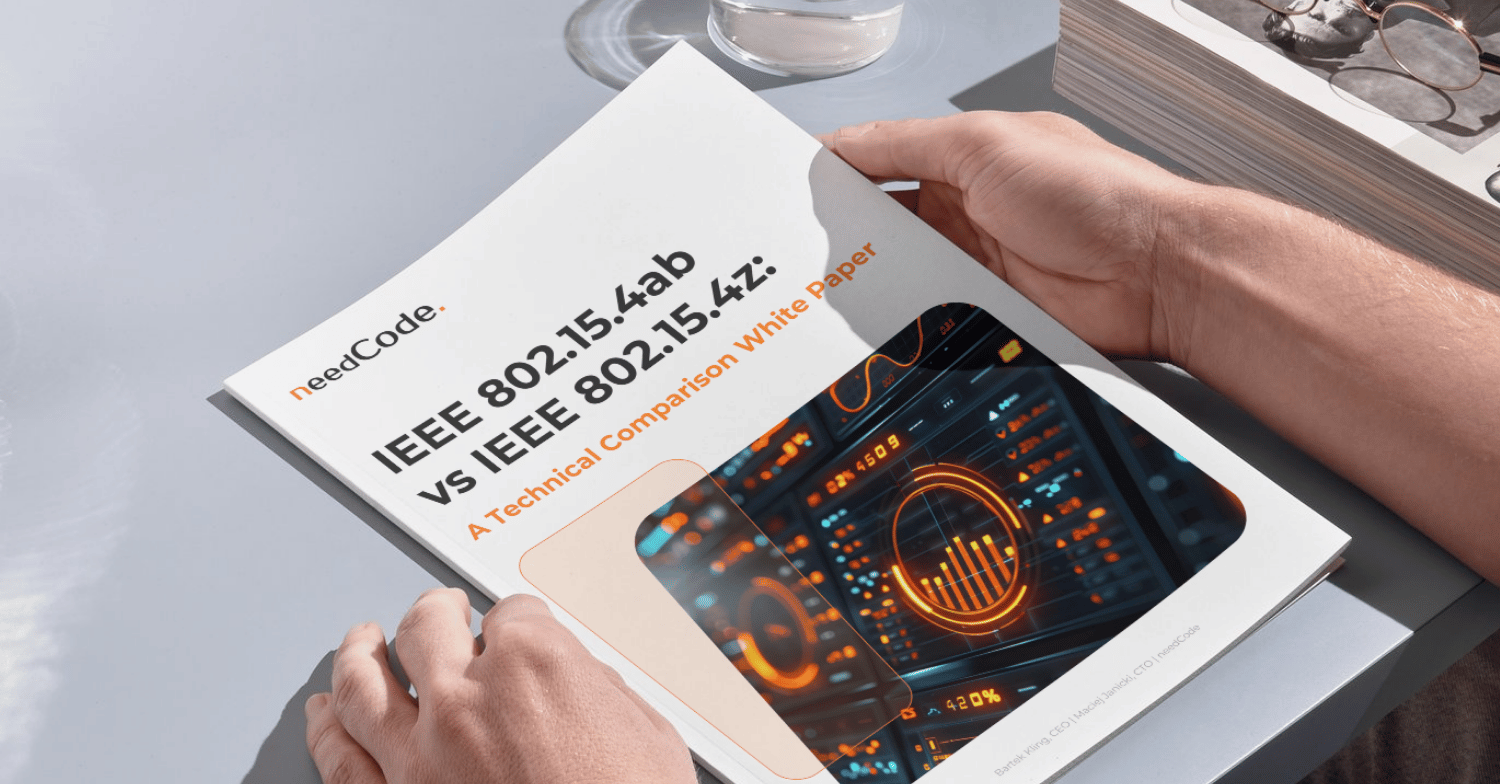
IEEE 802.15.4ab vs IEEE 802.15.4z: System-Level Implications for Automotive and RTLS Platforms

Access Your Complimentary E-Book

Please provide your details to receive immediate access to "IEEE 802.15.4ab vs IEEE 802.15.4z: System-Level Implications for Automotive and RTLS Platforms" and learn how to position your organization for market leadership.

Your expert partner in UWB integration Empowering Innovation, from Concept to Deployment

At needCode, we don't just integrate technology; we empower innovation.

As a trusted Qorvo Partner, we bring deep expertise in the Aliro standard, UWB technology, and specifically, Qorvo's QM35825 module. We are a leading system integrator and the go-to company for UWB implementation, helping manufacturers like you navigate the complexities of cutting-edge wireless technology.
needCode Qorvo ioT

Choose needCode for:

Specialized Expertise:

We possess unparalleled knowledge of Aliro, UWB, and the QM35825, ensuring optimal performance for your products.

Proven Partnership:

Our strong, established relationship with Qorvo means you benefit from direct access to the latest advancements and dedicated support.

End-to-End Solutions:

We provide comprehensive integration services that accelerate your time-to-market and de-risk your development process.

Let's work on your next project together

Book a demo and discovery call with our CEO
to get a look at:
Strategic Expertise
End-to-End Solutions
Advanced Technology
Custom Hardware Devices
Bartek Kling
Bartek Kling / CEO
© 2025 needCode. All rights reserved.

Manufacturing

Modern manufacturing machines are typically equipped with IoT sensors that capture performance data. AIoT technology analyzes this sensor data, and based on vibration patterns, the AI predicts the machine's behavior and recommends actions to maintain optimal performance. This approach is highly effective for predictive maintenance, promoting safer working environments, continuous operation, longer equipment lifespan, and less downtime. Additionally, AIoT enhances quality control on production lines.

For example, Sentinel, a monitoring system used in pharmaceutical production by IMA Pharma, employs AI to evaluate sensor data along the production line. The AI detects and improves underperforming components, ensuring efficient machine operation and maintaining high standards in drug manufacturing.

Logistics & supply chain

IoT devices - from fleet vehicles and autonomous warehouse robots to scanners and beacons - generate large amounts of data in this industry. When combined with AI, this data can be leveraged for tracking, analytics, predictive maintenance, autonomous driving, and more, offering greater visibility into logistics operations and enhancing vendor partnerships.

Example: Amazon employs over 750,000 autonomous mobile robots to assist warehouse staff with heavy lifting, delivery, and package handling tasks. Other examples include AI-powered IoT devices such as cameras, RFID sensors, and beacons that help monitor goods' movement and track products within warehouses and during transportation. AI algorithms can also estimate arrival times and forecast delays by analyzing traffic conditions.

Retail

IoT sensors monitor movement and customer flow within a building, while AI algorithms analyze this data to offer insights into traffic patterns and product preferences. This information enhances understanding of customer behavior, helps prevent stockouts, and improves customer analytics to drive sales. Furthermore, AIoT enables retailers to deliver personalized shopping experiences by leveraging geographical data and individual shopping preferences.

For instance, IoT sensors track movement and customer flow, and AI algorithms process this information to reveal insights into traffic patterns and product preferences. This ultimately leads to better customer understanding, stockout prevention, and enhanced sales analytics.

Agriculture

Recent research by Continental reveals that over 27% of surveyed farmers utilize drones for aerial land analysis. These devices capture images of crops as they are and transmit them to a dashboard for further assessment. However, AI can enhance this process even further.

For example, AIoT-powered drones can photograph crops at various growth stages, assess plant health, detect diseases, and recommend optimal harvesting strategies to maximize yield. Additionally, these drones can be employed for targeted crop treatments, irrigation monitoring and management, soil health analysis, and more.

Smart Cities

Smart cities represent another domain where AIoT applications can enhance citizens' well-being, facilitate urban infrastructure planning, and guide future city development. In addition to traffic management, IoT devices equipped with AI can monitor energy consumption patterns, forecast demand fluctuations, and dynamically optimize energy distribution. AI-powered surveillance cameras and sensors can identify suspicious activities, monitor crowd density, and alert authorities to potential security threats in real-time, improving public safety and security.

For example, an AIoT solution has been implemented in Barcelona to manage water and energy sustainably. The city has installed IoT sensors across its water supply system to gather water pressure, flow rate, and quality data. AI algorithms analyze this information to identify leaks and optimize water usage. Similarly, smart grids have been introduced to leverage AI to predict demand and distribute energy efficiently, minimizing waste and emissions. As a result, these initiatives have enabled the city to reduce water waste by 25%, increase renewable energy usage by 17%, and lower greenhouse gas emissions by 19%.

Healthcare

Integrating AI and IoT in healthcare enables hospitals to deliver remote patient care more efficiently while reducing the burden on facilities. Additionally, AI can be used in clinical trials to preprocess data collected from sensors across extensive target and control groups.

For example, intelligent wearable technologies enable doctors to monitor patients remotely. In real-time, sensors collect vital signs such as heart rate, blood pressure, and glucose levels. AI algorithms then analyze this data, assisting doctors in detecting issues early, developing personalized treatment plans, and enhancing patient outcomes.

Smart Homes

The smart home ecosystem encompasses smart thermostats, locks, security cameras, energy management systems, heating, lighting, and entertainment systems. AI algorithms analyze data from these devices to deliver context-specific recommendations tailored to each user. This enables homeowners to use utilities more efficiently, create a personalized living space, and achieve sustainability goals.

For example, LifeSmart offers a comprehensive suite of AI-powered IoT tools for smart homes, connecting new and existing intelligent appliances and allowing customers to manage them via their smartphones. Additionally, they provide an AI builder framework for deploying AI on smart devices, edge gateways, and the cloud, enabling AI algorithms to process data and user behavior autonomously.

Maintenance (Post-Release Support)

When your product is successfully launched and available on the market we provide ongoing support and maintenance services to ensure your product remains competitive and reliable. This includes prompt resolution of any reported issues through bug fixes and updates.

We continuously enhance product features based on user feedback and market insights, optimizing performance and user experience.

Our team monitors product performance metrics to identify areas for improvement and proactively addresses potential issues. This phase aims to sustain product competitiveness, ensure customer satisfaction, and support long-term success in the market.

Commercialization (From MVP to Product

Our software team focuses on completing the full product feature range, enhancing the user interface and experience, and handling all corner cases. We prepare product software across the whole lifecycle by providing all necessary procedures, such as manufacturing support and firmware upgrade.

We also finalize the product's hardware design to ensure robustness, scalability and cost-effectiveness.

This includes rigorous testing procedures to validate product performance, reliability, and security. We manage all necessary certifications and regulatory compliance requirements to ensure the product meets industry standards and legal obligations.

By the end of this phase, your product is fully prepared for mass production and commercial deployment, with all documentation and certifications in place.

Prototyping (From POC to MVP)

Our development team focuses on implementing core product features and use cases to create a functional Minimum Viable Product (MVP). We advance to refining the hardware design, moving from initial concepts to detailed PCB design allowing us to assemble first prototypes. Updated documentation from the Design phase ensures alignment with current project status. A basic test framework is established to conduct preliminary validation tests.

This prepares the product for real-world demonstrations to stakeholders, customers, and potential investors.

This phase is critical for validating market readiness and functionality before proceeding to full-scale production.

Design (From Idea to POC)

We meticulously select the optimal technology stack and hardware components based on your smart product idea with detailed use cases and feature requirements (Market Requirements Document / Business Requirements Document). Our team conducts thorough assessments of costs, performance metrics, power consumption, and resource requirements.

Deliverables include a comprehensive Product Requirements Document (PRD), detailed Software Architecture plans, an Initial Test Plan outlining validation strategies, Regulatory Compliance Analysis to ensure adherence to relevant standards, and a Proof of Concept (POC) prototype implemented on breakout boards.

This phase aims to validate the technical feasibility of your concept and establish a solid foundation for further development.

If you lack a validated idea and MRD/BRD, consider utilizing our IoT Strategic Roadmap service to gain insights into target markets, user needs, and desired functionality. Having a structured plan in the form of an IoT Strategic Roadmap before development begins is crucial to mitigate complications in subsequent product development phases.