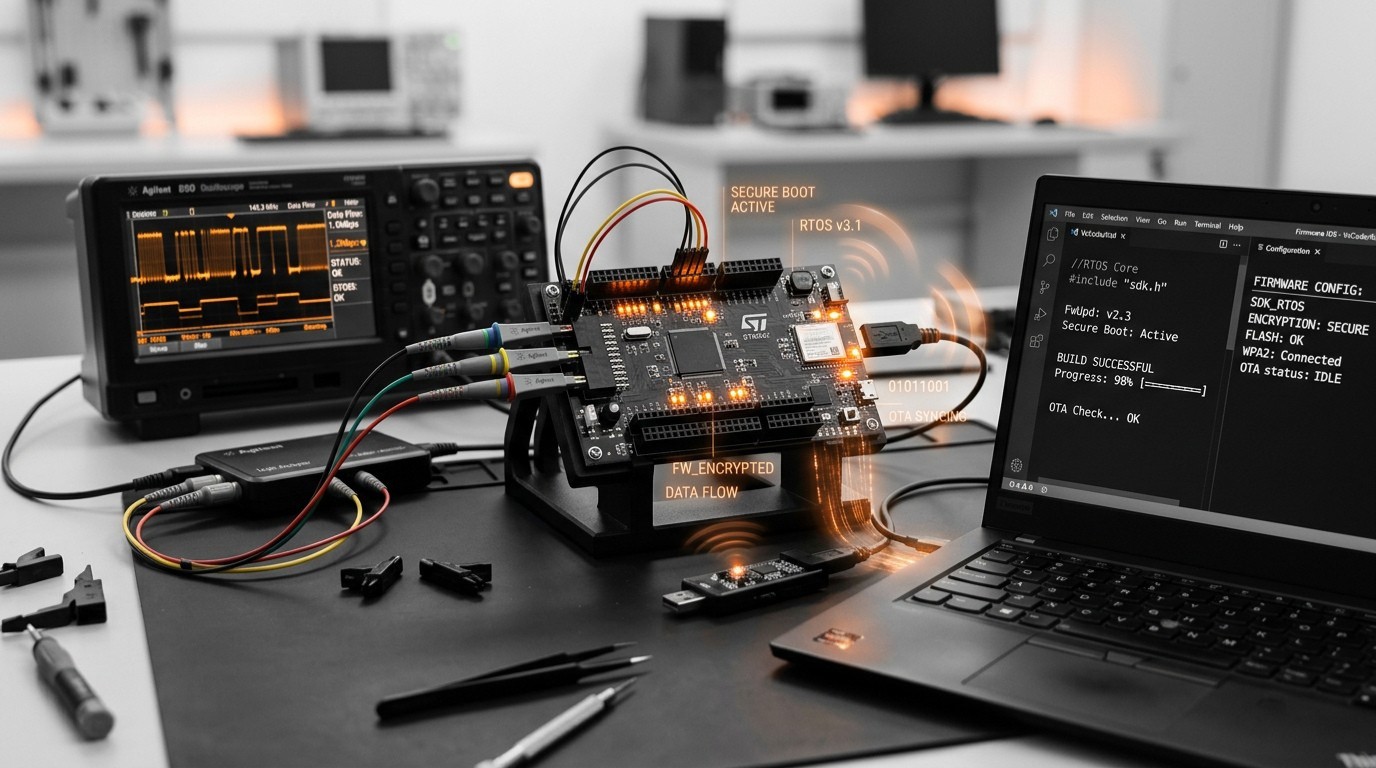
There is a category of firmware bug whose cost is measured not in support tickets but in truck rolls.
A failed over-the-air firmware update on a field-deployed device leaves it non-functional, often unrecoverable without physical access — which means an engineer in a van, a customer’s calendar, a service window, and an invoice. For a single broken device this is an expensive afternoon. For a fleet of broken devices distributed across a city or a region or a country, it is a full-scale operational crisis that can permanently damage the team’s relationship with the customer.
OTA firmware update is one of the highest-stakes features in any wireless IoT product, and it is also one of the least thoroughly tested. The reason is structural: testing OTA properly requires deliberately inducing failures in a process whose happy path takes minutes to complete, and most teams’ test infrastructure is not equipped to inject the specific failures that cause field bricking. This article is about what those failures look like, why testing only the happy path leaves you exposed, and what a rigorous OTA test suite needs to cover.
Why OTA failure is so consequential
To understand why OTA testing deserves disproportionate attention, it helps to think about what happens when an update goes wrong. A firmware update is, mechanically, a process of replacing the running firmware image with a new one. If something interrupts the process at the wrong moment — power loss during the flash write, a reset during the verification step, a corrupted image that nevertheless passes early validation checks — the device can end up in a state where neither the old firmware nor the new firmware is bootable. The device, from the customer’s perspective, is dead.
This is qualitatively different from other categories of firmware bugs. A bug in normal protocol handling can be debugged remotely, possibly worked around by the customer, and fixed in a subsequent update. A bug that bricks the device removes the device from the network entirely, which means the next update — the one that would fix the bug — cannot reach it. The recovery requires physical intervention, and depending on the device design, even physical intervention may not recover the device. The economic asymmetry between OTA failures and other firmware failures is enormous.
The asymmetry is amplified by the deployment patterns of wireless IoT products. Devices are often installed in locations that are inconvenient or expensive to reach: ceilings, walls, sealed enclosures, remote field installations, customer homes that require scheduled visits. A device that fails an OTA update in a lab can be reset and reflashed in seconds. The same device in a customer’s installation requires a service call. A fleet rollout that bricks even a small percentage of devices can produce hundreds or thousands of service calls, which can easily exceed the entire margin earned on those products.
This is the operational reality that makes OTA testing different from other testing. The cost of an OTA bug is not the cost of fixing the bug — it is the cost of recovering all the devices the bug has bricked before the fix can be deployed. That cost can be catastrophic, and it dwarfs the cost of building a thorough OTA test suite by orders of magnitude.

The asymmetry between happy path and failure modes
Testing the happy path of an OTA update is straightforward. You build a new firmware image, you initiate an update on the device, and you verify that the device successfully boots into the new image. If you can do this once reliably, you can do it many times, and you have established that under normal conditions the update process works.
The trouble is that normal conditions are not the conditions you are worried about. The bricking failures happen during abnormal conditions: power loss at exactly the wrong moment, network interruption mid-transfer, partial transfers that pass partial validation, image versions that should not be allowed but somehow are, downgrades that leave the device with stale credentials, updates that target a different hardware variant. Every one of these is an edge case from the perspective of the happy path, but collectively they are where OTA failures actually live.
The asymmetry is essentially this: there is roughly one happy path through an OTA update, and there are dozens or hundreds of distinct failure modes. A test suite that exercises the happy path many times has covered roughly one percent of the actual failure surface. The other ninety-nine percent is structurally not exercised by any number of happy-path runs, no matter how many times they are repeated. To cover the failure modes, you have to deliberately induce each one — which requires a test infrastructure designed specifically for that purpose.
This is why OTA testing tends to look adequate when it is actually deeply inadequate. The team runs the OTA suite, the suite reports that updates work, and the team feels confident shipping. The confidence is misplaced, because the suite has only been measuring the part of the surface where things go right. The bricking failures live in the part it never tests.
The categories of OTA failures worth testing
A rigorous OTA test suite covers several distinct categories, each addressing a different way an update can go wrong. The categories are not arbitrary — they correspond to the structural weak points of the update process — and each one requires a specific kind of fault injection to test.
The first category is interrupted transfers. An update transfers a new firmware image from a server or a peer to the device, and the transfer can be interrupted at any point during this transfer. To test this, the test framework needs to be able to interrupt the transfer at controlled completion percentages — at one percent, at fifty percent, at ninety-nine percent, and at every percentage that corresponds to a structural transition in the transfer protocol. After each interruption, the device should be in a recoverable state: either able to resume the transfer where it left off, or able to abort cleanly and accept a fresh transfer. What it must never be is in a state where the partial image has corrupted the existing firmware.
The second category is power loss during flash write. The actual write of the new image to flash memory is the most dangerous moment in the update process, because flash writes are not atomic. A power loss during a flash write can leave individual flash sectors in indeterminate states. To test this, the test framework needs to be able to cut power to the device at controlled moments during the flash write, then restore power and verify that the device boots correctly — either into the old firmware or into the new firmware, but always into something. Cutting power at the precise moment of a sector erase or a sector write is the worst case, and the test should specifically target those moments.
The third category is reset during image verification. After the new image is written, the device typically verifies it — checking a cryptographic signature, validating the image format, confirming version compatibility — before committing to boot from it. A reset during this verification step can leave the device’s bootloader in a confused state about which image is the current one. The test framework should induce resets at specific points during verification and confirm the device recovers correctly.
The fourth category is rollback after a failed update. Modern OTA implementations include a rollback mechanism: if the new firmware fails to boot or fails its post-boot health checks, the bootloader reverts to the previous image. Testing rollback requires deliberately deploying a firmware image that fails — for instance, one that does not check in with the management interface within the expected window — and confirming that the device correctly rolls back to the previous image rather than getting stuck in a boot loop. This is perhaps the single most operationally important OTA test, because a working rollback mechanism is what protects customers from a bad update reaching their devices.
The fifth category is the version compatibility matrix. Not every device in the fleet will be running the latest firmware at the moment of an update. Some devices will be on the previous version, some on the version before that, some on a long-deprecated version that has not connected for a year. The update process needs to handle every transition that might occur — not just latest-to-latest, but every-version-to-latest. Testing this requires explicitly running updates across the version matrix and confirming that each transition produces a working device.
The sixth category is hardware-variant safety. A firmware image built for one hardware revision should not be installable on a different revision, because the differences between revisions can render the firmware non-functional. The test framework should attempt to deploy mismatched images and confirm that the device correctly rejects them rather than installing them and bricking.
These six categories are not exhaustive, but they cover most of the bricking failures that real-world OTA deployments encounter. A team building OTA test coverage should work through them systematically, and should treat any uncovered category as a known unknown — a place where a bricking failure could exist undetected.

How fault injection actually works
The mechanical question is how the test framework induces the failures the test suite wants to exercise. The answer involves a few specific techniques, each requiring its own piece of test infrastructure.
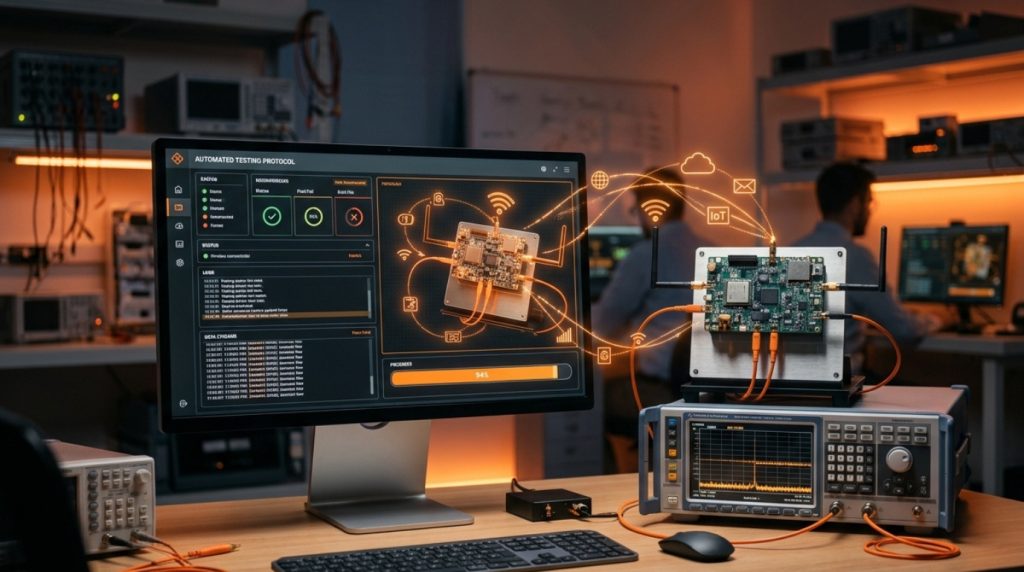
Power-cut injection requires a programmable power supply or a relay-based power switch under test framework control. The framework signals the device to begin the update, monitors the update progress through the device’s serial API, and at the chosen moment cuts power to the device. After a defined delay, power is restored, and the framework observes the device’s behaviour as it attempts to boot. The whole sequence is scripted, the timing is precise, and the test is repeatable.
Transfer interruption requires control over whatever channel the update transfer is using. For a Bluetooth-based update, this means controlling the simulated central or peer that is sending the image, and instructing it to stop sending at a chosen point. For an LTE-based update, it means controlling the cloud backend or the network simulator, and inducing a transfer failure or connection drop at the right moment. The principle is the same: the test framework owns the channel, and can choose when to interrupt it.
Reset injection requires a way to trigger a hardware reset of the device on demand. This is usually done through a GPIO line that the test framework pulses, or through the device’s debug interface. The framework triggers the reset at a precise moment during the update sequence and observes the recovery.
Image manipulation requires the test framework to construct deliberately-malformed or version-mismatched images and attempt to deploy them. This is mostly a software task, but it requires a flexible image-building pipeline that can produce variants of the production image with specific properties — wrong hardware ID, corrupted signature, truncated payload, version downgrade. The variants are kept in a test image library and deployed against the device to verify the device’s defences.
Combining these techniques, a test framework can execute the full failure-mode test suite without human intervention. Each test runs in minutes, the device’s recovery behaviour is observed through its serial API and through measurements of its boot time and post-boot state, and the result is logged. A full OTA regression covering every failure mode against every supported version transition is a multi-hour test, but it is fully automated, and once built it runs as often as the team chooses to schedule it.
Where OTA testing fits in the pipeline
OTA tests do not belong on every commit. They take too long, they require specialised hardware test fixtures, and most code changes do not affect the OTA path. The right cadence for the full OTA suite is on every release candidate, plus a smaller smoke-test subset on every nightly build. This catches OTA regressions before they ship without slowing down the per-commit feedback loop.
The smoke-test subset should include at least the happy path on the supported version transitions, plus one or two of the most common failure modes — typically interrupted transfers and rollback. These are the OTA tests that catch the regressions most likely to be introduced by routine firmware changes. The full failure-mode matrix runs less frequently because the regressions that affect, say, hardware-variant safety are rare and tied to specific subsystems.
There is also a strong argument for running the OTA suite as part of any change that explicitly touches the update mechanism. A pull request that modifies the bootloader, the image format, the verification logic, or the transfer protocol should trigger the full OTA suite before being merged. This is more than a CI configuration choice — it is a discipline that prevents the riskiest changes from sneaking through with reduced testing.
The compounding return
The investment in OTA testing has a particular kind of compounding return that is worth recognising. Every test in the suite is a permanent guard against a specific failure mode. Once the test exists, that failure mode cannot recur in shipped firmware without being caught first. As the suite grows over time, the surface of guaranteed-not-to-brick conditions grows with it, and the team’s confidence in OTA deployments grows correspondingly.
The team that has been investing in OTA testing for two or three years has a suite that covers hundreds of failure modes, and the marginal cost of adding the next test is small because the infrastructure is already in place. The team that has not invested has a suite that covers the happy path, and the cost of building rigorous coverage is large because nothing is in place to build on.
The decision to invest is therefore a long-horizon decision, and the right time to make it is before the first major fleet deployment rather than after the first bricking incident. Teams that get this ordering right ship updates with confidence, expand their fleets without anxiety, and avoid the support cost spikes that follow bad OTA rollouts. Teams that get it wrong learn the same lessons in the most expensive possible way: from the field, in real time, with their reputation on the line.
OTA is the feature with the highest cost of failure in most wireless IoT products. Treating it as such — with disproportionate test investment, deliberate fault injection, and continuous regression coverage — is one of the highest-leverage decisions a wireless team can make.
needCode designs and delivers automated OTA test infrastructure for embedded wireless products, including fault-injection frameworks for power loss, transfer interruption, and version-matrix coverage. We have built rigorous OTA test suites across BLE mesh, LTE-connected IoT, and multi-protocol embedded engagements. If your OTA testing is mostly happy-path and you are about to deploy a meaningful fleet, we are happy to talk about what changing that would involve.
Book a free discovery call or get in touch
Further reading
- BLE Over-the-Air Firmware Updates: How to Ship Updates That Don’t Brick Devices — the direct companion piece on how to design OTA so it doesn’t brick; this article covers how to test OTA so it doesn’t brick
- Anatomy of a Production OTA Pipeline — the release pipeline that runs this article’s OTA test suite as a gate before any fleet rollout
- Semantic Versioning Isn’t Enough for Embedded SDKs — the version compatibility matrix (category 5 in this article) only works if version semantics actually mean something; this post is the discipline that makes the matrix testable
- Security Isn’t a Feature You Add Later: PSA, TF-M and Secure Boot for Embedded SDKs — image verification, signature checks, and secure boot are the basis of category 3 (reset during image verification) and the integrity guarantees this article’s tests probe